
A Classroom Discussion
The pendulum is going to swing from reason to emotion once again. From Neo-Classical to Romantic. But there is an intermediary poet who can’t be overlooked: William Blake. He wrote during the transition from the Eighteenth to the Nineteenth Century, and represents the transition from Neo-Classical to Romantic.
But he is generally thought of as unique. Quote: “a man not forestalled by predecessors, nor to be classed with contemporaries, nor to be replaced by known or readily surmisable successors.” He is often called a visionary, and he emphasized the imagination as being the most important element of human existence. He was sometimes considered mad.
Again I’ll use pictures to convey meaning. His illustrations are as famous as his poetry, and as beautifully imaginative.
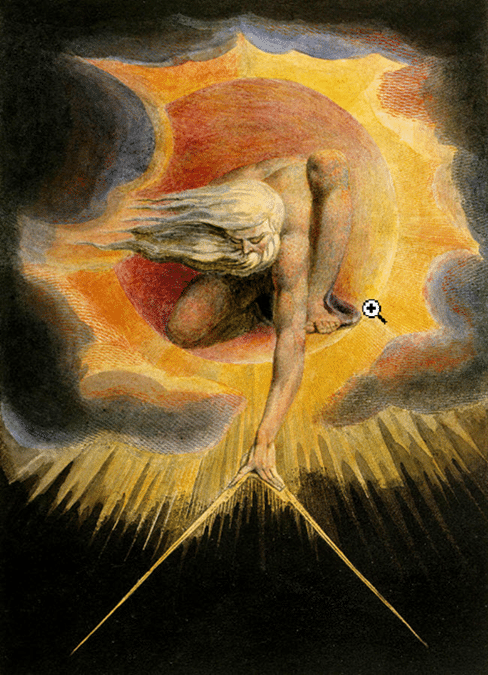
“Wow.”
If you are moved, be sure to go to the library and browse the books of his illustrations.
Blake’s ideas were very controversial at the time; they still would be controversial to some. He abhorred slavery; he resented any kind of “manacles” (handcuffs), including the joined union of marriage; championed sexual freedom of all kinds; and insisted on the individual freedom of the spirit.
“The Little Black Boy”
My mother bore me in the southern wild,
And I am black, but O! my soul is white;
White as an angel is the English child:
But I am black as if bereav’d of light.
My mother taught me underneath a tree
And sitting down before the heat of day,
She took me on her lap and kissed me,
And pointing to the east began to say.
Look on the rising sun: there God does live
And gives his light, and gives his heat away.
And flowers and trees and beasts and men receive
Comfort in morning joy in the noon day.
And we are put on earth a little space,
That we may learn to bear the beams of love,
And these black bodies and this sun-burnt face
Is but a cloud, and like a shady grove.
For when our souls have learn’d the heat to bear
The cloud will vanish we shall hear his voice.
Saying: come out from the grove my love & care,
And round my golden tent like lambs rejoice.
Thus did my mother say and kissed me,
And thus I say to little English boy;
When I from black and he from white cloud free,
And round the tent of God like lambs we joy:
I’ll shade him from the heat till he can bear,
To lean in joy upon our father’s knee.
And then I’ll stand and stroke his silver hair,
And be like him and he will then love me.
His most famous work is a collection of poems called “Songs of Innocence and Experience showing the Two Contrary States of the Human Soul.” Two of the most famous poems are ones with which you probably are familiar: “The Lamb,” symbolizing the innocence of childhood and the gentler nature of religion’s influence; and “The Tyger,” symbolizing the darker, inexplicable forces of existence.
“The Lamb”
Little Lamb who made thee
Dost thou know who made thee
Gave thee life & bid thee feed.
By the stream & o’er the mead;
Gave thee clothing of delight,
Softest clothing wooly bright;
Gave thee such a tender voice,
Making all the vales rejoice!
Little Lamb who made thee
Dost thou know who made thee
Little Lamb I’ll tell thee,
Little Lamb I’ll tell thee!
He is called by thy name,
For he calls himself a Lamb:
He is meek & he is mild,
He became a little child:
I a child & thou a lamb,
We are called by his name.
Little Lamb God bless thee.
Little Lamb God bless thee.
***
“The Tyger”
Tyger Tyger, burning bright,
In the forests of the night;
What immortal hand or eye,
Could frame thy fearful symmetry?
In what distant deeps or skies.
Burnt the fire of thine eyes?
On what wings dare he aspire?
What the hand, dare seize the fire?
And what shoulder, & what art,
Could twist the sinews of thy heart?
And when thy heart began to beat,
What dread hand? & what dread feet?
What the hammer? what the chain,
In what furnace was thy brain?
What the anvil? what dread grasp,
Dare its deadly terrors clasp!
When the stars threw down their spears
And water’d heaven with their tears:
Did he smile his work to see?
Did he who made the Lamb make thee?
Tyger Tyger burning bright,
In the forests of the night:
What immortal hand or eye,
Dare frame thy fearful symmetry?
While “The Lamb” is fairly straightforward, “The Tyger” is very symbolic. As a result there are many different interpretations of it. One obvious aspect, however, is the blacksmith imagery and the concept of forging something in the smithy’s furnace. The trochaic feet, with the emphasis on the first of two syllables, emphasize the meaning. The multiple interpretations arise from what is the tiger and who is the smithy. Is the tiger the frightening aspects of industrialism or is it artistic creation, or ??? Was the tiger created by God, Satan, the Artist? For our purposes we’ll assume that since Blake included “The Lamb” in “Songs of Innocence” and “The Tyger” in “Songs of Experience,” they are meant to contrast each other and represent differing aspects of the human condition: the gentle, meek aspect of the lamb, and the intense, fierce aspect of the tiger.
One of the burgeoning concepts of the Nineteenth Century was criticism of what civilization has done to nature. This becomes a predominant theme throughout the century. Many of the Romantic poets focused on London as a symbol of degradation and corruption. London visually represented this dark approach through its soot-blackened buildings and smoggy gas-lit streets. Coal was the main source of fuel and the main source of pollution. Let’s look at Blake’s “London.”
“London”
I wander thro’ each charter’d street,
Near where the charter’d Thames does flow.
And mark in every face I meet
Marks of weakness, marks of woe.
In every cry of every Man,
In every Infants cry of fear,
In every voice: in every ban,
The mind-forg’d manacles I hear
How the Chimney-sweepers cry
Every black’ning Church appalls,
And the hapless Soldiers sigh
Runs in blood down Palace walls
But most thro’ midnight streets I hear
How the youthful Harlot’s curse
Blasts the new-born Infants tear
And blights with plagues the Marriage hearse.
Why does Blake repeat the word “Charter’d”?
“Does he mean ‘charted’? That would work, meaning that man has measured out everything, even the Thames, something that should be natural.”
I hear that meaning as well. The first meaning, though, may literally be “chartered.” What does “chartered” imply?
“Some kind of permission given? Like the Magna Carta was the Great Charter. Or when you charter a boat. Blake focused on individual freedom, but here you have to have permissions to travel the streets or the river.”
That sounds right to me. Well done. What about “mind-forged manacles”?
“Cool image. Manacles are handcuffs or chains, and they tie up mankind. Blake doesn’t mean actual prison. He means mental manacles that chain our spirits and individualism.”
How about the last stanza?
“Really sad. Since the prostitute doesn’t live a ‘normal’ life with marriage and kids, she curses all the newborn babies. I’m not sure about the next part.”
Plagues?
“STD’s?”
Marriage hearse?
“Oxymoron? The marriage car (?) should be carrying the bride and groom to the beginning of their new life together and the beginning of their children’s lives. But the STD’s caught from the prostitutes will cause death instead of life.”
***
“The Chimney Sweeper”
When my mother died I was very young,
And my father sold me while yet my tongue
Could scarcely cry ” ‘weep! ‘weep! ‘weep! ‘weep!”
So your chimneys I sweep & in soot I sleep.
There’s little Tom Dacre, who cried when his head
That curled like a lamb’s back, was shaved, so I said,
“Hush, Tom! never mind it, for when your head’s bare,
You know that the soot cannot spoil your white hair.”
And so he was quiet, & that very night,
As Tom was a-sleeping he had such a sight!
That thousands of sweepers, Dick, Joe, Ned, & Jack,
Were all of them locked up in coffins of black;
And by came an Angel who had a bright key,
And he opened the coffins & set them all free;
Then down a green plain, leaping, laughing they run,
And wash in a river and shine in the Sun.
Then naked & white, all their bags left behind,
They rise upon clouds, and sport in the wind.
And the Angel told Tom, if he’d be a good boy,
He’d have God for his father & never want joy.
And so Tom awoke; and we rose in the dark
And got with our bags & our brushes to work.
Though the morning was cold, Tom was happy & warm;
So if all do their duty, they need not fear harm.
“They really used kids to go down chimneys, literally?”
Yes, obviously, they were the “best fit.”
“But isn’t coal dust dangerous?”
Yes. But these were poor children, so to the enfranchised classes, they were expendable. This is from Wikipedia:
“It was generally agreed that six was a good age to train a boy. A master sweep would have many apprentices, they would start the morning by roaming the streets calling out ‘Soot -Oh, Sweep’ or another cry to let the house-owners know they were around–this would remind the owners of the dangers of un-swept chimneys. When engaged, the master sweep would fix a cloth over the fireplace, and the climbing boy would take off his boots and any excess clothes, then get behind it. The flue would be as tall as the house and twist several times, and its dimensions would be 14in by 9in. [Think about that.] He would pull his cap down over his face and hold a large flat brush over his head, and wedge his body diagonally in the flue. Using his back, elbows and knees, he would shimmy up the flue in the manner of a caterpillar and use the brush to dislodge loose soot, which would fall over him and down to the bottom; and a scraper to chip away the solid bits, as a smooth chimney was a safe chimney. Having reached the top he would slide back down to the floor and the soot pile. It was now his job to bag up the soot and carry it back to the master sweep’s cart or yard.
An apprentice would do four or five chimneys a day. When they first started they scraped their knees and elbows, so the master would harden up their skin by standing them close to a hot fire and rubbing in strong brine using a brush. This was done each evening until the skin hardened. The boys got no wages but lived with the master, who fed them. They slept together on the floor or in the cellar under the sacks and the cloth used during the day to catch the soot. This was known as “sleeping black.” The boy would be washed by the mistress in a tub in the yard; this might happen as often as once a week, but rarely. One sweep used to wash down his boys in the Serpentine River. Another Nottingham sweep insisted they washed three times a year, for Christmas, Whitsun and the Goose Fair. Sometimes, a boy would need to be persuaded to climb faster or higher up the chimney, and the master sweep would light either a small fire of straw or a brimstone candle, to encourage him to try harder. This is the origin of our expression, ‘To light a fire under someone.’ Another method which also helped stop them from ‘going off’ was to send another boy up behind him to prick pins into the soles of his feet or buttocks.
“Chimneys varied in size. The common flue was designed to be one and a half bricks long by one brick wide, though they often narrowed to one brick square, that is 9 inches by 9 inches or less. Often the chimney would still be hot from the fire, and occasionally it would actually be on fire. Careless climbing boys could get stuck with their knees jammed against their chins. The harder they struggled the tighter they became wedged. They could remain in this position for many hours until they were pushed out from below or pulled out with a rope. If their struggling caused a fall of soot they would suffocate. Dead or alive the boy had to be removed and this would be done by removing bricks from the side of the chimney. If the chimney was particularly narrow the boys would be told to ‘buff it,’ that is to do it naked; otherwise they just wore trousers, and a shirt made from thick rough cotton cloth.
Chimney sweep’s cancer, also called Soot wart, is a squamous cell carcinoma of the skin of the scrotum. It has the distinction of being the first reported form of occupational cancer, and was initially identified in 1775. It was initially noticed as being prevalent amongst chimney sweeps. Warts caused by the irritation from soot particles, if not excised, developed into a scrotal cancer. This then invaded the dartos, enlarged the testicle, and proceeded up the spermatic cord into the abdomen where it proved fatal.
Child chimney sweeps were finally outlawed in 1875.”
I’m sorry to subject you to these descriptions, but they serve as a potent example of what the Romantic poets denounced in their poetry pertaining to the state of civilization, especially in London. These are not small-r romantic notions. They are reactions to what society caused to happen in its march toward progress. Blackened buildings, smog-filled air, soot-coated children.
***
Subscribing only means that you will receive a notice when I publish a new post.
***
(Note: You can view most poems on the website, Poetry Foundation.)
(Note: My Poetry Recordings Playlist: At the very bottom of the post Is a recording. To view my entire playlist of poetry recordings, hover over “1/18” in the upper right corner, then click on ‘My Poetry Recordings Playlist:´and make selection.)
***
Scroll down for comments. **Remember that comments are public. Enter your Comment below.**
Leave a Reply