A Classroom Discussion
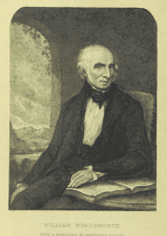
After Blake, the Romantic period goes into full swing. It’s an intense, but short life, usually with the dates 1800-1850, the year of Wordsworth’s death. However, Wordsworth and Coleridge ushered in the period with their joint collection of poems, Lyrical Ballads in 1798. In the Preface to that work, Wordsworth defined good poetry as “the spontaneous overflow of powerful feelings.” Every word in that statement is in direct contrast to what we have seen in the Age of Reason. In the same Preface, Coleridge spoke of “the willing suspension of disbelief” that the reader must bring to poetry. Both men came to be seen by the triumvirate of Byron, Shelley and Keats as conservative in their later years.
The latter three men became the touchstone of Romanticism, though they did not apply that term to themselves; it was adopted later in the Nineteenth Century to describe them. Their lives were as passionate and emotional as their work. Keats died of tuberculosis in 1821 at the age of 25, in part becoming the paradigm of the thin, starving poet. Shelley died in 1822 at the age of 29 as the result of a boating accident, and Byron and others built a funeral pyre for him on the beach. Byron died in 1824 of a fever at the age of 36 while assisting the Greeks in their attempt at independence from the Ottomans.
One of the most defining episodes of Romanticism occurred when Shelley, Byron and others were at a villa in Switzerland and were kept indoors by incessant rain. They decided to pass the time by reading and writing fantastical stories. Out of this exercise came Mary Godwin’s (later to be Shelley’s wife) “Frankenstein” and Polidori’s ”The Vampyre,” the forerunner of the vampire genre.
“Wow, they were really out there.”
Yup. Add to that Byron’s sexual escapades–he was omnisexual; he was rumored to have an affair with his half-sister–and, well, you get the idea. Emotion, individualism, freedom, passion, intensity, affinity with Nature, etc.
It’s difficult to decide what to include in a survey of this period. Since these poets have continued their hold on our imaginations, so many of their poems are still famous. We’ll begin with a theme that we’ve seen in Blake and which carried through the period.
The World Is Too Much with Us
William Wordsworth
The world is too much with us; late and soon,
Getting and spending, we lay waste our powers;—
Little we see in Nature that is ours;
We have given our hearts away, a sordid boon!
This Sea that bares her bosom to the moon;
The winds that will be howling at all hours,
And are up-gathered now like sleeping flowers;
For this, for everything, we are out of tune;
It moves us not. Great God! I’d rather be
A Pagan suckled in a creed outworn;
So might I, standing on this pleasant lea,
Have glimpses that would make me less forlorn;
Have sight of Proteus rising from the sea;
Or hear old Triton blow his wreathèd horn.
[teacher waits]
“Petrarchan Sonnet form.”
“Um, abba, abba, cd, cd,…cd.”
“Okay, Proteus and Triton?”
Proteus was a sea god in classical mythology, and Triton a son of Poseidon/Neptune, using a seashell trumpet. My turn to ask questions: first two lines?
“They’re terrific. The world is too much with us is a great way to say that we’ve become too attached to civilization at the expense of our feelings toward nature.”
“He could be writing this today, as a ‘green’ person.”
“’We have given our hearts away.’ I’m going to be quoting that. That says it all. Everything is politics, religion, beliefs, differences, and nothing is about the heart and love.”
“Come on, don’t get too mushy.”
“You come on. She’s right. For Nature, ‘we are out of tune.’ Who can argue that? Global warming, oil drilling, fracking, cutting down rain forests, you name it. We’re in trouble.”
“I thought ‘It moves us not’ was really cool. Four stresses, two spondees I guess, that move us not, I mean, they slow us down so we can’t move along quickly in the poem.”
Who needs a teacher? Well maybe for the sestet. Ideas?
[silence for a while]
“Um, the pagans were closer to nature?”
In Wordsworth’s opinion, yes. Their gods included ones associated with many aspects of nature, which kept them close to it. He would rather be one of them if it could repair his heart. And note the irony of his beginning the sestet with the fulcrum, “My God.”
And from Wordworth, lines that convey as well as any other the Romantics’ connection with Nature:
well pleased to recognise
In nature and the language of the sense,
The anchor of my purest thoughts, the nurse,
The guide, the guardian of my heart, and soul
Of all my moral being.
On a more positive note, providing a balance to some of the darker aspects we have seen in Blake and Wordsworth, Wordsworth’s other work contains some of the most beautiful sentiments in poetry. We just saw one example. Those lines were from “Lines Composed a Few Miles above Tintern Abbey.” The following is from the same poem, and would be, in my opinion, a great mantra for the whole world.
But oft, in lonely rooms, and ‘mid the din
Of towns and cities, I have owed to [Nature]
In hours of weariness, sensations sweet,
Felt in the blood, and felt along the heart;
And passing even into my purer mind,
With tranquil restoration: feelings too
Of unremembered pleasure: such, perhaps,
As have no slight or trivial influence
On that best portion of a good man’s life,
His little, nameless, unremembered, acts
Of kindness and of love.
What a sentiment: that best portion of a good man’s life, his little, nameless, unremembered, acts of kindness and of love. Your assignment: to commit five acts of kindness and of love by tomorrow. Oh well, I wish I could make such an assignment.
Please read “Tintern Abbey.”
Ok, next session, on to Byron, Keats, and Shelley.
***
Subscribing only means that you will receive a notice when I publish a new post.
***
(Note: You can view most poems on the website, Poetry Foundation.)
(Note: My Poetry Recordings Playlist: At the very bottom of the post Is a recording. To view my entire playlist of poetry recordings, hover over “1/18” in the upper right corner, then click on ‘My Poetry Recordings Playlist:´and make selection.)
***
Scroll down for comments. **Remember that comments are public. Enter your Comment below.**
Leave a Reply