
On to the triumvirate–Byron, Shelley, Keats (that’s only my term, by the way), starting with Byron.
She Walks in Beauty
She walks in beauty, like the night
Of cloudless climes and starry skies;
And all that’s best of dark and bright
Meet in her aspect and her eyes;
Thus mellowed to that tender light
Which heaven to gaudy day denies.
One shade the more, one ray the less,
Had half impaired the nameless grace
Which waves in every raven tress,
Or softly lightens o’er her face;
Where thoughts serenely sweet express,
How pure, how dear their dwelling-place.
And on that cheek, and o’er that brow,
So soft, so calm, yet eloquent,
The smiles that win, the tints that glow,
But tell of days in goodness spent,
A mind at peace with all below,
A heart whose love is innocent!
This is arguably Byron’s most famous poem, but it is impossible to choose just one that characterizes the poet. It does, though, characterize a love poem of the period, more direct and metaphor-free than some of those we have read previously. That, of course, is a generalization, but it’s one that often applies.
There is so much to Byron’s life, and so much of it that is typical of Romanticism, that I will include more details than usual.
The most flamboyant and notorious of the major English Romantic poets, George Gordon, Lord Byron, was likewise the most fashionable poet of the early 1800s. He created an immensely popular Romantic hero—defiant, melancholy, haunted by secret guilt—for which, to many, he seemed the model. He is also a Romantic paradox: a leader of the era’s poetic revolution, ; a worshiper of the ideal, he never lost touch with reality; a deist and freethinker, he retained from his youth a Calvinist sense of original sin; a peer of the realm, he championed liberty in his works and deeds, giving money, time, energy, and finally his life to the Greek war of independence. In his dynamism, sexuality, self-revelation, and demands for freedom for oppressed people everywhere, Byron captivated the Western mind and heart as few writers have, stamping upon 19th-century letters, arts, politics, even clothing styles, his image and name as the embodiment of Romanticism.
George Gordon Noel Byron was born, with a clubbed right foot, in London on January 22, 1788.
From 1801 to 1805, he attended the Harrow School. He formed the first of those passionate attachments with other, chiefly younger, boys that he would enjoy throughout his life; before reaching his teen years he had been sexually initiated by his maid. There can be little doubt that he had strong bisexual tendencies, though relationships with women seem generally, but not always, to have satisfied his emotional needs more fully.
In the summer of 1803 he fell so deeply in love with his distant cousin, the beautiful-and engaged-Mary Chaworth of Annesley Hall, that he interrupted his education for a term to be near her. Years later he told Thomas Medwin that all his “fables about the celestial nature of women” originated from “the perfection” his imagination created in Mary Chaworth.
Byron attended Trinity College, Cambridge, intermittently. Intellectual pursuits interested him less than such London diversions as fencing and boxing lessons, the theater, demimondes, and gambling. Living extravagantly, he began to amass the debts that would bedevil him for years.
T
Anxious to set down the myriad experiences the trip afforded him, Byron began an autobiographical poem in Ioannina, Greece, on October 31, 1809, wherein he recorded the adventures and reflections of Childe Burun (a combination of the archaic title for a youth of noble birth and an ancient form of his own surname); he subsequently renamed the hero Harold.
In January 1812 Byron resumed his seat in the House of Lords, allying himself with the Liberal Whigs. On April 21, he made a plea for Catholic emancipation, the most controversial issue of the day.
On March 10, 1812 Murray published Childe Harold’s Pilgrimage, Cantos I and II. 500 quarto copies, priced at 30 shillings each, sold out in three days. An octavo edition of 3,000 copies at 12 shillings was on the market within two days. Shortly after Childe Harold appeared, Byron remarked, “I awoke one morning and found myself famous.”
In June 1813 Byron began an affair with his 29-year-old half sister, Augusta.
and XVI. The Literary Gazette pronounced them “destitute of the least glimmering of talent” and a “wretched” “piece of stuff altogether.”
On April 9, having been soaked by a heavy rain while out riding, Byron suffered fever and rheumatic pains. By the 12th he was seriously ill. Repeated bleedings further debilitated him. On Easter Sunday, he entered a comatose state. At six o’clock on the evening of Easter Monday, April 19, 1824, during a violent electrical storm, Byron died.
In memorial services throughout the country, he was proclaimed a national hero of Greece. His death proved effective in uniting Greece against the enemy and in eliciting support for its struggle from all parts of the civilized world. In October 1827 British, French, and Russian forces destroyed the Turkish and Egyptian fleets at Navarino, assuring Greek independence, which was acknowledged by the sultan in 1829.
Byron’s body arrived in England on June 29, and for two days lay in state in a house in Great George Street, London. On Friday, 16 July 1824, Lord Byron was buried in the family vault Beneath the chancel of Hucknall Torkard Church near Newstead Abbey.
The fame to which Byron awoke in London in 1812 was spread rapidly throughout Europe and the English-speaking world by scores of translations and editions. His influence was pervasive and prolonged. Alfred de Musset was his disciple in France, Alexander Pushkin in Russia, Heinrich Heine in Germany, Adam Mickiewicz in Poland. His poetry inspired musical compositions by Hector Berlioz, Robert Schumann, and Pyotr Ilyich Tchaikovsky; operas by Gaetano Donizetti and Giuseppe Verdi; and paintings by J.M.W. Turner, John Martin, Ford Madox Brown, and Eugène Delacroix.
Philosophically and stylistically, Byron stands apart from the other major Romantics. He was the least insular, the most cosmopolitan of them. Poetic imagination was not for him, as for them, the medium of revelation of ultimate truth.
“I was born for opposition,” Byron proclaimed in Don Juan, Canto XV. The outstanding elements of his poetry both support his self-analysis and insure his enduring reputation. As a major political and social satirist, he repeatedly denounces war, tyranny, and hypocrisy. As an untiring champion of liberty, he firmly believed that “Revolution / Alone can save the earth from hell’s pollution”, a tenet he defended with his life.
Whew. Rather lengthy, I know, but the pervasive and iconic influence of the Byronic Hero cannot be overstated, still obvious well into the 21st century.
OK, back to his poetry, and his most lyrical poem, “Apostrophe to the Ocean.”
Excerpt
CLXXVIII.
There is a pleasure in the pathless woods,
There is a rapture on the lonely shore,
There is society where none intrudes,
By the deep Sea, and music in its roar:
I love not Man the less, but Nature more,
From these our interviews, in which I steal
From all I may be, or have been before,
To mingle with the Universe, and feel
What I can ne’er express, yet cannot all conceal.
CLXXIX.
Roll on, thou deep and dark blue Ocean—roll!
Ten thousand fleets sweep over thee in vain;
Man marks the earth with ruin—his control
Stops with the shore;—upon the watery plain
The wrecks are all thy deed, nor doth remain
A shadow of man’s ravage, save his own,
When for a moment, like a drop of rain,
He sinks into thy depths with bubbling groan,
Without a grave, unknelled, uncoffined, and unknown.
CLXXX.
His steps are not upon thy paths,—thy fields
Are not a spoil for him,—thou dost ariseAnd shake him from thee; the vile strength he wields
For earth’s destruction thou dost all despise,
Spurning him from thy bosom to the skies,
And send’st him, shivering in thy playful spray
And howling, to his gods, where haply lies
His petty hope in some near port or bay,
And dashest him again to earth:—there let him lay.
CLXXXI.
The armaments which thunderstrike the walls
Of rock-built cities, bidding nations quake,
And monarchs tremble in their capitals.
The oak leviathans, whose huge ribs make
Their clay creator the vain title takeOf lord of thee, and arbiter of war;
These are thy toys, and, as the snowy flake,
They melt into thy yeast of waves, which mar
Alike the Armada’s pride, or spoils of Trafalgar.
CLXXXII.
Thy shores are empires, changed in all save thee—Assyria, Greece, Rome, Carthage, what are they?
Thy waters washed them power while they were free
And many a tyrant since: their shores obey
The stranger, slave, or savage; their decay
Has dried up realms to deserts: not so thou,
Unchangeable save to thy wild waves’ play—
Time writes no wrinkle on thine azure brow—
Such as creation’s dawn beheld, thou rollest now.
CLXXXIII.
Thou glorious mirror, where the Almighty’s form
Glasses itself in tempests; in all time
,Calm or convulsed—in breeze, or gale, or storm,
Icing the pole, or in the torrid clime
Dark-heaving;—boundless, endless, and sublime—
The image of Eternity—the throne
Of the Invisible; even from out thy slime
The monsters of the deep are made; each zone
Obeys thee: thou goest forth, dread, fathomless, alone.
CLXXXIV.
And I have loved thee, Ocean! and my joy
Of youthful sports was on thy breast to be
Borne like thy bubbles, onward: from a boy
I wantoned with thy breakers—they to me
Were a delight; and if the freshening sea
Made them a terror—’twas a pleasing fear,
For I was as it were a child of thee,
And trusted to thy billows far and near
,And laid my hand upon thy mane—as I do here.
“I love not Man the less, but Nature more.” What better way to begin a Romantic poem than placing Nature above Civilization.
“The opposite of the dark sides of society in some of Blake’s and Wordsworth’s poems. “
“The meter is great in: Roll on, thou deep and dark blue Ocean—roll! The up and down of the iambic feet mimics the waves of the ocean, especially with the words mostly being monosyllabic. Very onomatopoetic.”
Yes.
“And the fact that there is no contest between man and ocean is made clear in the hopelessness of man in a wrecking storm, when the dead from the ship sink into the ocean “Without a grave, unknelled, uncoffined, and unknown,” so separated from society that they cannot even be buried.”
CLXXX, CLXXXI, CLXXXII further demonstrate the ocean’s dominance over man.
CLXXXIII
“Thou glorious mirror, where the Almighty’s form Glasses itself.” But it no only reflects God, it also takes on his characteristics, in the three gorgeous and famous words: boundless, endless, and sublime.”
“‘The image of eternity.’ Again characteristics that we normally only attribute to God. I know it’s easy to be overwhelmed when I am at the ocean and think about how enormous it is. My family would tease me because I would be the only one afraid to go in.”
CLXXXIV
The last stanza?
“The tone shifts from fear of the ocean’s destructive power to love of its nurturing powers: loved, joy, youthful, borne like thy bubbles, boy, wantoned, delight, freshening, pleasing, child, trusted, laid my hand upon they mane (as one trusts a horse).
“Such a beautiful, beautiful poem. Why we’re lucky Romanticism happened, I f that’s not too nerdy a think to say.”
Hey, we’re in a Poetry Class; emotion is allowed.
***
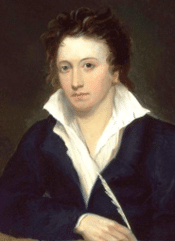
Shelley wrote many apostrophes as well, mostly to the moon and to the stars, once again indicating the Romantics’ affinity with nature. The following poem indicates that affinity as well, but also the concern for how civilization can thwart Nature.
Summer And Winter.
It was a bright and cheerful afternoon,
Towards the end of the sunny month of June,
When the north wind congregates in crowds
The floating mountains of the silver clouds
From the horizon – and the stainless sky
Opens beyond them like eternity.
All things rejoiced Beneath the sun; the weeds,
The river, and the corn-fields, and the reeds;
The willow leaves that glanced in the light breeze,
And the firm foliage of the larger trees.
It was a winter such as when birds die
In the deep forests; and the fishes lie
Stiffened in the translucent ice, which makes
Even the mud and slime of the warm lakes
A wrinkled clod as hard as brick; and when,
Among their children, comfortable men
Gather about great fires, and yet feel cold:
Alas, then, for the homeless beggar old!
“Killer last line.”
Indeed. Shelley leads us through the joys of summer and the pains of winter, but then presents an idyllic portrait of a happy home, so we are prepared for a positive resolution. Instead we get that bruiser of a last line. Once again we have the contrast between Nature and civilization, or society, or whatever we want to call it. Remember that the dates of the Romantic Period are just after the revolutions in the United States and France; the Romantics keenly felt these attempts at throwing off the perceived despotism of tyrants. A famous quote from one of their greatest influences, the Eighteenth Century philosopher Jean-Jacques Rousseau states: “Man is born free, and everywhere he is in chains.” Those chains are both literal and symbolic.
Perhaps most famous of Shelley’s poems is Ozymandias, a variation on the sonnet form, and, to me, one of the great works of the period.
I met a traveller from an antique land,
Who said—“Two vast and trunkless legs of stone
Stand in the desert. . . . Near them, on the sand,
Half sunk a shattered visage lies, whose frown,
And wrinkled lip, and sneer of cold command,
Tell that its sculptor well those passions read
Which yet survive, stamped on these lifeless things,
The hand that mocked them, and the heart that fed;
And on the pedestal, these words appear:
My name is Ozymandias, King of Kings;
Look on my Works, ye Mighty, and despair!
Nothing beside remains. Round the decay
Of that colossal Wreck, boundless and bare
The lone and level sands stretch far away.”
What’s the rhyme scheme?
“abab?acdc…I’m lost.”
“ecefef. Whew.”
We will see more and more loosening of the poetic “rules,” so to speak, as we progress through time. Poets feel free to experiment.
What’s the meter?
“Iambic pentameter, sort of. At least in the second and third lines.”
Meter, too, becomes less fixed. This is a difficult poem to scan. If the first line is spoken with today’s cadence, it could read: “I met a trav-ler from an an-tique land,” which has only four feet. To make it five feet would be, “I met a trav-ler from an an-que land”; or is it trav-el-er from an an-tique land, with an anapest”? Line three?
“Begins with a stress, trochee.”
Effect?
“Stops us short, so, we, too, have to stand, sort of.”
Good. Where does this same thing happen again?
“Line 6, with ‘Tell’?”
Agreed. To say “Tell that” would be awkward, and would undermine the emphasis of the internal rhyme, “tell” and “well.” Next instance is tricky. Anyone?
[pause]
“’Stamped’?”
I would agree. Otherwise, you would have to say, “stamped on,” which would be artificial. Also, sound and sense?
“’Stamped’ needs to be ‘stamped,’ hard.”
Yes. Next?
“’Look.’”
Then?
“’Nothing.’”
“’Round.’”
“’boundless.’”
What sonnet type would you say this is a variation of?
“Italian because the lines organize into an octet and a, uh, sextet.”
Close enough. Sestet. Good.
So much for sound. Now on to sense. What’s the central image?
“A huge statue of a king, broken in half.”
What’s the difference between saying, “two vast legs,” and “two vast and trunkless legs?”
“Well, the trunk would contain the organs, all part of a living person. Without them, the legs are just, well, legs, not a person.”
And then.
“The onomatopoeia here is awesome. I kept reading it over and over. ‘sunk’ sinks. ‘shattered’ shatters. ‘frown’ frowns. ‘wrinkled’ wrinkles. ‘sneer’ sneers. And ‘cold command’ is pretty frosty. You just can’t say these words without the sound sounding like the meaning. Really great.”
Really great yourself!
Then on the pedestal–an arrogant king must have a pedestal–are those devastating words of the sestet. This is irony at its greatest.
“Really. King of Kings, of course. But who was Ozymandias?”
His name is an ancient Greek transliteration of one of the titles used by Rameses, or Ramses, King of Egypt. In other words, it’s how the Greeks expressed the Egyptian title in their own language.
What about “Despair?”
“Talk about irony. Ozymandias is saying that anyone who thinks he is mighty should look at this huge statue and despair at ever being as mighty as him. The irony is that anyone who thinks he is mighty should look at this wreck and despair that his mightiness won’t last with time.”
The next line is devastating. “Nothing beside remains.”
“Genius here again–me, I mean! It took me a while, but then I realized it can be read two ways. Nothing is left of the statue but these parts he mentions. But also, nothing of the king’s mightiness remains but these broken pieces of stone.”
And genius in that short line of heavy stresses. The finishing lines?
“What I thought it means is that not only is Ozymandias no longer anything, but his kingdom has also disappeared. All that’s left are the endless, empty, lonely, level sands of the desert, stretching away for miles.”
Sound and sense?
“’Wreck,’ ‘boundless and bare,’ ‘lone and level,’ ‘sands streeeeetch,’ ‘faaaaar awaaaaaay.’”
A great poem.
Shelley and other poets would often challenge each other to a poetry competition based on the same subject. Horace Smith also wrote an “Ozymandias.”
In Egypt’s sandy silence, all alone,
Stands a gigantic Leg, which far off throws
The only shadow that the Desert knows:—
“I am great OZYMANDIAS,” saith the stone,
“The King of Kings; this mighty City shows
“The wonders of my hand.”— The City’s gone,—
Nought but the Leg remaining to disclose
The site of this forgotten Babylon.
We wonder,—and some Hunter may express
Wonder like ours, when thro’ the wilderness
Where London stood, holding the Wolf in chace,
He meets some fragment huge, and stops to guess
What powerful but unrecorded race
Once dwelt in that annihilated place.
“A not as great poem.”
Why.
“Oh come on. ‘Stands a gigantic capital-L Leg.’ It just sounds like a kid wrote it. Like I wrote it. He might just as well have said, ‘Stands a really big leg.’”
“’The City’s gone.’ ‘Nought but the Leg remaining.’ Instead of using imagery to convey the meaning of the lost city as Shelley does, Smith just tells us. The entire sestet might just as well be a prose paragraph.”
Okay. You get the idea. Glad to see all this discernment.
Back to Shelley.
One of the problems in conducting a very brief survey like this–aside from the many significant poets not included–is that long poems can’t be covered, and long poems are common in the Romantic Period. That is why I am including them as extra reading. In that light, please read Shelley’s Ode to a Skylark.
“What exactly is an ode?”
There really isn’t an “exact” definition: “a lyric poem, typically addressed to a particular subject, with lines of varying lengths and complex rhythms.”
Next: Keats.

Keats is the tragic figure among the Triumvirate. Contracting tuberculosis after nursing his brother who had the disease, growing weaker and thinner, feeling that he was dying just as he was hitting his stride as a poet–going so far as to ask for euthanasia. Dying at twenty-four. Twenty-four! As his poetry stands, he is one of the greatest of all English-speaking poets, able to tear your heart out with his imagery. What more might he have accomplished. It hurts to think about it, as with, in our time, the AIDS victims who died so young, before they could fully realize their potential.
“There wasn’t any cure for tuberculosis?”
No, doctors were still practicing things like blood-letting with leeches, which we now know would make their patients even weaker. It was pretty much a death-sentence. It’s hard to imagine now, but in Keats’ time, one in four deaths in Europe was the result of tuberculosis, commonly referred to as consumption, due to the weight loss that accompanies it. Strides were made in controlling it, but in the Nineteen-Eighties a completely drug-resistant strain appreared. It is estimated that about 1/3 of the world’s population has been infected with tuberculosis, though it is dormant and non-commnicable in ninety-to-ninety-five percent of the cases. Unsurprisingly, it is most common in third-world and developing countries. Okay, sorry for that long digression, but it is difficult to over-emphasize the effect t.b. had on the Eighteen Hundreds.
Ok. Let’s look at Keats’ “Solitude.”
O Solitude! if I must with thee dwell,
Let it not be among the jumbled heap
Of murky buildings: climb with me the steep,
Nature’s observatory, whence the dell,
In flowery slopes, its river’s crystal swell,
May seem a span; let me thy vigils keep
‘Mongst boughs pavilioned, where the deer’s swift leap
Startles the wild bee from the foxglove bell.
But though I’ll gladly trace these scenes with thee,
Yet the sweet converse of an innocent mind,
Whose words are images of thoughts refined,
Is my soul’s pleasure; and it sure must be
Almost the highest bliss of human-kind,
When to thy haunts two kindred spirits flee.
“Like everything I’ve read by Keats so far, this is beautiful. It’s such a wake-up to see how an image can be so amazingly powerful with a great poet. ‘Where the deer’s swift leap startles the wild bee from the foxglove bell.’ It might as well be a painting, the visual image is so strong and clear.”
“And ‘swift leap startles’ is a perfect combination of sound and sense.”
“This is an apostrophe, right?”
Right. “O, Solitude,” directly addressing an abstract as if it were a person. Also, personification, of course.
“And the typical Romantic thing of getting away from society, ‘the jumbled heap of murky buildings.’”
“But what’s really neat to me is that Nature by itself is not enough for him. He feels that being in Nature with a kindred spirit would make the experience even more deep. He uses some pretty strong words to express his feeling, like ‘my soul’s pleasure,’ and ‘highest bliss of human-kind.’ I’d like to meet this guy.”
Great discussion.
And now, a masterpiece. Yes, I am putting judgments before you, but I hope you are now secure enough in your own perceptions to agree or disagree as you see fit. “Ode to a Nightingale” is, to me, what poetry is all about.
My heart aches, and a drowsy numbness pains
My sense, as though of hemlock I had drunk,
Or emptied some dull opiate to the drains
One minute past, and Lethe1-wards had sunk:
‘Tis not through envy of thy happy lot,
But being too happy in thine happiness,—
That thou, light-winged Dryad 2of the trees
In some melodious plot
Of beechen 3green, and shadows numberless,
Singest of summer in full-throated ease.
O, for a draught of vintage! that hath been
Cool’d a long age in the deep-delved earth,
Tasting of Flora 4and the country green,
Dance, and Provençal 5song, and sunburnt mirth!
O for a beaker full of the warm South,
Full of the true, the blushful Hippocrene6,
With beaded bubbles winking at the brim,
And purple-stained mouth;
That I might drink, and leave the world unseen,
And with thee fade away into the forest dim:
Fade far away, dissolve, and quite forget
What thou among the leaves hast never known,
The weariness, the fever, and the fret
Here, where men sit and hear each other groan;
Where palsy shakes a few, sad, last gray hairs,
Where youth grows pale, and spectre-thin, and dies;7
Where but to think is to be full of sorrow
And leaden-eyed despairs,
Where Beauty cannot keep her lustrous eyes,
Or new Love pine at them beyond to-morrow.
Away! away! for I will fly to thee,
Not charioted by Bacchus 8and his pards9,
But on the viewless wings of Poesy,
Though the dull brain perplexes and retards:
Already with thee! tender is the night,
And haply the Queen-Moon is on her throne,
Cluster’d around by all her starry Fays;
But here there is no light,
Save what from heaven is with the breezes blown
Through verdurous glooms and winding mossy ways.
I cannot see what flowers are at my feet,
Nor what soft incense hangs upon the boughs,
But, in embalmed darkness, guess each sweet
Wherewith the seasonable month endows
The grass, the thicket, and the fruit-tree wild;
White hawthorn, and the pastoral eglantine10;
Fast fading violets cover’d up in leaves;
And mid-May’s eldest child,
The coming musk-rose, full of dewy wine,
The murmurous haunt of flies on summer eves.
Darkling I listen; and, for many a time
I have been half in love with easeful Death,
Call’d him soft names in many a mused rhyme,
To take into the air my quiet breath;
Now more than ever seems it rich to die,
To cease upon the midnight with no pain,
While thou art pouring forth thy soul abroad
In such an ecstasy!
Still wouldst thou sing, and I have ears in vain—
To thy high requiem 11become a sod.
Thou wast not born for death, immortal Bird!
No hungry generations tread thee down;
The voice I hear this passing night was heard
In ancient days by emperor and clown:
Perhaps the self-same song that found a path
Through the sad heart of Ruth12, when, sick for home,
She stood in tears amid the alien corn;
The same that oft-times hath
Charm’d magic casements, opening on the foam
Of perilous seas, in faery lands forlorn.
Forlorn! the very word is like a bell
To toll me back from thee to my sole self!
Adieu! the fancy cannot cheat so well
As she is fam’d to do, deceiving elf.
Adieu! adieu! thy plaintive 13anthem fades
Past the near meadows, over the still stream,
Up the hill-side; and now ’tis buried deep
In the next valley-glades:
Was it a vision, or a waking dream?
Fled is that music:—Do I wake or sleep?
My heart aches, and a drowsy numbness pains
My sense, as though of hemlock I had drunk,
Or emptied some dull opiate to the drains
One minute past, and Lethe-wards had sunk:
’Tis not through envy of thy happy lot,
But being too happy in thine happiness,
That thou, light-winged Dryad of the trees,
In some melodious plot
Of beechen green and shadows numberless,
Singest of summer in full-throated ease.
Three words set a melancholic, forlorn tone the suffuses the poem.
“’My heart aches.’ Not only is ‘aches’ onomatopoetic, but the three(?) stressed syllables emphasize the heaviness of the speaker’s feeling. This drugged-type state is continued in the rest of that line and the three following it. ‘Drowsy numbness’ is perfect as though he is in a stupor, but then the word ‘pains’ jolt him and us out of feeling nothing. Even in this state, he, unfortunately can still feel pain.”
“He feels as though he has taken a large quantity of opium, and has sunk toward the Greek underground river of forgetfulness, the Lethe. Pains, drunk, drains, sunk. Ow.”
“The next part is a little strange with him saying that his heart aches not because he envies the skylark and his song, but because for some reason the happiness he feels in hearing the song is too happy. Hard to understand exactly.”
Try looking at it metaphorically.
“Well, the bird sings, um, creates a song, like an artist right? Maybe Keats in hearing the stirring song feels inadequate as a poet; he can’t ‘sing’ as well?”
I would consider that a valid approach, especially considering the words, “full-throated ease.” Keep your eye on that for the rest of the poem.
“To drown his sorrows he wants wine which figuratively tastes of Summer, or some water of the Hippocrene spring, which supposedly gave inspiration to poets.”
“This becomes so sad. He wants to die alone, ‘unseen.’ ‘Fade far away—all those A sounds—‘dissolve,’ which never occurred to me before is onomatopoetic—and ‘forget.’ Now we get to at least part of the problem, the Romantics’ disgust with contemporary society. Weariness, fever, fret.”
“And the fact that in old age we begin to have the shakes. ‘A few, sad, last grey hairs’ is so painful. This is what we have to look forward to.”
“And maybe worse is that youth is no better off. I think he must be thinking of his consumptive brother in the last lines, where youth grows pale, and ghost-thin, then dies. Youth fades just as Keats wants to. And he’s so young himself. Hard to take.”
“And maybe worse worse, for him just thinking is depressing because the thoughts are all of sorrow and despair.”
“And Beauty and Love don’t last.”
“Are you sure this is good for our mental-health?”
No. In fact I’ve been worrying about it because so many of your comments are do empathetic. I seriously am going to make a concerted effort to add some joy to our class, when we get to Whitman, next.
“ I think we can handle it. We know we’re reading poetry, not living it.”
I know. But I want to be sure I’m not helping you dwell on it. However, that’s not going to stop me from sharing this gorgeous poem with you. Let’s move on.
“He wants to join the nightingale in flight, though not through wine (Bacchus), but on the wings of poetry.”
“Then he pictures himself there, with the nightingale, and the night is tender and the moon is out.”
“But if I’m reading this right, he comes crashing down to earth, in his state seeing darkness as the absence of light.”
“Not seeing the flowers at his feet is symbolic of the darkness inside of him that prevents him from seeing happiness.”
“And using the word, ‘embalmed’ says it all. It’s as if he’s in his grave and can only imagine all the nature above him.”
“He gets to that image again later.”
Darkling means, “growing dark.”
“Well, that would mean the same thing as his fading.”
[sudden silence]
[after a long pause, ]
I assume we’re all quiet for the same reason, yes? The next stanza is pretty unbearable.
“Can’t we talk about baseball, or something?”
To me, the second line is one of the saddest in all of poetry. “And for many a time, I have been half in love with easeful death.” He’s in his early twenties; when did he start thinking this way? How young was he? For me, “have” and “half” are exhalations of exhaustion. And you just cannot read this line except in a quiet voice, as though he is making a confession. And it may just be the teacher in me, but when I imagine a young person saying this, it breaks my heart. To think of death as “easeful.”
“It just gets more and more painful. ‘Quiet breath,’ as though he is too weak to be heard. ‘It seems rich to die.’ No one would say that who isn’t clinically depressed. But to express his pain in such beautiful ways: ‘To cease upon the midnight with no pain.’
“Okay, I’m going out on a limb here. But doesn’t the pace of the next lines seem sexual, ending in ‘ecstasy?’”
Personally, I would agree. It was not uncommon in European figurative language to associate death with orgasm, for obvious reasons. And not to put too fine a point on it, the rocking motion of the iambs in “now more than ever seems it rich to die”–followed by the end-stop comma–then back rocking again with “to cease upon the midnight with no pain,”–followed by the end-stop of the comma–followed by the open sounds of pour, forth, soul, abroad–all building–slight pause at end of line, then release: “In such an ecstasy.” Exclamation point. That’s as far as I’ll go.
“Yeah, but, just in case we get too excited, so to speak , whether it’s sex, or poetry, or love, or whatever, if it’s human, it has an end-point, but the nightingale continues to sing. Even when the poet is dead and can no longer hear the nightingale’s song, having deteriorated into the earth.”
“I need a drink.”
The next stanza continues, considering the timelessness of the Nightingale’s song, as though this Nightingale represents all those nightingales that were heard throughout history.
But when he mentions the word,”Forlorn,” it stops his reveries and poetic fancies. “Forlorn! The very word is like a bell to toll me back from thee to my sole self!” And in tolling him back, it makes him realize that poetry does not offer comfort as she is famed to do. So he bids adieu to the nightingale, faced with his truth that song, poetry, cannot compensate for the pain of life.
“The next lines are totally awesome. Anthem fades, past, over, up, and now buried deep. The meter imitates the flight of the bird as it fades into the distance, first past the near meadow, then over the still stream, then up the hillside, then gone. I mean, either you have it or you don’t. And Keats has it.”
And now he is left in a confused state, between sleep and wakefulness, life and death. Did he even see a Nightingale?
That was a terrific session, by the way. You guys are terrific.
For a truly special way to end this discussion, treat yourself to listen to Benedict Cumberbatch’s (Star Trek, Dr. Strange, The Imitation Game, Sherlock Holmes) magnificent reading of “Nightingale,” at YouTube, with over a million views: https://www.youtube.com/watch?v=TdphtMWjies.
Since the reading for Walt Whitman is so lengthy, we’ll stop here.
Okay, go do something that makes you laugh.
- a river in Greek mythology’s underworld, Hades, whose waters induce total forgetfulness, symbolizing oblivion ↩︎
- a tree nymph or spirit from Greek mythology, intrinsically linked to a specific tree, especially oaks, with the word itself meaning “oak” ↩︎
- comprised of beech trees ↩︎
- the ancient Roman goddess of flowers, spring, and the blossoming of plants, symbolizing fertility, beauty, and the renewal of nature ↩︎
- Something of, from, or related to Provence, a region of France ↩︎
- a mythical spring on Mount Helicon, sacred to the Muses as a source of poetic inspiration, but ↩︎
- an apt description of tuberculosis ↩︎
- ancient Roman god of wine ↩︎
- leopards ↩︎
- a wild rose known for its apple-scented leaves, pink flowers, and thorny stems, ↩︎
- a musical composition setting parts of a requiem Mass, or of a similar character ↩︎
- the feeling of being a stranger, alone in a familiar-looking but foreign landscape, embodying universal feelings of homesickness ↩︎
- sounding sad and mournful. ↩︎
***
Subscribing only means that you will receive a notice when I publish a new post.
***
(Note: You can view most poems on the website, Poetry Foundation.)
(Note: My Poetry Recordings Playlist: At the very bottom of the post Is a recording. To view my entire playlist of poetry recordings, hover over “1/18” in the upper right corner, then click on ‘My Poetry Recordings Playlist:´and make selection.)
***
Scroll down for comments. **Remember that comments are public. Enter your Comment below.**
Leave a Reply