An eloquent and ironically lyrical contrast of war-machinery and natural beauty forms the content of Henry Reed’s free verse poem, “The Naming of Parts”:
Vixi duellis nuper idoneus Et militavi non sine gloria
(Till lately I have lived on easy terms with girls, and fought in love’s battles not without renown …)
Today we have naming of parts. Yesterday,
We had daily cleaning. And tomorrow morning,
We shall have what to do after firing. But today,
Today we have naming of parts. Japonica
Glistens like coral in all of the neighboring gardens,
And today we have naming of parts.
This is the lower sling swivel. And this
Is the upper sling swivel, whose use you will see,
When you are given your slings. And this is the piling swivel,
Which in your case you have not got. The branches
Hold in the gardens their silent, eloquent gestures,
Which in our case we have not got.
This is the safety-catch, which is always released
With an easy flick of the thumb. And please do not let me
See anyone using his finger. You can do it quite easy
If you have any strength in your thumb. The blossoms
Are fragile and motionless, never letting anyone see
Any of them using their finger.
And this you can see is the bolt. The purpose of this
Is to open the breech, as you see. We can slide it
Rapidly backwards and forwards: we call this
Easing the spring. And rapidly backwards and forwards
The early bees are assaulting and fumbling the flowers:
They call it easing the Spring.
They call it easing the Spring: it is perfectly easy
If you have any strength in your thumb: like the bolt,
And the breech, and the cocking-piece, and the point of balance,
Which in our case we have not got; and the almond-blossom
Silent in all of the gardens and the bees going backwards and forwards,
For today we have naming of parts.
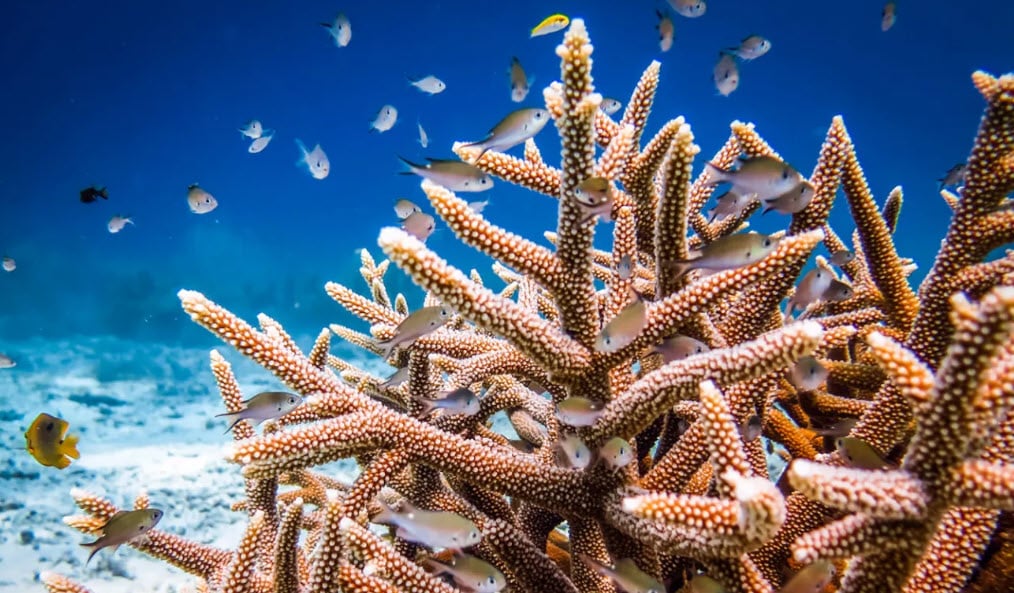
What works so well here is the contrast between the external speaker–the weapons instructor–and the internal speaker–the soldier. As the instructor continues to bark his inventory of gun parts, the soldier’s attention drifts to parts of nature, in the first stanza “japonica” blooming nearby, compared in a simile to coral, orange-pinkish-red mineral accretions on the ocean floor (see photo above). Contrasted to the utilitarian coloring (often green) of weaponry, the japonica flowers glow (glisten) against the backdrop of the green green gardens. The deconstruction by name of the rifle parts contrasts with the harmonious vision of the gardens. One significant choice Reed makes is to have the soldier’s thought intrude on the same line as the instructor’s speech. The easy, obvious choice would have been to have the word “japonica” begin a new line, so that the instructor’s words are always in the first four lines and the soldier’s thoughts always in the last two, keeping them distinct and separate. But by placing “japonica” at the end of the instructor’s words, the soldier’s thoughts are made more immediate and obtrusive. These poetic structural choices are free verse’s driving force, as opposed to the rhyme and meter of static forms like the sonnet.
Irony also exists in the almost farcical comments made by the instructor in stanza two, in which he demonstrates parts that the soldiers’ cannot even handle since they “have not got” them yet. Form without substance. Poignantly, the soldier also thinks of what they do not have at the moment, the “silent, eloquent gestures” of branches in the gardens, with their glistening flowers, in contrast to the loud, meaningless demonstrations of the instructor.
Stanza four continues the contrasts, leading to the culmination of all the images: the harsh, mechanical suggestion of the words, “bolt.” “breech,” and “rapidly backwards and forwards,” in describing “easing the spring” (note the lower case of “s” of “spring”) in opposition to some of the same types of words–“rapidly backwards and forwards,” assaulting (an ironic war-term) and fumbling”–describing the movements of flower-inhabiting bees, which appear “early” in the season, symbolically ushering in Spring (note the capital “S” in “Spring”), i.e., “easing the Spring” season.
In the final stanza, Reed recapitulates the intention of the poem by again contrasting weapon parts to nature’s parts, the former parts “named” by the instructor, the latter parts “named” by the soldier. The poem ends with a serene tableau of almond-blossom-laden gardens inhabited by back-and-forthing bees.
The use of irony in this poem illustrates how powerful a tool it can be in the imagination of a poet who can implement it to magnify their meaning.