Museum of Fine Arts.

Landscape with the Fall of Icarus
***
W. H. Auden wrote Musée des Beaux Arts in December 1938 following a visit to the Musées Royaux des Beaux-Arts de Belgique (a.k.a. Belgium’s Royal Museums of Fine Arts). The poem’s speaker walks through a gallery, contemplating various paintings and admiring their ability to convey the “human position” towards suffering—that is, indifference. The speaker focuses specifically on Landscape with the Fall of Icarus by Pieter Breughel the Elder, in which Icarus, the mythical figure famous for flying too close to the sun and then drowning, appears only in the corner of the painting as a pair of legs sticking out from the water’s surface.

***
About suffering they were never wrong,
The Old Masters: how well they understood
Its human position; how it takes place
While someone else is eating or opening a window or just walking dully along;
How, when the aged are reverently, passionately waiting
For the miraculous birth, there always must be
Children who did not specially want it to happen, skating
On a pond at the edge of the wood:
They never forgot
That even the dreadful martyrdom must run its course
Anyhow in a corner, some untidy spot
Where the dogs go on with their doggy life and the torturer’s horse
Scratches its innocent behind on a tree.
In Brueghel’s Icarus for instance: how everything turns away
Quite leisurely from the disaster; the ploughman may
Have heard the splash, the forsaken cry,
But for him it was not an important failure; the sun shone
As it had to on the white legs disappearing into the green
Water; and the expensive delicate ship that must have seen
Something amazing, a boy falling out of the sky,
Had somewhere to get to and sailed calmly on.
***
The tone and meaning of the poem are immediately established in line 1 by the reversed syntactical order of placing the adverbial phrase1 (About suffering) before the verb (were), thus placing the keyword, suffering, right up front. They are then identified in line 2 as The Old Masters, i.e., established classical painters and are acknowledged for having known (understood) where suffering stood in the scheme of things (its human positioning), how it takes place, not dramatically bookended by significant events, but amid the mundanity of everyday life, exampled in the wonderful line 4 .Not only are the examples them- selves common enough–eating, opening a window, walking dully along–but the meter of this lengthy line emulates a casual stroll: While someone else is eating or opening a window or just walking dully along. And the desolate feeling that accompanies this realization on the part of the person in pain,
In another example, the poet compares this contrast to adults (the aged) reverently and passionately anticipating (waiting for) the miracle of birth , while children, perhaps not even wanting the birth, indifferently skate/On a pond. This is also an allusion to the painting, Census at Bethlehem, in which even the imminent divine birth of Jesus goes unnoticed amid the day-to-day activity surrounding Mary and Joseph.
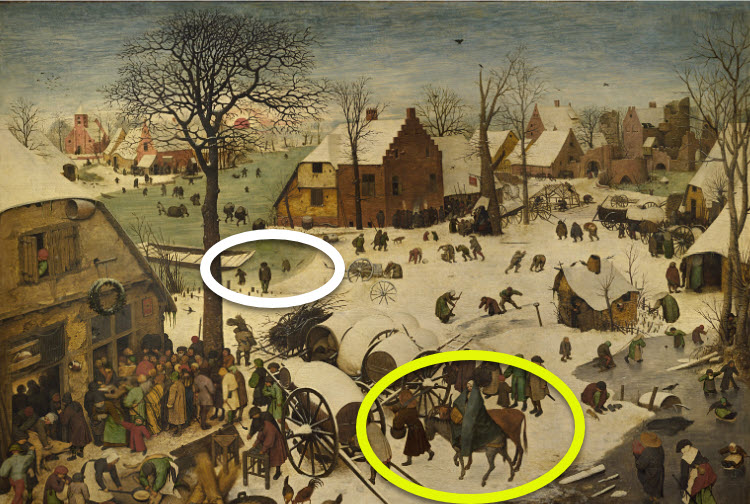
The Census at Bethlehem, Breughel.
Again alluding to the Old Masters of line 2, They never forgot that even the most profound, tragic suffering (martyrdom) must run its course within the mundanity of everyday life. In another painting, Massacre of the Innocents–referencing the biblical narrative in which King Herod the Great orders the murder of all male children aged two and under in order to eliminate the infant Jesus, rumored to be the future “King of the Jews”– as Herod’s plan is being carried out, in some corner, some untidy spot, dogs go to be dogs, and the torturer’s horse, /Scratching his innocent behind goes to be a horse, oblivious to the horror of the butchering of children,

Massacre of the Innocents, Breughel.
The final and central example of indifference is presented in the last eight lines, the third example of a Breughel painting, Icarus. Icarus is a figure in Greek mythology, the son of Daedalus, who famously crafted wings of feathers and wax to escape imprisonment in Crete’s labyrinth. Ignoring his father’s warning to fly neither too high nor too low, Icarus soared too close to the sun, melting the wax and falling to his death in the sea. The story is often used symbolically as an example of *hubris,* or overweening pride. In this case, however, as with the other two paintings alluded to, it’s the content of the artwork that is significant.
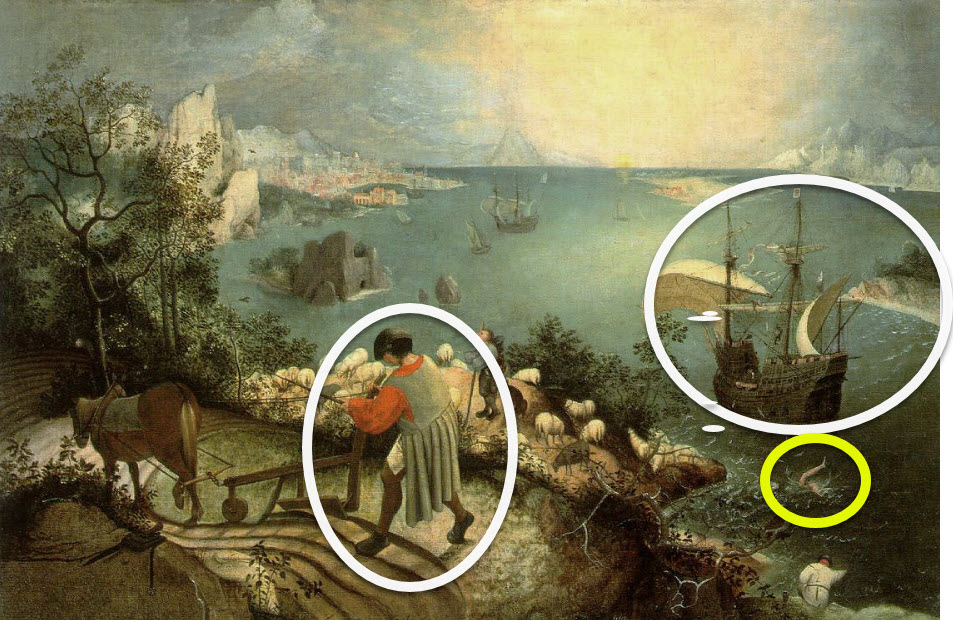
Icarus is shown in the bottom right of the painting, a pair of legs jutting out of the sea. Nothing regards his death (disaster), everything turns away/Quite leisurely, not that they are ignoring it, but that they aren’t even aware of it (the ploughman may have heard the splash and the forsaken cry, but just as background noise, not an important failure). So Icarus’s sad cry of realization goes unheeded (forsaken). The sun continues to shine, unperturbed, illuminating the white legs impersonally sticking out of the sea, Icarus reduced to just a body party. And the expensive, delicate ship, both descriptions irrelevant to what’is happening, must have seen something amazing, a boy (rehumanized here, increasing the pathos) falling out of the sky, but life goes on, the ship had some where to get to, the boy was of no significance, so the ship sailed calmly on, no rescue attempted. In the painting, Breughel conveys these sentiments without words by the diminutive size of the boy’s legs, their awkward positioning, and by the boy’s placement in the painting, not a focus but just another item in the lower right hand corner–his insignificance recorded for all time.
***
- An adverbial phrase is a group of words acting as a single adverb to modify verbs, adjectives, or other adverbs, explaining how, when, where, or why an action occurs. ↩︎
***
Subscribing only means that you will receive a notice when I publish a new post.
***
(Note: You can view most poems on the website, Poetry Foundation.)
(Note: My Poetry Recordings Playlist: At the very bottom of the post Is a recording. To view my entire playlist of poetry recordings, hover over “1/18” in the upper right corner, then click on ‘My Poetry Recordings Playlist:´and make selection.)
***
Scroll down for comments. **Remember that comments are public. Enter your Comment below.**
"""""""""
Leave a Reply