***
Byzantium was an ancient Greek city in classical antiquity that became known as Constantinople in late antiquity and Istanbul in modern times.
The poem consists of five 8-line stanzas (octave or octet), with a varied rhyme scheme, often using slant rhyme1, and a varied iambic2 meter. All the variations create an unsteady, shifting format.
***
The unpurged images of day recede;
The Emperor’s drunken soldiery are abed;
Night resonance recedes, night-walkers’ song
After great cathedral gong;
A starlit or a moonlit dome disdains
All that man is,
All mere complexities,
The fury and the mire of human veins.
Before me floats an image, man or shade,
Shade more than man, more image than a shade;
For Hades’ bobbin bound in mummy-cloth
May unwind the winding path;
A mouth that has no moisture and no breath
Breathless mouths may summon;
I hail the superhuman;
I call it death-in-life and life-in-death.
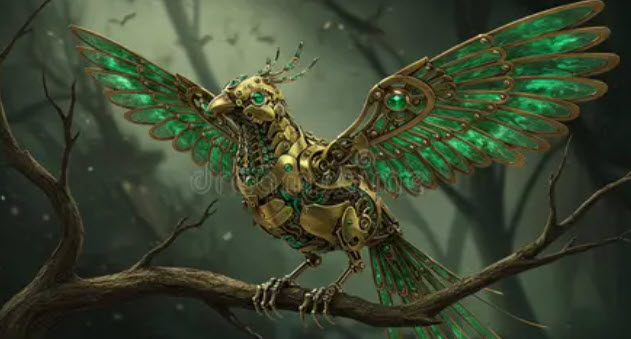
Miracle, bird or golden handiwork,
More miracle than bird or handiwork,
Planted on the starlit golden bough,
Can like the cocks of Hades crow,
Or, by the moon embittered, scorn aloud
In glory of changeless metal
Common bird or petal
And all complexities of mire or blood.
At midnight on the Emperor’s pavement flit
Flames that no faggot feeds, nor steel has lit,
Nor storm disturbs, flames begotten of flame,
Where blood-begotten spirits come
And all complexities of fury leave,
Dying into a dance,
An agony of trance,
An agony of flame that cannot singe a sleeve.
Astraddle on the dolphin’s mire and blood,
Spirit after spirit! The smithies break the flood,
The golden smithies of the Emperor!
Marbles of the dancing floor
Break bitter furies of complexity,
Those images that yet
Fresh images beget,
That dolphin-torn, that gong-tormented sea.
***
The poem begins, somewhat mystically–and negatively, with the advent of deep night in the city of Byzantium. The raw (unpurged) mages of day recede; the Emperor’s drunken soldiers have retired; early night noises (resonance), including the night-walkers’ (street-walkers’ ) pleas fade (recedes)after the bell-ringing (gong) of the great Hagia Sophia cathedral. These remnants of daily life are a degrading commentary on society’s mores; judgment is provided by the beauty of a starlit/moonlit dome that disdains/All that man is–an extremely harsh condemnation (lines 5-6)–nothing more than a collection of meaningless (mere) complications (complexities), a haphazard (fury) quagmire (mire)of bloody veins.
In stanza two, In stark contrast to man’s mire of blood, the speaker encounters (Before me floats) an ambiguous vision (man/shade/image), but surely an image since it floats, a dry (no moisture) and life-less (no breath) intermediary between life and death (I call it death-in-life and life-in-death), that like an afterlife’s (Hades) metaphorical spool (bobbin) may unwind the mummy-cloth of daily life’s complexities and summon Breathless mouths (the dead) to it, mystically bridging the breathing and the breath-less, life and afterlife–I hail the superhuman.
Stanza three asserts the transcendence of art (miracle), specifically a golden bird (mechanical or sculpted) perched (planted) on a starlit golden bough, a miraculous work of art that, like the real “Hades cocks” 3, can actually crow, and, made defiant by its link to the otherworldly (by the moon embittered), scorn aloud–in the glory of its immortal (changeless) metal being–common, living birds or branches (petal), and all the complications of the human condition(mire or blood).
At midnight in the streets (pavement) appear, mysterious flames that are not fueled with wood (faggot), nor started with the spark of flint and steel, and which even storm winds cannot extinguish (disturb), self replicating flames (flames begotten of flame). They are purifying flames to which spirits forged in blood (blood-begotten) come to purge themselves (all complexities of fury leave) by ecstatically (agony of trance) dancing to death in mystical flames, not the everyday flames that can singe a sleeve.
The fifth stanza, perhaps the most oblique, is an amalgam of images used previously throughout the poem, creating an artistic entity. It begins with an image that is an admixture of human and divine, Dolphins, often used in classical mythology as symbol of the duality of body and spirit, in this case actual dolphins of mire and blood, see stanza 1: The fury and the mire of human veins: . Astride the mystical dolphins are a flood of spirit after spirit–spirits yet blood-begotten, stanza 4, The smithies (artisans) that created the golden bird of stanza 3. through artistic creation stop (break) the flood, and the marbles of the purifying dancing floor (stanza 4)–artistic creation– break up and transform the bitter mire(fury) of human complications (complexity). As the smithies break up the fury of life and then re-arrange it into immortal art, so, too, has the poet taken his own disparate images and recombined them into a single, cohesive work of art–the poem. All art is existing images engendering (beget) new (fresh) images, in an endless cycle of creativity. An image of the sea interrupted by the image of dolphins breaking the surface; an image of the sensate life (the sea) tormented by the spiritual, creative transcendence of the cathedral-gong (stanza 1). .
Note on Yeats’s mysticism. 4
***
- occurs when two words share similar but not identical sounds. For example, “hill’ and “full.” ↩︎
- lines with iambic feet, each containing one unstressed syllable followed by a stressed one ↩︎
- “Hades” is a name often given to majestic, dark, or protective roosters. ↩︎
- W.B. Yeats was a dedicated mystic, occultist, and practitioner of magic, stating in 1892 that “the mystical life is the centre of all that I do”. His work was profoundly shaped by theosophy, Hermeticism, and Irish folklore, focusing on communication with spirits, automatic writing, and symbols. Key Aspects of Yeats and Mysticism:
The Hermetic Order of the Golden Dawn: Yeats was a leading figure in this influential occult society, engaging in ceremonial magic.
Anima Mundi: He believed in a “Great Memory” (or Anima Mundi), a collective spiritual memory of nature that artists could access through symbols.
Automatic Writing: Along with his wife, Georgie Hyde-Lees, Yeats practiced automatic writing, believing they were receiving messages from spirits that later formed his book A Vision.
Celtic Mysticism: Yeats blended esoteric occultism with Irish folklore, aiming to revive Irish spiritual identity through myth.
Influence on Poetry: His mystical beliefs permeate his poetry, including concepts of reincarnation, the supernatural, and his complex symbolic system of “gyres” (spirals of history).
His lifelong interest included séances, investigating miracles, and studies of Eastern philosophy.
↩︎
***
Subscribing only means that you will receive a notice when I publish a new post.
***
(Note: You can view most poems on the website, Poetry Foundation.)
(Note: My Poetry Recordings Playlist: At the very bottom of the post Is a recording. To view my entire playlist of poetry recordings, hover over “1/18” in the upper right corner, then click on ‘My Poetry Recordings Playlist:´and make selection.)
***
Scroll down for comments. **Remember that comments are public. Enter your Comment below.**
Leave a Reply