***
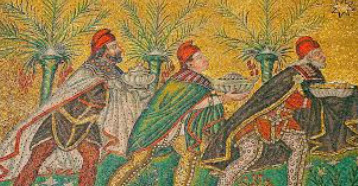
In Christianity, the Biblical Magi (singular: magus), also known as the Three Wise Men, Three Kings, and Three Magi are distinguished foreigners who visit Jesus after his birth, bearing gifts of gold, frankincense, and myrrh. The Magi appear solely in the Gospel of Matthew, which states that they came, having seen “his star in the east” to worship the “one who has been born king of the Jews”. The poem consists of three stanzas, in free verse.1
***
A cold coming we had of it,
Just the worst time of the year
For a journey, and such a long journey:
The ways deep and the weather sharp,
The very dead of winter.’
And the camels galled, sorefooted, refractory,
Lying down in the melting snow.
There were times we regretted
The summer palaces on slopes, the terraces,
And the silken girls bringing sherbet.
Then the camel men cursing and grumbling
and running away, and wanting their liquor and women,
And the night-fires going out, and the lack of shelters,
And the cities hostile and the towns unfriendly
And the villages dirty and charging high prices:
A hard time we had of it.
At the end we preferred to travel all night,
Sleeping in snatches,
With the voices singing in our ears, saying
That this was all folly.
Then at dawn we came down to a temperate valley,
Wet, below the snow line, smelling of vegetation;
With a running stream and a water-mill beating the darkness,
And three trees on the low sky,
And an old white horse galloped away in the meadow.
Then we came to a tavern with vine-leaves over the lintel,
Six hands at an open door dicing for pieces of silver,
And feet kicking the empty wine-skins.
But there was no information, and so we continued
And arriving at evening, not a moment too soon
Finding the place; it was (you might say) satisfactory.
All this was a long time ago, I remember,
And I would do it again, but set down
This set down
This: were we led all that way for
Birth or Death? There was a Birth, certainly
We had evidence and no doubt. I had seen birth and death,
But had thought they were different; this Birth was
Hard and bitter agony for us, like Death, our death.
We returned to our places, these Kingdoms,
But no longer at ease here, in the old dispensation,
With an alien people clutching their gods.
I should be glad of another death.
***
The first stanza chronicles the arduousness of the journey to Bethlehem: cold, worst time, long journey, ways deep, weather sharp, dead of winter. That this was not an easy trek in a temperate climate as is sometime imagined is made clear. Even the camels, hobbled (galled) and sore, were difficult (refractory), at times refusing to go on (lying down in the melting snow). The poet makes clear that this is not the noble entry of royalty, composed in demeanor. These are weary travelers, regretting the pleasures they left behind–The summer palaces, the silken girls bringing sherbet. In stark contrast to, again, the perhaps usually imagined ease of their trip, was the sordid reality of recalcitrant camel men, surly (cursing and grumbling), defecting (running away), wanting their liquor and women, and the warming night fires going out, the lack of shelter, the hostile cities, unfriendly towns, and dirty villages with their exorbitant prices. In all, not a pleasant, expectant journey to see the newborn king, but a nightmare–the inconveniences of Mary and Joseph trivial compared to this–summarized by a monosyllabic, ironic understatement: A hard time we had of it.
Eventually they chose to travel all night, sleeping when they could (in snatches), haunted (singing in our ears) by voices (their own and others’ ?) saying/That this was all folly. It is significant to remember that this so arduous journey was motivated only by the rumor of a holy birth, their only guide a star in the sky. Sacrifice may or may not have been expected, the implication of the poem being, are we aware of the potential consequences when we seek transcendence, when we bear witness to events of such significance. (As an aside, readers may or may no be aware that, according to Matthew, the three Magi met with King Herod, who asked them to let him know the exact location of the child when they found him, enraged by having heard the rumors of a new king [Jesus]. Warned in a dream, the magi avoided Herod later, prompting him instead defensively to order the death of all children under two (“The Massacre of the Innocents”).
In stanza three, the Magi finally reach a temperate valley, smelling of vegetation, /With a running stream and water-mill, perhaps presaging hope. However, once again unaware of the enormity of what they will be witnessing at the birth, they are oblivious to warning signs of death that will attend the birth: three trees, the crucifixion; the old white horse galloping away, the old ways and religions supplanted by Christianity; vine leaves , symbol of the blood of Christ?; Six hands…dicing; the Roman soldiers gambling for Christ’s garments at the crucifixion; pieces of silver, the betrayal of Christ; feet kicking the empty wine-skins, the persecution of Christ. But there was no information–or any understanding. So they continued, finding the place not a moment too soon. Their reaction: another ironic understatement, almost shocking in its casual observation of the birth of Christianity: it was (you might say) satisfactory.
In the final stanza the Magus, with the benefit of time (All this was a long time ago, I remember). finally can look back with some objectivity. He begins with an almost casual aside, I would do it again, so there is no major regret, but follows with an adamant, emphasized command (but set down/This set down/This), a question of obvious significance– were we led all that way for/Birth or Death?, implying that he may finally have begun to realize the significance of his journey. There was the obvious evidence that there was a birth, no doubt. But he had seen both birth and death before and found them different. In this case, though, the Birth was/Hard and bitter agony for us, so much so that it was like death to the Magi. They returned to their Kingdoms, but no longer at ease there–a change, a passing away had occurred with the “death” of the old ways (dispensation), with his now alien people clutching their gods out of desperation when confronted with Christianity. I should be glad of another death. The Birth of the new ways and the death of the old ways have left him bereft of belonging, isolated by what he has witnessed, so that he now would welcome another death, his.
A profound meditation on self-awareness , mortality, faith, and revelation.
***
- a form of poetry that does not use consistent meter patterns, rhyme, or any musical pattern ↩︎
***
Subscribing only means that you will receive a notice when I publish a new post.
***
(Note: You can view most poems on the website, Poetry Foundation.)
(Note: My Poetry Recordings Playlist: At the very bottom of the post Is a recording. To view my entire playlist of poetry recordings, hover over “1/18” in the upper right corner, then click on ‘My Poetry Recordings Playlist:´and make selection.)
***
Scroll down for comments. **Remember that comments are public. Enter your Comment below.**
Leave a Reply