***
The poem is a series of four octets (eight line stanzas), with the rhyme scheme abababcc, in iambic pentameter.1
I
That is no country for old men. The young
In one another’s arms, birds in the trees,
—Those dying generations—at their song,
The salmon-falls, the mackerel-crowded seas,
Fish, flesh, or fowl, commend all summer long
Whatever is begotten, born, and dies.
Caught in that sensual music all neglect
Monuments of unageing intellect.
II
An aged man is but a paltry thing,
A tattered coat upon a stick, unless
Soul clap its hands and sing, and louder sing
For every tatter in its mortal dress,
Nor is there singing school but studying
Monuments of its own magnificence;
And therefore I have sailed the seas and come
To the holy city of Byzantium.
III
O sages standing in God’s holy fire
As in the gold mosaic of a wall,
Come from the holy fire, perne in a gyre,
And be the singing-masters of my soul.
Consume my heart away; sick with desire
And fastened to a dying animal
It knows not what it is; and gather me
Into the artifice of eternity.
IV
Once out of nature I shall never take
My bodily form from any natural thing,
But such a form as Grecian goldsmiths make
Of hammered gold and gold enamelling
To keep a drowsy Emperor awake;
Or set upon a golden bough to sing
To lords and ladies of Byzantium
Of what is past, or passing, or to come.
***
In the famous first line, the first word, That, distances the speaker, significant to the whole poem, as though he is pointing away from himself, and possibly with some disdain.. We learn that he is distancing himself from a country that has no place for old men, such as he is. It is a country of the young in embrace (in one another’s arms), concerned only with the sensual life of procreation, living, and dying (whatever is begotten, born, and dies), like the instinctual world of fish (salmon,, mackerel)and birds (Fish, flesh, and fowl), a world consisting of dying generations (life–>death). It is a world of sensual music (physical pleasure), with no place (neglect) for old men or works (monuments) of eternal (unageing) substance (intellect, i.e., art, philosophy, etc.).
Stanza II is a reflection on the old age that alienates the speaker from his country. It is a rather bitter portrayal of aging, with man reduced (paltry) to a scarecrow likeness–old and tattered clothes upon a skinny, stick-like body. unless–emphasized as the last word of the line, followed by the end-line pause–the soul takes precedence, rejoicing (clap, sing) in itself, rejoicing even (louder sing) in every tatter of its mortal appearance, self-asserting in that song its own magnificence. To aid his transcendence, he has left his old, sense-driven country (sailed the seas) and arrived in the holy city of Byzantium.2
In Byzantium the speaker appeals (come) to the wise men (sages) there–who are purified of sensuality by God’s holy fire, as if represented in the exquisite art of a gold mosaic–to come to him from the holy fire, descending in a hawk-like spiral (pern3 in a gyre4), and act as teachers (masters) of song, the ideation of his soul, as in Stanza II. He asks them to consume his sensual heart–made sick by sensual desire, chained (fastened) to a dying, physical (animal) body, so that it no longer has an identity (It knows not what it is)–and then to gather his purified soul into a death-negating (eternity) artful form (artifice).
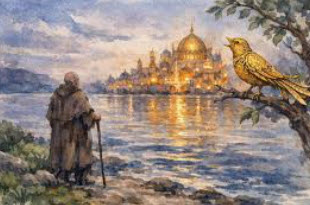
In the fourth stanza, the speaker describes the anticipated results of the soul’s transcendence. Now that he would be free of his material being (out of nature), he would not take his new form from any natural, sensual thing, but would take a form such as those created by ancient Greek goldsmiths, made of hammered gold and gold enameling–the artifice of stanza three–or the form of a mechanical songbird upon a golden bough, expressing his soul (to sing) to the lords and ladies of Byzantium, a song of what was (past), is (passing), or will be (to come). The poet has morphed from a scarecrow of sticks and tatters into a purified entity of art– beauty, sublime and eternal.
- lines with five iambic feet—each containing one unstressed syllable followed by a stressed one (iamb)– (ta-DUM ta-DUM ta-DUM ta-DUM ta-DUM). This 10-syllable pattern is often likened to a heartbeat, ↩︎
- Byzantium (the Eastern Roman Empire) was crucial for preserving classical Greek and Roman knowledge, spreading Orthodox Christianity, and influencing European art, law, and culture for a thousand years after the Western Roman Empire fell. Its capital, Constantinople, was a vital trade hub and center of learning, ensuring that Greco-Roman heritage survived and later fueled the Renaissance in the West. ↩︎
- Derived from “pirn” (a bobbin/spool), Yeats uses it to describe a spiraling, winding movement.
↩︎ - Yeats’ signature symbol for historical and spiritual cycles of time (2,000-year epochs) that expand and contract. ↩︎
***
Subscribing only means that you will receive a notice when I publish a new post.
***
(Note: You can view most poems on the website, Poetry Foundation.)
(Note: My Poetry Recordings Playlist: At the very bottom of the post Is a recording. To view my entire playlist of poetry recordings, hover over “1/18” in the upper right corner, then click on ‘My Poetry Recordings Playlist:´and make selection.)
***
Scroll down for comments. **Remember that comments are public. Enter your Comment below.**
Leave a Reply