***
Lawrence Ferlinghetti was born in 1919. He was famous as a poet, a publisher of poetry, and a bookseller—he was the cofounder of the famous City Lights bookshop in San Francisco. Ferlinghetti is often considered one of the “Beat”1 poets, though he always insisted he was not a Beat himself. Nevertheless, as the publisher of Allan Ginsberg and Jack Kerouac, among others, he was certainly part of the movement. This poem is from Ferlinghetti’s most famous collection, Coney Island of the Mind; Ferlinghetti’s mantra was that “art should be accessible to all people,” and that “truth is not the secret of a few.”
***
Constantly risking absurdity
and death
whenever he performs
above the heads
of his audience
the poet like an acrobat
climbs on rime
to a high wire of his own making
and balancing on eyebeams
above a sea of faces
paces his way
to the other side of day
performing entrechats
and sleight-of-foot tricks
and other high theatrics
and all without mistaking
any thing
for what it may not be
For he’s the super realist
who must perforce perceive
taut truth
before the taking of each stance or step
in his supposed advance
toward that still higher perch
where Beauty stands and waits
with gravity
to start her death-defying leap
And he
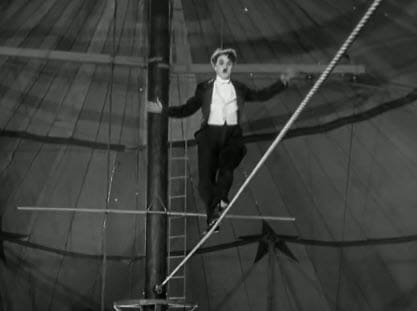
a little charleychaplin man
who may or may not catch
her fair eternal form
spreadeagled in the empty air
of existence
The first line of the poem establishes the requisite informal tone since it asserts that absurdity will probably be an essential element. It creates an expectation that the poem will not be somber or religious or sad, etc. The way and death is linked to absurdity–both in concept and in its placement alone on a second line, as if parenthetical–continues the light tone and adds a note of perplexity since we do not know yet the who may be the subject of the poem. We soon learn that the subject is an artist of some sort (performs), perhaps an aerialist2 (above the heads), with an audience..
All our expectation is turned on its head when we learn that the artist is–a poet. Ferlinghetti introduces the extended simile/metaphor that runs throughout the poem: the poet as an acrobat, which causes a look back at the first four lines. When poets express themselves through poetry, they become vulnerable to the readers’ (audience) perceptions. Perhaps the concept of poet as acrobat strikes them as absurd, maybe because they missed the meaning of the poem–it went over (above) their heads, figuratively. Like acrobats, poets balance a fine line (the tightrope) between presentation and success, which may result in complete failure (death, absurdity). It is not something to be entered into lightly.
The basic “ladder” of a poem is often rime (rhyme), by which poets “climb ” up to the final expressed poem (high wire of his own making), balancing on the eyebeams (with pun on I-beams [structural girders], and, perhaps, I-beam again for the projection [beams] of self [I]) of their audience(spectators/readers). With the words of the poems, poets pace their way (express themselves)through meaning, hoping to transcend the words (to the other side of day), using meter and figurative language (entrechats3, sleight-of-foot-tricks, high theatrics) to enhance their concepts. In order to avoid the risk of absurdity, while precariously balancing on their words and devices, they also must be honest and insightful. never misrepresenting (for what it may not be)or misunderstanding (without mistaking) the truth of the poems.
Because poets are super realists, they must necessarily (perforce) perceive the (taut/taught) (taut/firm) truth of what they have observed before compiling the poem’s elements (stance or step) with the aim (advance) of achieving an even higher revelation–Beauty, She is like a trapeze artist who waits with gravity (seriousness/weight) in anticipation to make her extremely dangerous (death-defying) leap from the platform, trusting in the poet. The poet, (a little charleychaplin man), constantly risking absurdity, may (Beauty achieved) or may not (poetic failure) achieve (catch her) Beauty–that is always (constantly) the risk, even knowing all the dangers–as she (her fair eternal form), having taken a leap of faith, hangs in midair (empty air), frighteningly suspended (spreadeagled ), completely vulnerable to the poet., We, the readers, the audience leave them in the midair of existence, not knowing if she will be caught or die, not knowing if truth and beauty will be achieved.
The poet is an entertainer, an acrobat who must sustain perfect balance in order to reach the reader, his audience, with the truth and beauty of his skills–the poem.
***
***
- a 1950s counterculture literary movement originating in New York and San Francisco, rejecting post-WWII conformism, capitalism, and academic conventions. ↩︎
- a circus acrobat who performs acrobatic, gravity-defying maneuvers while suspended in the air on apparatuses like silks, trapeze, or highwire. ↩︎
- a vertical jump during which the dancer repeatedly crosses the feet and beats them together. ↩︎
***
Subscribing only means that you will receive a notice when I publish a new post.
***
(Note: You can view most poems on the website, Poetry Foundation.)
(Note: My Poetry Recordings Playlist: At the very bottom of the post Is a recording. To view my entire playlist of poetry recordings, hover over “1/18” in the upper right corner, then click on ‘My Poetry Recordings Playlist:´and make selection.)
***
Scroll down for comments. **Remember that comments are public. Enter your Comment below.**
Leave a Reply