,
The Caged Skylark is a Petrarchan Sonnet in format: 14 lines consisting of 1 octet (8-line stanza) and 1 sestet(6-line stanza), with rhyme scheme abbaabba ccdccd.
Hopkins was a priest-poet, with many of his poems having a religious connotation, this one in particular, using extended analogy 1, comparing a skylark in a cage to a person’s soul in their body.
As a dare-gale skylark scanted in a dull cage,
Man’s mounting spirit in his bone-house, mean house, dwells —
That bird beyond the remembering his free fells;
This in drudgery, day-labouring-out life’s age.
Though aloft on turf or perch or poor low stage
Both sing sometímes the sweetest, sweetest spells,
Yet both droop deadly sómetimes in their cells
Or wring their barriers in bursts of fear or rage.
Not that the sweet-fowl, song-fowl, needs no rest —
Why, hear him, hear him babble & drop down to his nest,
But his own nest, wild nest, no prison.
Man’s spirit will be flesh-bound, when found at best,
But uncumberèd: meadow-down is not distressed
For a rainbow footing it nor he for his bónes rísen.
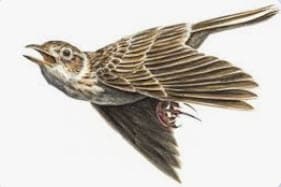
In the first quatrain (4-line stanza) the first analogy compares the imprisonment of man’s soul (spirit) in his body to a skylark imprisoned in a cage. The metaphors used intensify the caged aspect: the skylark is dare-gale, i.e., so powerful in flight that he can fly against a strong wind; this makes his imprisonment all the more cruel since now he cannot fly at all, reduced (scanted) in freedom and his nature. So, too, man’s soul, meant to soar (mount) toward heaven, is caged in his body, a materialistic (bone), worthless (mean) housing. As a result, the skylark becomes so removed from his true nature that he no longer can remember the free (unrestricted) fells (hills, mountains, or high, open moorland)
where he normally lives. So the soul of man (This) is deadened by the drudgery (the damning , onomatopoetic2 phrase, day-labouring-out) of daily survival (life’s age).
In the second quatrain, though when spiritually raised (aloft) above their environment (turf, perch, or stage), both the skylark and the soul can produce the most beautiful (sweetest) enchanting songs (spells), both, when caged, sometimes appear completely lifeless (droop deadly) in their prison cells. When they are energized, it is only to crash against (wring, with pun on ring) their cages (barriers) in bursts of fear or rage, rebelling against their captivity.
In the first three lines (tercet) of the sestet, the poet asserts that rest, of course, is necessary. We can hear the skylark warbling (babble) as it softly drops down to his nest–a nest of his own making, however, a wild (natural) nest, not a prison.
So, too, will the soul retain its body (flesh-bound) when it goes to its final, best rest.(Recall that Hopkins was a priest; Catholics believe in the resurrection of both the soul and the body), the body, though, now free (unencumbered) of its earthly cage quality (bones risen). In a beautiful metaphor, Hopkins asserts that just as as the grass of a meadow (meadow-down) shows no impression (not distressed) from a weightless rainbow ending (footing) on it , so the now resurrected soul, the body free of its material encumbrance (bones risen), is no longer physically disfigured (distressed) nor spiritually troubled (distressed).
As a note, Hopkins had great trouble in reconciling his poetic and priestly natures. Thus many of the poems we have–some represented on this blog–are of a religious nature, though at one point in his life, out of guilt to his Faith, he burned many others. When the Church assigned him to Ireland, where he was a stranger in a strange land, he began a slow decline of his already frail constitution, ending in his death from typhoid contracted due to the poor sanitation at University College, Dublin, where he was assigned, in 1889 at age 44. A sad story of a fragile genius too at odds with himself.
***
Subscribing only means that you will receive a notice when I publish a new post.
***
(Note: You can view most poems on the website, Poetry Foundation.)
(Note: My Poetry Recordings Playlist: At the very bottom of the post Is a recording. To view my entire playlist of poetry recordings, hover over “1/18” in the upper right corner, then click on ‘My Poetry Recordings Playlist:´and make selection.)
***
Scroll down for comments. **Remember that comments are public. Enter your Comment below.**
Leave a Reply