To strive, to seek, to find, and not to yield.
.
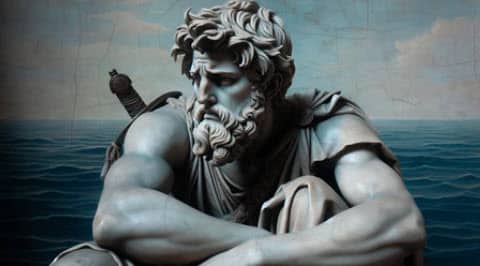
Tennyson’s poem is a contemplative rumination by Ulysses after the Trojan War has ended and after his prolonged journey home, a period of some twenty years. It is especially famous for many of its lines, including the last six. This is Tennyson’s lament on aging, on a regretful perception that the best is past and little of note may remain. It reflects the universal concern for the transience of life, when our ” our little life is rounded with a sleep.”1 But it is a great hero’s heroic refusal to acquiesce.
It does require some background.
The Trojan War: The Trojan War was a, perhaps mythical, decade-long conflict between Mycenaean Greece and the city of Troy in Asia Minor (modern Turkey) during the 13th or 12th century BC, famously initiated after Paris of Troy abducted Helen of Sparta.
The Odyssey: one of two major epics of ancient Greek literature attributed to Homer. It is one of the oldest surviving works of literature. Like the Iliad, the Odyssey is divided into 24 books. It follows the heroic king of Ithaca, Odysseus, also known by the Latin variant Ulysses, and his homecoming journey after the ten-year long Trojan War. His journey from Troy to Ithaca lasts an additional ten years, during which time he encounters many perils. In Odysseus’s long absence, he is presumed dead, leaving his wife Penelope and son Telemachus to contend with a group of suitors competing for Penelope’s hand in marriage.
For a full synopsis of the Odyssey, see footnotes below.2
***
It little profits that an idle king,
By this still hearth, among these barren crags,
Match’d with an aged wife, I mete and dole
Unequal laws unto a savage race,
That hoard, and sleep, and feed, and know not me.
I cannot rest from travel: I will drink
Life to the lees: All times I have enjoy’d
Greatly, have suffer’d greatly, both with those
That loved me, and alone, on shore, and when
Thro’ scudding drifts the rainy Hyades
Vext the dim sea: I am become a name;
For always roaming with a hungry heart
Much have I seen and known; cities of men
And manners, climates, councils, governments,
Myself not least, but honour’d of them all;
And drunk delight of battle with my peers,
Far on the ringing plains of windy Troy.
I am a part of all that I have met;
Yet all experience is an arch wherethro’
Gleams that untravell’d world whose margin fades
For ever and forever when I move.
How dull it is to pause, to make an end,
To rust unburnish’d, not to shine in use!
As tho’ to breathe were life! Life piled on life
Were all too little, and of one to me
Little remains: but every hour is saved
From that eternal silence, something more,
A bringer of new things; and vile it were
For some three suns to store and hoard myself,
And this gray spirit yearning in desire
To follow knowledge like a sinking star,
Beyond the utmost bound of human thought.
This is my son, mine own Telemachus,
To whom I leave the sceptre and the isle,—
Well-loved of me, discerning to fulfil
This labour, by slow prudence to make mild
A rugged people, and thro’ soft degrees
Subdue them to the useful and the good.
Most blameless is he, centred in the sphere
Of common duties, decent not to fail
In offices of tenderness, and pay
Meet adoration to my household gods,
When I am gone. He works his work, I mine.
There lies the port; the vessel puffs her sail:
There gloom the dark, broad seas. My mariners,
Souls that have toil’d, and wrought, and thought with me—
That ever with a frolic welcome took
The thunder and the sunshine, and opposed
Free hearts, free foreheads—you and I are old;
Old age hath yet his honour and his toil;
Death closes all: but something ere the end,
Some work of noble note, may yet be done,
Not unbecoming men that strove with Gods.
The lights begin to twinkle from the rocks:
The long day wanes: the slow moon climbs: the deep
Moans round with many voices. Come, my friends,
‘T is not too late to seek a newer world.
Push off, and sitting well in order smite
The sounding furrows; for my purpose holds
To sail beyond the sunset, and the baths
Of all the western stars, until I die.
It may be that the gulfs will wash us down:
It may be we shall touch the Happy Isles,
And see the great Achilles, whom we knew.
Tho’ much is taken, much abides; and tho’
We are not now that strength which in old days
Moved earth and heaven, that which we are, we are;
One equal temper of heroic hearts,
Made weak by time and fate, but strong in will
To strive, to seek, to find, and not to yield.
The first stanza begins with a somewhat startling description of the barren world this warrior and traveler finds himself in now that he is home and represents the emptiness felt by someone who has lived life fully, only to find a hollowness in having aged. The passage is replete with negative connotations: little, idle, still, barren, aged, savage, hoard.
But Odysseus is as heroic in mind as in body and refuses to go gently:I cannot rest from travel: I will drink /Life to the lees. He is a man who has not participated quietly in his life, regardless of circumstance–All times I have enjoy’d /Greatly, have suffer’d greatly–devouring experience, always roaming with a hungry heart. The poem is brilliant in its ability to convey Ulysses heroic stance while also ironically coating it with a patina of the reader’s sense of poignancy that this, ultimately, is a man diminished, as are all of us, by age.
Ulysses recounts some of his exploits, concluding (in a theme that is recounted throughout this blog) in the well-known words, I am a part of all that I have met, a particularly revelatory comment considering his twenty years of exploits, adding poignancy to our apprehension of this man, a colossus in his own way of, well, heroic proportions.
But, forever restless, he realizes that there is always more, that untravell’d world whose margin fades/For ever and forever when I move. He is always looking forward to what may be, never content with what was.
How dull it is to pause, to make an end, /To rust unburnish’d, not to shine in use! As tho’ to breathe were life! Glorious words of exhortation, urging not to accept but to engage as in battle, to burnish and shine, even in advanced age (little remains). There is always more (a bringer of new things):
Life piled on life
Were all too little, and of one to me
Little remains: but every hour is saved
From that eternal silence, something more,
A bringer of new things; and vile it were
For some three suns to store and hoard myself,
And this gray spirit yearning in desire
To follow knowledge like a sinking star,
Beyond the utmost bound of human thought.
The next stanza is a tribute to his son, Telemachus, To whom I leave the sceptre and the isle, extolling his virtues of slow prudence, soft degrees, and tenderness. However, He works his work, I mine.
There lies the port….The final stanza is an exhortation to his “mariners,” that, though you and I are old/Old age hath yet his honour and his toil./Some work of noble note, may yet be done,/Not unbecoming men that strove with Gods. Though the long day and, metaphorically, their lives, wane(s), ‘Tis not too late to seek a newer world. And though their lives are drawing to a close, and tho’ /We are not now that strength which in old days /Moved earth and heaven, we still can accept ourselves, that which we are, we are and move forward as we can. Tennyson ends the poem with powerful words of reminder–that our spirits do not have to age with our bodies; our will is ageless–some of the most famous lines in poetry:
Made weak by time and fate, but strong in will
To strive, to seek, to find, and not to yield.
- Shakespeare’s The Tempest. ↩︎
- From Wikipedia: Ten years after the Achaean Greeks won the Trojan War, Odysseus, king of Ithaca, has yet to return home from Troy. In his absence, 108 boorish suitors court his wife Penelope. Penelope tells them she will remarry when she is done weaving a shawl; however, she secretly unweaves it every night.
The goddess Athena, disguised first as Mentes then as Mentor, tells Odysseus’s son Telemachus to seek news of his father. The two leave Ithaca and visit Nestor, who tells them that Agamemnon, the commander of the Greek army at Troy, was murdered soon after the war. Telemachus travels to Sparta to meet Agamemnon’s brother Menelaus, who in turn describes his encounter with the shape-shifting god known as the Old Man of the Sea. Menelaus says he learned from the Old Man of the Sea that Odysseus is alive, but held captive by the nymph Calypso.
Athena petitions Zeus to rescue Odysseus, and Zeus sends Hermes to negotiate his release. As Odysseus leaves Calypso’s island, Poseidon destroys his raft with a storm. The sea nymph Ino protects Odysseus as he swims to Scherie, home of the Phaeacians, and Athena leads the Phaeacian princess Nausicaä to recover him. In the court of Nausicaä’s parents Arete and Alcinous, Odysseus excels at athletic games and is overcome with emotion when the bard Demodocus sings about the Trojan War. Odysseus reveals his identity and recounts his adventures following the war.
On leaving Troy, Odysseus’s men unsuccessfully raided the Cicones. Afterward, on an island of lotus-eaters, they found intoxicating fruit which made them forget about reaching home. On another island, they were captured by the cyclops Polyphemus. Odysseus, deceptively calling himself “Nobody”, escaped by intoxicating the cyclops and blinding him. However, he boastfully revealed his true identity while escaping, and Polyphemus asked his father Poseidon to take revenge.
Odysseus’s crew nearly arrived in Ithaca, but were blown off course after opening a bag of winds they received from Aeolus. Afterwards, all but one of their ships were destroyed by giant cannibals called Laestrygonians. On the island of Aeaea, the goddess Circe turned Odysseus’s men into pigs. Hermes helped Odysseus resist Circe’s magic using the herb moly, and Odysseus forced her to restore the crew’s human forms. Odysseus and Circe then became lovers for a year until he left to continue home. Next, Odysseus traveled to the edge of Oceanus, where the living can speak with the dead. The spirit of the prophet Tiresias told Odysseus he would return home, but must eventually undertake another journey. Odysseus also met the spirits of his mother Anticleia and former comrades Agamemnon and Achilles.
Odysseus and the Sirens, eponymous vase of the Siren Painter, c. 480–470 BC (British Museum)
Odysseus’s crew then sailed past the Sirens, whose enticing song lured sailors to their deaths. His crewmen plugged their ears with beeswax to avoid hearing them, while Odysseus tied himself to the ship’s mast. Next, they navigated the narrow passage between the whirlpool Charybdis and the multi-headed monster Scylla. Finally, on the island of Thrinacia, Odysseus’s men killed and ate sacred cattle belonging to the sun god Helios. Helios asked Zeus to punish them, which he did by destroying their last ship. Odysseus, the sole survivor, washed ashore on the island Ogygia. There he met Calypso, who took him captive as her lover until Hermes eventually intervened.
After hearing Odysseus’s story, the Phaeacians take him to Ithaca, where Athena disguises him as an elderly beggar. Without knowing his identity, the swineherd Eumaeus offers him lodging and food. Telemachus returns home from Sparta, evading an ambush from the suitors. Odysseus reveals himself to his son and the two return home, where Odysseus’s elderly dog Argos, long neglected, recognizes him through his disguise; the old dog had been faithfully awaiting his master and upon finally seeing his return, dies peacefully. The suitors mock and mistreat Odysseus in his own home. He and Telemachus hide the suitors’ weapons in preparation for revenge. Odysseus also reencounters Penelope and her servant Eurycleia, who recognizes him from a scar on his leg.
Penelope announces she is ready to remarry, and that she will choose whoever wins an archery contest with Odysseus’s bow. After each suitor fails to even string the bow, Odysseus strings it and fires an arrow through a series of axe heads. Having won the contest, he kills the suitors; Telemachus also hangs a group of slaves who had sex with them. Odysseus reveals his identity to Penelope, who tests him by asking to move their bed. He correctly states that the bed, which he carved from the trunk of an olive tree, is immovable, and the two lovingly reunite. ↩︎

***
Subscribing only means that you will receive a notice when I publish a new post.
***
(Note: You can view most poems on the website, Poetry Foundation.)
(Note: My Poetry Recordings Playlist: At the very bottom of the post Is a recording. To view my entire playlist of poetry recordings, hover over “1/18” in the upper right corner, then click on ‘My Poetry Recordings Playlist:´and make selection.)
***
Scroll down for comments. **Remember that comments are public. Enter your Comment below.**
Leave a Reply