Often cited as one of the best short stories.
James Joyce’s short story, The Dead, is from the collection, Dubliners. It is often cited as one of the truly great short stories. The bulk of the story describes a dinner party on January 6th, 1904, the Epiphany1,in Dublin and serves as a critique of the paralyzing traditionalism and hermeticism of the day, and at least the possibility of redemption (epiphany2). (Joyce eventually chose to leave Ireland, which, in much harsher terms he described in Portrait of the Artist as the sow who eats her farrow [young], a priest-ridden race--the Catholic Church was complicit in the demise of Charles Parnell, an Irish reformer.)
I have always felt that a complete reading of The Dead would mean re-reading upon finishing it. As a result, I am beginning this analysis in a completely unorthodox manner with the the story’s ending.
Generous tears filled Gabriel’s eyes. He had never felt like that himself towards any woman but he knew that such a feeling must be love. The tears gathered more thickly in his eyes and in the partial darkness he imagined he saw the form of a young man standing under a dripping tree. Other forms were near. His soul had approached that region where dwell the vast hosts of the dead. He was conscious of, but could not apprehend, their wayward and flickering existence. His own identity was fading out into a grey impalpable world: the solid world itself which these dead had one time reared and lived in was dissolving and dwindling.
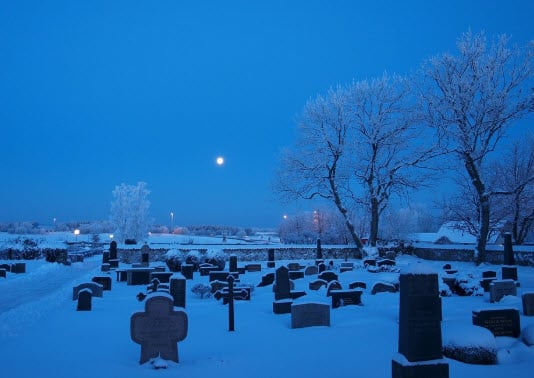
A few light taps upon the pane made him turn to the window. It had begun to snow again. He watched sleepily the flakes, silver and dark, falling obliquely against the lamplight. The time had come for him to set out on his journey westward. Yes, the newspapers were right: snow was general all over Ireland. It was falling on every part of the dark central plain, on the treeless hills, falling softly upon the Bog of Allen and, farther westward, softly falling into the dark mutinous Shannon waves. It was falling, too, upon every part of the lonely churchyard on the hill where Michael Furey lay buried. It lay thickly drifted on the crooked crosses and headstones, on the spears of the little gate, on the barren thorns. His soul swooned slowly as he heard the snow falling faintly through the universe and faintly falling, like the descent of their last end, upon all the living and the dead.
***
Part One: The guests arrive. We learn that the Misses Morkan, with their niece Mary Jane, had been holding their annual holiday dance for years and years, which sounds like a charming tradition. Everyone who knew them came to it, and It was always a great affair. There’s a slight suggestion of stultification in that the affair was repeated, without change, for a good thirty years., extending even to the food (Lily, the housemaid, seldom made a mistake in the [identical annual food and drink] orders so as to avoid clashing with her three mistresses. They were fussy, that was all. So the event has been repeated for thirty years in the same place, at the same time of year, with the same menu, and, we are to learn, with the same entertainment, and, of course, the same guests. No change, no novelty, no stimulation. But Joyce’s ability to deftly capture character, dialogue, and humanism also captures our interest; underneath the social criticism is a nod to the general warmth of this gathering.
The guests arrive: Gabriel Conroy, the sisters’ nephew and main protagonist, and his wife, Gretta; Freddy Malin, who was usually “screwed” (drunk), dreaded for his potential to upset the evening’s calm; Mr. Browne, the only Protestant; the Misses Daly, Power, and Furlong; Molly Ivor, an Irish nationalist and colleague of Gabriel who challenges his cultural allegiances–she is the main source of something unexpected; Mary Jane’s music pupils; and Bartell D’Arcy, a tenor, who inadvertently provides a wrench to the proceedings.
The first chink in the evening’s armor occurs when Gabriel commits his first faux pas and suggests to Lily that he supposes she will be married soon (as all young women must), to which she responds, with great bitterness: The men that is now is only all palaver3 and what they can get out of you. Very subtly a clash is introduced between social propriety, Gabriel’s socially typical remark, and Lily, whose vehemence and implied reprimand are “beyond her station” in life, a break in protocol. Later Kate laments a change in Lily, a sensed undercurrent of a crack in tradition: There’s that Lily, I’m sure I don’t know what has come over her lately. She’s not the girl she was at all. Probably rarely, if ever, presented with a servant’s “insolence,” Gabriel colored as if he had made a mistake. He hadn’t, of course. In terms of his social standing, he was just making “polite” small talk. But Lily drops the facade, which would have been to the horror of the Morkan sisters, had they heard (But the only thing they would not stand was back answers, a servant no knowing their place, knowing one’s place critical to the ordered existence represented by the dinner-party). In a fumbling attempt to recover, Gabriel thrusts a coin into her hand, which she tries, unsuccessfully, to refuse. Insistence on refusal would only have been an even worse “insolence.” This is the first “blow” to Gabriel’s enfranchised manhood and introduces a bump in the evening’s “perfect” proceedings. He was still discomposed by the girl’s bitter and sudden retort. It had cast a gloom over him.
Also introduced in this section is the symbolic use of snow, layered and complicated, not unusual for Joyce.
[Gabriel] stood on the mat, scraping the snow from his goloshes4. light fringe of snow lay like a cape on the shoulders of his overcoat and like toecaps on the toes of his goloshes; and, as the buttons of his overcoat slipped with a squeaking noise through the snow-stiffened frieze, a cold, fragrant air from out-of-doors escaped from crevices and folds.
“Is it snowing again, Mr Conroy?” asked Lily.
“Yes, Lily,” he answered, “and I think we’re in for a night of it.”
The snow symbolically introduces two new notes to the evening: Whatever is new is bizarre:
“And what are goloshes, Gabriel?”
“Goloshes, Julia!” exclaimed her sister. “Goodness me, don’t you know what goloshes are? You wear them over your … over your boots, Gretta, isn’t it?”
“Yes,” said Mrs Conroy. “Guttapercha things. We both have a pair now. Gabriel says everyone wears them on the continent.”
“O, on the continent,” murmured Aunt Julia, nodding her head slowly.
Gabriel knitted his brows and said, as if he were slightly angered:
“It’s nothing very wonderful but Gretta thinks it very funny because she says the word reminds her of Christy Minstrels.5”
and Gretta’s uniqueness.
We learn that Gretta has a side we have not seen yet, unpredictable (walking in the snow), unlike the dinner-party’s ambience and Gabriel’s predictable “bandwagon” tendency:
“But as for Gretta there,” said Gabriel, “she’d walk home in the snow if she were let.”
Mrs Conroy laughed.
“Don’t mind him, Aunt Kate,” she said. “He’s really an awful bother, what with green shades for Tom’s eyes at night and making him do the dumb-bells, and forcing Eva to eat the stirabout. The poor child! And she simply hates the sight of it!.
A next major section of the story concerns the annual speech Gabriel gives at the dinner party. While still upset and feeling inadequate after his interchange with Lily, he removes his speech notes from his pocket. He had planned on quoting the poet Robert Browning, but now, his weaknesses exposed, he doubts the wisdom of doing so.
He would only make himself ridiculous by quoting poetry to them which they could not understand. They would think that he was airing his superior education. He would fail with them just as he had failed with the girl in the pantry. He had taken up a wrong tone. His whole speech was a mistake from first to last, an utter failure.
He is afraid that the speech would put him outside the norm of the evening.
The subtle shift, not yet really having an effect, is furthered by the arrival of Freddy. “Slip down, Gabriel, like a good fellow and see if he’s all right, and don’t let him up if he’s screwed. I’m sure he’s screwed. I’m sure he is.” Will he be disruptive? It is important to remember that at this point nothing very troubling has happened to significantly alter the tenor of the evening. It still presents itself as another pleasant reunion: chat continues; music is played; the table is set; drinks are served; there is dancing.
Part Three: Erin Go Bragh
The key element in this section is the interchange between Gabriel and Miss Ivors, between traditionalism and radicalism. It is succinctly introduced by Miss Ivors’ first words, “I have a crow to pluck with you” (i.e., “bone to pick”), nicely contrasting the traditional dance and her radical words. This marks a major shift in the story, as all vestiges of “polite conversation” are dropped in Miss Ivors’ condemnation of Gabriel for writing for an English-owned, right-wing, conservative newspaper. “I have found out that you write for The Daily Express. Now, aren’t you ashamed of yourself?” It seems that it never occurred to Gabriel that this could be an issue, a testimony to his obliviousness and paralyzing acculturation. “Why should I be ashamed of myself?” asked Gabriel, blinking his eyes and trying to smile. “Well, I’m ashamed of you,” said Miss Ivors frankly. “To say you’d write for a paper like that. I didn’t think you were a West Briton,” West Briton used as an insult to criticize people for being ashamed of Irish culture or being too British in their manners, accent, or interests. This is a sharp rebuke, well outside of the polite veneer of the party, an abrupt shift. Perplexed, Gabriel only knows that he is motivated by his love of books. He does not know how to meet her charge. He wanted to say that literature was above politics. However, there is a glimmer of understanding when he refers to that statement as a grandiose phrase that he could not use on her. He continued blinking his eyes and trying to smile and murmured lamely that he saw nothing political in writing reviews of books. Miss Ivors, on the other hand, decides that the party is not an appropriate venue for insistence of her ideas, and her “good breeding” intercedes: “Of course, I was only joking.”
But only for a moment.
“O, Mr Conroy, will you come for an excursion to the Aran Isles this summer? We’re going to stay there a whole month. It will be splendid out in the Atlantic. You ought to come. Mr Clancy is coming, and Mr Kilkelly and Kathleen Kearney. It would be splendid for Gretta too if she’d come. She’s from Connacht, isn’t she?”
“Her people are,” said Gabriel shortly.
“But you will come, won’t you?” said Miss Ivors, laying her warm hand eagerly on his arm.
“The fact is,” said Gabriel, “I have just arranged to go——”
“Go where?” asked Miss Ivors.
“Well, you know, every year I go for a cycling tour with some fellows and so——”
“But where?” asked Miss Ivors.
“Well, we usually go to France or Belgium or perhaps Germany,” said Gabriel awkwardly.
“And why do you go to France and Belgium,” said Miss Ivors, “instead of visiting your own land?”
“Well,” said Gabriel, “it’s partly to keep in touch with the languages and partly for a change.”
“And haven’t you your own language to keep in touch with—Irish?” asked Miss Ivors.
“Well,” said Gabriel, “if it comes to that, you know, Irish is not my language.”
Their neighbours had turned to listen to the cross-examination. Gabriel glanced right and left nervously and tried to keep his good humour under the ordeal which was making a blush invade his forehead.
“And haven’t you your own land to visit,” continued Miss Ivors, “that you know nothing of, your own people, and your own country?”
“O, to tell you the truth,” retorted Gabriel suddenly, “I’m sick of my own country, sick of it!”
“Why?” asked Miss Ivors.
Gabriel did not answer for his retort had heated him.
“Why?” repeated Miss Ivors.
They had to go visiting together and, as he had not answered her, Miss Ivors said warmly:
“Of course, you’ve no answer.”
Gabriel tried to cover his agitation by taking part in the dance with great energy. He avoided her eyes for he had seen a sour expression on her face. But when they met in the long chain he was surprised to feel his hand firmly pressed. She looked at him from under her brows for a moment quizzically until he smiled. Then, just as the chain was about to start again, she stood on tiptoe and whispered into his ear:
“West Briton!”
Unlike Gabriel’s passivity, Miss Ivors is passionate and resolute. At the end of the conversation, she ameliorates her harshness with a warm and friendly touch and gaze, but nevertheless once again condemns Gabriel’s lack of conviction with the parting insult, “West Briton!”
Miss Ivors’ accusations are a blow to Gabriel’s already injured ego. This was not what he expected from a pleasant evening, as in years past.
Gabriel tried to banish from his mind all memory of the unpleasant incident with Miss Ivors. Of course the girl or woman, or whatever she was, was an enthusiast but there was a time for all things. Perhaps he ought not to have answered her like that. But she had no right to call him a West Briton before people, even in joke. She had tried to make him ridiculous before people, heckling him and staring at him with her rabbit’s eyes.
This prompts a cool interchange with his wife, and yet another rebuke.
“There was no row,” said Gabriel moodily, “only she wanted me to go for a trip to the west of Ireland and I said I wouldn’t.”
His wife clasped her hands excitedly and gave a little jump.
“O, do go, Gabriel,” she cried. “I’d love to see Galway again.”
“You can go if you like,” said Gabriel coldly.
She looked at him for a moment, then turned to Mrs Malins and said:
“There’s a nice husband for you, Mrs Malins.”
Gabriel is beginning to feel trapped by the changed environment, used as he was to being regarded as a social anchor for the evening: “It’s such a relief,” said Aunt Kate to Mrs Conroy, “that Gabriel is here. I always feel easier in my mind when he’s here….” The usually safe, placid social environment of the party has begun to unravel. Gabriel would like to escape, to go outside into the snowy landscape, a safe haven:
Gabriel’s warm trembling fingers tapped the cold pane of the window. How cool it must be outside! How pleasant it would be to walk out alone, first along by the river and then through the park! The snow would be lying on the branches of the trees and forming a bright cap on the top of the Wellington Monument. How much more pleasant it would be there than at the supper-table!
A radical shift, at least temporarily, has introduced.
However, the evening re-asserts itself with a highly praised song by Julia. This, in turn, revives memories of when the Catholic powers enforced a change in the choir, removing the adults and replacing them with choir boys.
“Well, isn’t it for the honour of God, Aunt Kate?” asked Mary Jane, twisting round on the piano-stool and smiling.
Aunt Kate turned fiercely on her niece and said:
“I know all about the honour of God, Mary Jane, but I think it’s not at all honourable for the pope to turn out the women out of the choirs that have slaved there all their lives and put little whipper-snappers of boys over their heads. I suppose it is for the good of the Church if the pope does it. But it’s not just, Mary Jane, and it’s not right.”
She had worked herself into a passion and would have continued in defence of her sister for it was a sore subject with her but Mary Jane, seeing that all the dancers had come back, intervened pacifically:
“Now, Aunt Kate, you’re giving scandal to Mr Browne who is of the other persuasion.”
Aunt Kate turned to Mr Browne, who was grinning at this allusion to his religion, and said hastily:
“O, I don’t question the pope’s being right. I’m only a stupid old woman and I wouldn’t presume to do such a thing. But there’s such a thing as common everyday politeness and gratitude. And if I were in Julia’s place I’d tell that Father Healey straight up to his face….”
“And besides, Aunt Kate,” said Mary Jane, “we really are all hungry and when we are hungry we are all very quarrelsome.”
“And when we are thirsty we are also quarrelsome,” added Mr Browne.
“So that we had better go to supper,” said Mary Jane,
Remember Joyce’s quote that Ireland is “a priest- ridden race.”
Kate’s vehemence here (fiercely, passion), as was Miss Ivors’, is in stark contrast to Gabriel’s passivity, and predictable expectations of men’s and women’s roles. The static, stuffy veneer of respectability begins to show vulnerability to passionate beliefs. As we have seen all along, however, the veneer always asserts itself. Miss Ivors leaves in good humor.
Gabriel finally gets a boost to his confidence when, as the “man of the house,” he is called upon to carve the goose, which he does with gusto: he “plunging his fork firmly into the goose.” The following description of the food presentation, a relief from the tension that has appeared, is somewhat humorously presented as though a battlefield. There are the two rivals at either end of the table–a goose and a ham–with two little minsters (churches) of jelly, and two sentries of wine decanters, accompanied by three squads of bottles of stout and ale and minerals, drawn up according to the colours of their uniforms. Gabriel, as general of this army, is self-assertive now, fulfilling a well-admired traditional function: Gabriel took his seat boldly at the head of the table and, having looked to the edge of the carver, plunged his fork firmly into the goose. He felt quite at ease now for he was an expert carver and liked nothing better than to find himself at the head of a well-laden table.
An inevitable discussion of Irish tenors ensues, general conversation of a genial nature, typical of any gathering such as this. Not so typical is a chat about a monastery where the monks allow visitors to room and board for free, and where the monks never spoke, got up at two in the morning and slept in their coffins, presaging the life/death conclusion of the story.
There is a pause in the story, preparatory to and contrasted with Gabriel delivering his speech: People, perhaps, were standing in the snow on the quay outside, gazing up at the lighted windows and listening to the waltz music. The air was pure there. In the distance lay the park where the trees were weighted with snow. The Wellington Monument wore a gleaming cap of snow that flashed westward over the white field of Fifteen Acres. The symbolic nature of the snow is ambiguous: is it adorning? disfiguring? cloaking? expressive? silencing?
Gabriel finally delivers his speech, a long exposition on the current nature of the Irish people, especially highlighting the dichotomy between the new enthusiasm, somewhat misdirected, thought-tormented, and hypereducated–though in the main sincere— and the old virtues of humanity, of hospitality, of kindly humour, a dichotomy that we have explored throughout our discussion of the story. The speech provides a transition into the final section of the story:
Listening tonight to the names of all those great singers of the past it seemed to me, I must confess, that we were living in a less spacious age. Those days might, without exaggeration, be called spacious days: and if they are gone beyond recall let us hope, at least, that in gatherings such as this we shall still speak of them with pride and affection, still cherish in our hearts the memory of those dead and gone great ones whose fame the world will not willingly let die.”
A fond encomium6 to things past.
But it should not be a cause of stultification:
But yet,” continued Gabriel, his voice falling into a softer inflection, “there are always in gatherings such as this sadder thoughts that will recur to our minds: thoughts of the past, of youth, of changes, of absent faces that we miss here tonight. Our path through life is strewn with many such sad memories: and were we to brood upon them always we could not find the heart to go on bravely with our work among the living. We have all of us living duties and living affections which claim, and rightly claim, our strenuous endeavours.
“Therefore, I will not linger on the past.
The eloquence of this speech is in stark contrast to what, perhaps we had been expecting, and signals the beginning of a shift in Gabriel’s perception, a new awareness. These words do not signify paralysis, but growth, change.
Final Scene: The Dead
People start to leave. A song is heard.
Gabriel had not gone to the door with the others. He was in a dark part of the hall gazing up the staircase. A woman was standing near the top of the first flight, in the shadow also. He could not see her face but he could see the terracotta and salmon-pink panels of her skirt which the shadow made appear black and white. It was his wife. She was leaning on the banisters, listening to something. Gabriel was surprised at her stillness and strained his ear to listen also. But he could hear little save the noise of laughter and dispute on the front steps, a few chords struck on the piano and a few notes of a man’s voice singing.
He stood still in the gloom of the hall, trying to catch the air that the voice was singing and gazing up at his wife. There was grace and mystery in her attitude as if she were a symbol of something. He asked himself what is a woman standing on the stairs in the shadow, listening to distant music, a symbol of.
Joyce’s storytelling becomes more eloquent as well.
Gabriel said nothing but pointed up the stairs towards where his wife was standing. Now that the hall-door was closed the voice and the piano could be heard more clearly. Gabriel held up his hand for them to be silent. The song seemed to be in the old Irish tonality and the singer seemed uncertain both of his words and of his voice. The voice, made plaintive by distance and by the singer’s hoarseness, faintly illuminated the cadence of the air with words expressing grief:
O, the rain falls on my heavy locks
And the dew wets my skin,
My babe lies cold….
Death and grief intrude, though in the form of beauty.
The singer, Mr. D’Arcy, stops . They implore him to sing again, but he declines, citing a sore throat. They all agree it’s because of the weather.
“Yes, everybody has colds,” said Aunt Kate readily, “everybody.”
“They say,” said Mary Jane, “we haven’t had snow like it for thirty years; and I read this morning in the newspapers that the snow is general all over Ireland.”
“I love the look of snow,” said Aunt Julia sadly.
“So do I,” said Miss O’Callaghan. “I think Christmas is never really Christmas unless we have the snow on the ground.”
“But poor Mr D’Arcy doesn’t like the snow,” said Aunt Kate, smiling.
Snow is again ambiguous: at once lovely and Christmassy, but part of illness-inducing weather; the singing is beautiful, but the song is about the death of a young person. It also tells the tragic tale of a woman seeking shelter from her lover, carrying their baby in the rain. The story’s shift in tone becomes more pronounced, in places, elegiac7, with the heightened emotion of sorrow, The voice, made plaintive by distance and by the singer’s hoarseness, faintly illuminated the cadence of the air with words expressing grief, in stark contrast to the festive atmosphere of the party. The song seems to have a singular effect on Gretta, Gabriel’s wife; she seems to have been weeping.
Gabriel watched his wife, who did not join in the conversation. She was standing right under the dusty fanlight and the flame of the gas lit up the rich bronze of her hair, which he had seen her drying at the fire a few days before. She was in the same attitude and seemed unaware of the talk about her. At last she turned towards them and Gabriel saw that there was colour on her cheeks and that her eyes were shining.
Framed by the dusty fanlight’s glow and the flame of a gas-light, she is a poignant portrait of sorrow. Gabriel’s reaction to her is extraordinary, a far cry from his usual placidity: A sudden tide of joy went leaping out of his heart. It is as if he is awakened, even to ardor.
Moments of their secret life together burst like stars upon his memory….A wave of yet more tender joy escaped from his heart and went coursing in warm flood along his arteries. Like the tender fire of stars moments of their life together, that no one knew of or would ever know of, broke upon and illumined his memory. He longed to recall to her those moments, to make her forget the years of their dull existence together and remember only their moments of ecstasy. For the years, he felt, had not quenched his soul or hers. Their children, his writing, her household cares had not quenched all their souls’ tender fire. In one letter that he had written to her then he had said: “Why is it that words like these seem to me so dull and cold? Is it because there is no word tender enough to be your name?”
The layers of dull existence that had accrued over the years fall away as he recalls earlier moments of their life, which burst like stars upon his memory: moments of joy, moments of ecstasy. These thoughts pour forth, coursing in warm flood. This moment is ecstatic.
Which extends to his desire, but her face looked so serious and weary that the words would not pass Gabriel’s lips. No, it was not the moment yet.
What follows, to the discomfort of the reader, is an interchange of complete blindness on Gabriel’s part, symbolic of their current dull existence together. Gabriel may be somewhat changed, but he still can be oblivious, insensitive to Gretta’s melancholy, so wrapped up in his own somewhat brutish desire, symbolically becoming an aggressive male like the one in the song from whom the woman is fleeing in the rain with her dead child. Gretta, too, has a “child” in her past who died from exposure to the rain and is the source of her sorrow. Gabriel’s hyper-masculine desire is ugly in contrast to what we will learn is Gretta’s grief.
He was trembling now with annoyance. Why did she seem so abstracted? He did not know how he could begin. Was she annoyed, too, about something? If she would only turn to him or come to him of her own accord! To take her as she was would be brutal. No, he must see some ardour in her eyes first. He longed to be master of her strange mood….Gabriel strove to restrain himself from breaking out into brutal language….He longed to cry to her from his soul, to crush her body against his, to overmaster her.
The tension is finally broken when Gretta unexpectedly comes to him with a kiss. Which Gabriel completely misinterprets.
Gabriel, trembling with delight at her sudden kiss … put his hands on her hair and began smoothing it back, scarcely touching it with his fingers. The washing had made it fine and brilliant. His heart was brimming over with happiness. Just when he was wishing for it she had come to him of her own accord. Perhaps her thoughts had been running with his. Perhaps she had felt the impetuous desire that was in him, and then the yielding mood had come upon her.
Mistakenly appeased, he finally comes out of himself enough to acknowledge Gretta’s mood.
He stood, holding her head between his hands. Then, slipping one arm swiftly about her body and drawing her towards him, he said softly:
“Gretta, dear, what are you thinking about?”
She did not answer nor yield wholly to his arm. He said again, softly:
“Tell me what it is, Gretta. I think I know what is the matter. Do I know?”
The irony here is intensely painful since, of course, Gabriel doesn’t have the slightest insight into what Gretta is feeling. As a result, her response causes him to stand stock-still for a moment in astonishment .
She did not answer at once. Then she said in an outburst of tears:
“O, I am thinking about that song, The Lass of Aughrim.”
She broke loose from him and ran to the bed and, throwing her arms across the bed-rail, hid her face.
The interchange that thus far had been completely nonreciprocal takes a turn here, as the better part of Gabriel emerges and eventually results in a personal epiphany8. (It is hard to over-emphasize the significance of this term in Joyce’s work. It is the basic premise of Portrait of the Artist as a Young Man. And, of course, it is not accidental that The Dead takes place on the Feast of the Epiphany, when Jesus as the son of God was made manifest to man.)
When Gretta reveals that she was thinking of a long-lost love, a boy she went out “walking” with, Gabriel’s first reaction, predictably, is jealousy.
She did not answer at once. Then she said in an outburst of tears:
“O, I am thinking about that song, The Lass of Aughrim.”
She broke loose from him and ran to the bed and, throwing her arms across the bed-rail, hid her face. Gabriel stood stock-still for a moment in astonishment and then followed her. As he passed in the way of the cheval-glass he caught sight of himself in full length, his broad, well-filled shirt-front, the face whose expression always puzzled him when he saw it in a mirror and his glimmering gilt-rimmed eyeglasses. He halted a few paces from her and said:
“What about the song? Why does that make you cry?”
She raised her head from her arms and dried her eyes with the back of her hand like a child. A kinder note than he had intended went into his voice.
“Why, Gretta?” he asked.
“I am thinking about a person long ago who used to sing that song.”
“And who was the person long ago?” asked Gabriel, smiling.
“It was a person I used to know in Galway when I was living with my grandmother,” she said.
The smile passed away from Gabriel’s face. A dull anger began to gather again at the back of his mind and the dull fires of his lust began to glow angrily in his veins.
“Someone you were in love with?” he asked ironically.
“It was a young boy I used to know,” she answered, “named Michael Furey. He used to sing that song, The Lass of Aughrim. He was very delicate.”
Gabriel was silent. He did not wish her to think that he was interested in this delicate boy.
“I can see him so plainly,” she said after a moment. “Such eyes as he had: big, dark eyes! And such an expression in them—an expression!”
“O then, you were in love with him?” said Gabriel.
“I used to go out walking with him,” she said, “when I was in Galway.”
He jumps to the conclusion that the reason she had said earlier that she would like to go to Galway was so she could see this boy, now a man.
“He is dead,” she says at length. “He died when he was only seventeen. Isn’t it a terrible thing to die so young as that?”
The first reference to the dead changes the course of the story, finally beginning to elucidate the meaning of the title. The reader may have assumed until now that the dead only referred to the party guests, “No change, no novelty, no stimulation,” and specifically to Gabriel, in his stunted passivity. It now takes on greater significance, conjoining the memory of the dead with the living, which permeates the rest of the story.
The depth of Gretta’s feelings for the delicate boy, Michael Furey, after so many years–I can see him so plainly, she says after a moment. “Such eyes as he had: big, dark eyes! And such an expression in them—an expression!”–causes Gabriel, in an epiphany, to see himself for the first time.
Gabriel felt humiliated by the failure of his irony and by the evocation of this figure from the dead, a boy in the gasworks. While he had been full of memories of their secret life together, full of tenderness and joy and desire, she had been comparing him in her mind with another. A shameful consciousness of his own person assailed him. He saw himself as a ludicrous figure, acting as a pennyboy9 for his aunts, a nervous, well-meaning sentimentalist, orating to vulgarians and idealising his own clownish lusts, the pitiable fatuous fellow he had caught a glimpse of in the mirror. Instinctively he turned his back more to the light lest she might see the shame that burned upon his forehead.
He realizes now how vain it would be to try to lead her whither he had purposed, caressed one of her hands and said, also sadly: “And what did he die of so young, Gretta? Consumption, was it?” “I think he died for me,” she answers.
A vague terror seizes Gabriel at this answer, as he instinctively concludes that the dead are a more formidable “foe” than any living person could be, permanently venerated in memory: some impalpable and vindictive being was coming against him, gathering forces against him in its vague world. But, confronted with the selfishness of his reaction, he shook himself free of it with an effort of reason and continued to caress her hand, in a gesture of tenderness.
Outside of Gabriel’s reactions and embedded in Gretta’s memories, we learn that the boy was ill. With winter upon them, Gretta was to be sent away, and although Michael’s condition worsened, she was not allowed to see him.
so I wrote him a letter saying I was going up to Dublin and would be back in the summer and hoping he would be better then.”
She paused for a moment to get her voice under control and then went on:
“Then the night before I left I was in my grandmother’s house in Nuns’ Island, packing up, and I heard gravel thrown up against the window. The window was so wet I couldn’t see so I ran downstairs as I was and slipped out the back into the garden and there was the poor fellow at the end of the garden, shivering.”
“And did you not tell him to go back?” asked Gabriel.
“I implored of him to go home at once and told him he would get his death in the rain. But he said he did not want to live. I can see his eyes as well as well! He was standing at the end of the wall where there was a tree.”
“And did he go home?” asked Gabriel.
“Yes, he went home. And when I was only a week in the convent he died and he was buried in Oughterard where his people came from. O, the day I heard that, that he was dead!”
She stopped, choking with sobs and, overcome by emotion, flung herself face downward on the bed, sobbing in the quilt.
We now learn the profound significance of Gretta’s words: “And what did he die of so young, Gretta? Consumption, was it?” “I think he died for me,” she answered.
No longer one of the deadened, now beyond his jealousy and lust, Gabriel is deeply touched, and, shy of intruding on her grief, does not disturb her. Looking at her with new eyes, he realizes that, unlike himself, she had had that romance in her life: a man had died for her sake.
It hardly pained him now to think how poor a part he, her husband, had played in her life. He watched her while she slept as though he and she had never lived together as man and wife. His curious eyes rested long upon her face and on her hair: and, as he thought of what she must have been then, in that time of her first girlish beauty, a strange, friendly pity for her entered his soul.
Outside of himself and his own petty insecurities, he is able to feel empathy: a strange, friendly pity for her entered his soul.
And for himself. This encounter with the dead engenders thoughts of his own mortality and dying in general.
He wondered at his riot of emotions of an hour before. From what had it proceeded? From his aunt’s supper, from his own foolish speech, from the wine and dancing, the merry-making when saying good-night in the hall, the pleasure of the walk along the river in the snow. Poor Aunt Julia! She, too, would soon be a shade….He had caught that haggard look upon her face for a moment when she was singing Arrayed for the Bridal. Soon, perhaps, he would be sitting in that same drawing-room, dressed in black, his silk hat on his knees. The blinds would be drawn down and Aunt Kate would be sitting beside him, crying and blowing her nose and telling him how Julia had died. He would cast about in his mind for some words that might console her, and would find only lame and useless ones. Yes, yes: that would happen very soon.
The thought of impermanence–One by one they were all becoming shades–casts a new aspect on life, and another epiphany:
Better pass boldly into that other world, in the full glory of some passion, than fade and wither dismally with age. He thought of how she who lay beside him had locked in her heart for so many years that image of her lover’s eyes when he had told her that he did not wish to live.
Gabriel’s thoughts become increasingly elegiac, as though the stereotypical poet in all Irishmen has been released.
The line between the living and the dead seem to dissolve, irrevocably linking the two.
Generous tears filled Gabriel’s eyes. He had never felt like that himself towards any woman but he knew that such a feeling must be love. The tears gathered more thickly in his eyes and in the partial darkness he imagined he saw the form of a young man standing under a dripping tree. Other forms were near. His soul had approached that region where dwell the vast hosts of the dead. He was conscious of, but could not apprehend, their wayward and flickering existence. His own identity was fading out into a grey impalpable world: the solid world itself which these dead had one time reared and lived in was dissolving and dwindling.
And the ambiguous snow–enhancing/cloaking, beautifying/suppressing–begins to fall again, in its ubiquity unifying all of Ireland and its people, just as death does. Gabriel’s soul swoons as he hears the snow faintly falling throughout the universe as well, a gorgeous evocation of life-sorrow.
It had begun to snow again. He watched sleepily the flakes, silver and dark, falling obliquely against the lamplight. The time had come for him to set out on his journey westward. Yes, the newspapers were right: snow was general all over Ireland. It was falling on every part of the dark central plain, on the treeless hills, falling softly upon the Bog of Allen and, farther westward, softly falling into the dark mutinous Shannon waves. It was falling, too, upon every part of the lonely churchyard on the hill where Michael Furey lay buried. It lay thickly drifted on the crooked crosses and headstones, on the spears of the little gate, on the barren thorns. His soul swooned slowly as he heard the snow falling faintly through the universe and faintly falling, like the descent of their last end, upon all the living and the dead.
***
- Primarily in the West, it commemorates the Wise Men following the star to bring gifts to the infant Jesus, symbolizing his manifestation to the Gentiles. ↩︎
- a moment of sudden revelation or insight. ↩︎
- “all talk” ↩︎
- waterproof overshoes, typically made of rubber, designed to be worn over regular shoes or boots to protect them from rain, snow, and mud ↩︎
- a renowned 19th-century American blackface minstrel troupe formed by Edwin Pearce Christy in the 1840s. They were famous for popularizing plantation melodies and established a standard structure for minstrel shows, often performing in the U.S. and abroad, including notable success in Great Britain ↩︎
- a speech or piece of writing that praises someone or something highly. ↩︎
- describes something mournful, sad, or plaintive, often expressing sorrow for a person who has died or a time in the past ↩︎
- comes from the Greek epiphainein, which means “reveal”, hence the meaning in English: “a moment of sudden and great realization.” ↩︎
- an employee whose duties include menial tasks ↩︎
***
Subscribing only means that you will receive a notice when I publish a new post.
***
(Note: You can view most poems on the website, Poetry Foundation.)
(Note: My Poetry Recordings Playlist: At the very bottom of the post Is a recording. To view my entire playlist of poetry recordings, hover over “1/18” in the upper right corner, then click on ‘My Poetry Recordings Playlist:´and make selection.)
***
Scroll down for comments. **Remember that comments are public. Enter your Comment below.**
Leave a Reply