Beauty and Barbarism.
.
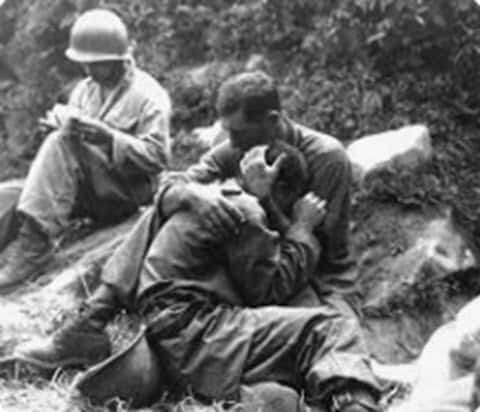
The poetry of war can be paradoxical: horror portrayed through the beauty of expression. One of the most powerful examples of this is Wilfred Owen’s poem, Dulce et Decorum Est. Owen (1893-1918) was a poet and a soldier of World War I. In a proposed preface to his book of poetry, he wrote: This book is not about heroes. English poetry is not yet fit to speak of them. Nor is it about deeds, or lands, nor anything about glory, honour, might, majesty, dominion, or power, except War. Above all I am not concerned with Poetry. My subject is War, and the pity of War.
The Poetry is in the pity. Yet these elegies are to this generation in no sense consolatory. They may be to the next. All a poet can do today is warn. That is why the true Poets must be truthful. In this poem, the pity and the beauty both are overwhelming, an elegy1 to the estimated 9.7 million lives lost in battle, and a condemnation of the hypocrisy and “jingoism”2 that contributed to that number, among them Owen, who was killed seven days before the war ended.
***
Bent double, like old beggars under sacks,
Knock-kneed, coughing like hags, we cursed through sludge,
Till on the haunting flares we turned our backs,
And towards our distant rest began to trudge.
Men marched asleep. Many had lost their boots,
But limped on, blood-shod. All went lame; all blind;
Drunk with fatigue; deaf even to the hoots
Of gas-shells dropping softly behind.
Gas! GAS! Quick, boys!—An ecstasy of fumbling
Fitting the clumsy helmets just in time,
But someone still was yelling out and stumbling
And flound’ring like a man in fire or lime.—
Dim through the misty panes and thick green light,
As under a green sea, I saw him drowning.
In all my dreams before my helpless sight,
He plunges at me, guttering, choking, drowning.
If in some smothering dreams, you too could pace
Behind the wagon that we flung him in,
And watch the white eyes writhing in his face,
His hanging face, like a devil’s sick of sin;
If you could hear, at every jolt, the blood
Come gargling from the froth-corrupted lungs,
Obscene as cancer, bitter as the cud
Of vile, incurable sores on innocent tongues,—
My friend, you would not tell with such high zest
To children ardent for some desperate glory,
The old Lie: Dulce et decorum est
Pro patria mori.
In the first stanza, the use of poetic rhyme belies the ugliness of the descriptions: young men transformed by battle into old men. This is not a heroic view: boys, basically, bent double, coughing like hags, trudging with exhaustion, half asleep. For many, blood had replaced shoes for their feet (blood-shod). The hyperboles (all..lame, all blind, drunk, deaf) emphasize the severity of their condition. Vulnerable as they had become, the stanza ends on an ominous note: Drunk with fatigue; deaf even to the hoots/Of gas-shells dropping softly behind. Shells of lethal, poisonous gas were first used in World War I, signaling the introduction of chemical warfare. As the rest of the poem describes, the effects of gas were horrific, as with all chemical warfare. Owen uses the irony of owl-like hoots and softly to mitigate the actual horror of the gas shells.
The second stanza begins with the urgent cry, Gas! GAS!, the exclamation points and capitalization underscoring the intensity of the cry. The poem moves from the lethagy of the first stanza to the turmoil of the second. The gorgeous phrase, ecstasy of fumbling, incisively describes the panic that ensues, born of the knowledge that safety comes in a very small window. And one of the men does not make it, his yelling out, stumbling, and flound’ring depicting the pain and suffering of exposure to the gas, writhing as if he is drowning in the green haze the gas produces.
The memory of this sight haunts the speaker’s dreams, made worse by his helplessness, as he watches his comrade gutter and choke in his death-throes, wildly plunging at the speaker for help. Both are victims.
The final, shattering stanza, draws the reader into the speaker’s unbearable memory (If in some smothering dreams, you too), forcing us to experience the dying soldier’s agony, as he is unceremoniously flung into a wagon–a callousness born of repetition. Forcing us to watch the white eyes writhing in his face, with the extreme suffering reflected in writhing, his face hanging off the wagon, like a devil’s sick of sin. If we, too, could hear… the the blood come gargling from his froth-corrupted lungs, bitter as… incurable sores on innocent tongues–.
The speaker then addresses us directly (my friend) with brutal admonishment for our complicity: you would not influence with such enthusiasm (zest) children, potential soldiers, desperate for their share of Glory , The Old Lie:
Dulce et decorum est /Pro patria mori.
It is sweet and proper to die for one’s country. The juxtaposition of sweet and proper with the harrowing scene above is powerfully condemnatory as an attack on conscience.
***
- a serious, melancholic poem written to lament, mourn, and honor someone who has passed away ↩︎
- Appears in media, entertainment, or rhetoric that encourages a “war-thirst,” irrational patriotism ↩︎
***
Subscribing only means that you will receive a notice when I publish a new post.
***
(Note: You can view most poems on the website, Poetry Foundation.)
(Note: My Poetry Recordings Playlist: At the very bottom of the post Is a recording. To view my entire playlist of poetry recordings, hover over “1/18” in the upper right corner, then click on ‘My Poetry Recordings Playlist:´and make selection.)
***
Scroll down for comments. **Remember that comments are public. Enter your Comment below.**
Leave a Reply