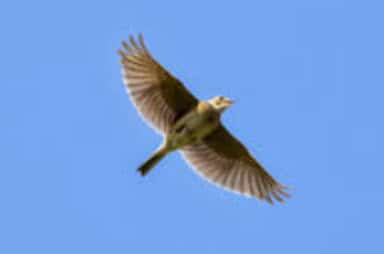
When, in Disgrace is one of the first 126 sonnets by Shakeseare which are usually attributed to a “fair youth,” not a woman. Note the absence of any gender-specific pronouns.
When, in disgrace with fortune and men’s eyes,
I all alone beweep my outcast state,
And trouble deaf heaven with my bootless cries,
And look upon myself and curse my fate,
Wishing me like to one more rich in hope,
Featured like him, like him with friends possessed,
Desiring this man’s art and that man’s scope,
With what I most enjoy contented least;
Yet in these thoughts myself almost despising,
Haply I think on thee, and then my state,
(Like to the lark at break of day arising
From sullen earth) sings hymns at heaven’s gate;
For thy sweet love remembered such wealth brings
That then I scorn to change my state with kings
This is, of course, a Shakespearean or Elizabethan Sonnet, 14 lines consisting of three quatrains (4-line stanzas) and a couplet (2-line stanza), with a rhyme scheme abab cdcd efef gg, iniambic (poetic “foot” consisting of a unstressed and stressed syllable) pentameter (5 feet per line).
Generally, this type of sonnet follows a logic of three variations (the quatrains) of concept, and a resolution (the couplet); see My mistress’ eyes are nothing like the sun. However, Shakespeare will also follow the logic of the Petrarchan or Italian Sonnet, which consists of an octet (8-line stanza) and a sestet (6-line stanza), as he does here. The first two stanzas are variations of his current depressed state; the final quatrain and couplet reverse that feeling.
The tone of the poem is immediately set in the first three words: When, in disgrace, very strong words. Disgrace implies a wrongdoing for which the subject is held accountable and in condemnation. With fortune and men’s eyes: he is condemned both by his “luck” and by men, so he is without sympathy, an outcast. To compound his situation, even heaven is unsympathetic (deaf) to his importuning (bootless–ineffective– cries), so he is completely alone, cursing his fate, which implies a degree of self-pity, as if fate is complicit. That notion is further suggested by the lack of accountability and the envy he feels for others, rather than remorse: their hopes, their looks (features), their friends, their skills (art), and their abilities (scope). This, perhaps, affects our sympathy as well. If this seems like a very harsh assessment, it is one so many of us can identify with when we feel we are a failure (“I hate myself.”). And the despair this can lead to can seem overwhelming and self-defeating (myself almost despising). There can seem to be no way out.
However, in the last six lines there is a turn (often referred to as a volta in sonnets), which ameliorates all the other feelings: love (Haply I think on thee). The heart overcomes the mind and offers solace to his condition (state). (The reversal of the usual iambic stresses–reversed here to stressed, unstressed–places an emphasis on Haply, emphasizing the volta. The next parenthetical statement, strict meter aside, is a gorgeous example of sound echoing sense: (Like to the lark at break of day arising/ From sullen earth)). When read, the rise in vocal pitch is inevitable, especially when drawn out by a-riising and the holding of one breath for arising from sullen earth and is a wonderful example of what poetry is. His love now causes him to rejoice (sings hymns at heaven’s gate). And its remembrance so fills him (such wealth brings) that now he wouldn’t change places with anyone else, for all their qualities. That then I scorn to change my state with kings. A profound reversal and testimony to love.
***
Subscribing only means that you will receive a notice when I publish a new post.
***
(Note: You can view most poems on the website, Poetry Foundation.)
(Note: My Poetry Recordings Playlist: At the very bottom of the post Is a recording. To view my entire playlist of poetry recordings, hover over “1/18” in the upper right corner, then click on ‘My Poetry Recordings Playlist:´and make selection.)
***
Scroll down for comments. **Remember that comments are public. Enter your Comment below.**
Leave a Reply