
Mark Twain:
A book of mine in which a sound heart & a deformed conscience come into collision & conscience suffers defeat.
I have never let my schooling interfere with my education.
***
It is fittingly ironic that the greatest American novel (opinion, of course) is the most misunderstood. Huck is a biting satire 1 of “sivilization,” its values and hypocrisy; as with all satire, it runs the risk of readers taking the meanings at face value and missing the irony. At the end of the novel, what Tom Sawyer sees as fun–making a free-Jim attempt a game–Twain sees as cruel. To call Huck Finn a basically humorous book misrepresents the painful-to-observe events throughout. But there is no denying that Twain’s genius with humor mitigates the gravitas2 of the intents and provides the reader with a fun, enjoyable read, full of quotable observations.
- “But I reckon I got to light out for the Territory ahead of the rest, because Aunt Sally she’s going to adopt me and sivilize me, and I can’t stand it. I been there before.” (Huck, Chapter 43).
- “I wish we could have some bad luck like this every day, Jim.” (Huck, regarding finding money after handling a snake-skin).
- “Yes; en I’s rich now, come to look at it. I owns myself, en I’s worth eight hundred dollars.” (Jim).
- “If you are with the quality, or at a funeral, or trying to go to sleep when you ain’t sleepy—if you are anywheres where it won’t do for you to scratch, why you will itch all over in upwards of a thousand places.” (Huck).
- “Jim said bees wouldn’t sting idiots; but I didn’t believe that, because I had tried them lots of times myself, and they wouldn’t sting me.” (Huck).
Another possible impediment to understanding is the use of Southern vernacular speech, specifically Pike’s County dialect, a regional, rural, and less educated form of American English. This serves a dual purpose: it provides general atmosphere (“less educated”), and it also delineates character (compare Huck’s father’s speech to Huck’s). Most importantly, it provides a contrast between our expectations based on the way Huck and Jim speak and the reality of their strength of heart, one of the story’s main ironies. It may provide some difficulty to the reader, but that can be overcome by reading aloud those passages for a clearer understanding.
***
In the first few chapters we meet the cast of characters;
- Tom Sawyer: Huck’s friend and partner in mischief. He represents the thoughtlessness of a deformed conscience, mirrored in his playful–but often hurtful–actions, such as the robber band that Tom and Huck’s friends plan to create: “So Tom got out a sheet of paper that he had wrote the oath on, and read it. It swore every boy to stick to the band, and never tell any of the secrets; and if anybody done anything to any boy in the band, whichever boy was ordered to kill that person and his family must do it, and he mustn’t eat and he mustn’t sleep till he had killed them and hacked a cross in their breasts, which was the sign of the band. And nobody that didn’t belong to the band could use that mark, and if he did he must be sued; and if he done it again he must be killed. And if anybody that belonged to the band told the secrets, he must have his throat cut, and then have his carcass burnt up and the ashes scattered all around, and his name blotted off of the list with blood and never mentioned again by the gang, but have a curse put on it and be forgot forever….Some thought it would be good to kill the families of boys that told the secrets. Tom said it was a good idea, so he took a pencil and wrote it in, and enjoying playing pranks on Jim, who is “just” a slave and a “nigger”3 and therefore simple-minded, one of the first examples of Twain’s incisive satire.
- The Widow Douglas and her sister, Miss Watson: Huck’s “foster” family, responsible for his well-being and education. Her sister, Miss Watson, a tolerable slim old maid, with goggles on, had just come to live with her, and took a set at me now with a spelling-book. She worked me middling hard for about an hour, and then the widow made her ease up. I couldn’t stood it much longer….Then she told me all about the bad place, and I said I wished I was there. She got mad then, but I didn’t mean no harm. All I wanted was to go somewheres; all I wanted was a change, I warn’t particular.
- Pap: Huck’s mean and cruel father, the epitome of a “deformed conscience.” Pap is a major foil in the novel, an enfranchised white man, loathesome and evil, contrasted with:
- Jim, a subjugated black man and slave, the epitome of a “sound heart,” who increasingly becomes Huck’s surrogate father on their journey together.
Jim is introduced in Chapter 2, and Huck and Tom play a trick on him so that he would believe that witches had visited him as he slept. Jim takes the bait, his enforced ignorance making him seem the simpleton the boys believe him to be, and he becomes famous among his peers. Jim was most ruined for a servant, because he got stuck up on account of having seen the devil and been rode by witches. That Huck and Jim’s relationship begins this way, meanly humorous and deprecating, sets the low point from which they evolve and indicates the difficulty for Huck in altering his perspective as they move down the river. The irony, of course, is that Huck is just as ignorant and superstitious:Then Miss Watson she took me in the closet and prayed, but nothing come of it. She told me to pray every day, and whatever I asked for I would get it. But it warn’t so. I tried it. Once I got a fish-line, but no hooks. It warn’t any good to me without hooks. I tried for the hooks three or four times, but somehow I couldn’t make it work. By-and-by, one day, I asked Miss Watson to try for me, but she said I was a fool. She never told me why, and I couldn’t make it out no way.
Chapter 5: Pap shows up.He was most fifty, and he looked it. His hair was long and tangled and greasy, and hung down, and you could see his eyes shining through like he was behind vines. It was all black, no gray; so was his long, mixed-up whiskers. There warn’t no color in his face, where his face showed; it was white; not like another man’s white, but a white to make a body sick, a white to make a body’s flesh crawl—a tree-toad white, a fish-belly white. There is no humor when Pap is in a scene. Although we know we are looking at a fool, he is a dangerous fool. and the way he treats Huck is nothing short of child abuse.
Pap had abandoned Huck a while ago, but we learn he is aware of the substantial wealth Huck accrued when he and Tom discovered pirate-abandoned treasure in a cave. This is why he has returned.
Pap’s cruel, depraved, abusive nature becomes the yardstick against which we measure Jim’s behaviour toward Huck. Pap may be all of those things, but he is a white man and thus enfranchised with certain privileges, protected and enabled by the hypocrisy of the “Christian” South. The judge and the widow went to law to get the court to take me away from him and let one of them be my guardian; but it was a new judge that had just come, and he didn’t know the old man; so he said courts mustn’t interfere and separate families if they could help it; said he’d druther not take a child away from its father. So Judge Thatcher and the widow had to quit on the business.
The next few chapters chronicle Pap’s attempt to ingratiate himself with the Judge, but his nature eventually betrays him. In desperation, mostly for the money, he kidnaps Huck and keeps him locked in a cabin: At first Huck enjoys his new perceived freedom: It was kind of lazy and jolly, laying off comfortable all day, smoking and fishing, and no books nor study. But Pap is Pap. I t was pretty good times up in the woods there, take it all around. But by-and-by pap got too handy with his hick’ry, and I couldn’t stand it. I was all over welts. He got to going away so much, too, and locking me in. Once he locked me in and was gone three days. It was dreadful lonesome. Between the humor, the layering of satire, and Huck’s simple language, sometimes the gravity of what we are reading takes a while to sink in. In effect, this passage has described extensive physical abuse and neglect. It is not funny. And always present is the irony of Pap’s privileged status as a white man, in spite of his nature. We see some of Twain’s most biting satire in a Pap “soliloquy”:
“Call this a govment! why, just look at it and see what it’s like. Here’s the law a-standing ready to take a man’s son away from him—a man’s own son, which he has had all the trouble and all the anxiety and all the expense of raising. Yes, just as that man has got that son raised at last, and ready to go to work and begin to do suthin’ for him and give him a rest, the law up and goes for him. And they call that govment! That ain’t all, nuther. The law backs that old Judge Thatcher up and helps him to keep me out o’ my property. Here’s what the law does: The law takes a man worth six thousand dollars and up’ards, and jams him into an old trap of a cabin like this, and lets him go round in clothes that ain’t fitten for a hog. They call that govment! A man can’t get his rights in a govment like this. Sometimes I’ve a mighty notion to just leave the country for good and all. Yes, and I told ’em so; I told old Thatcher so to his face. Lots of ’em heard me, and can tell what I said. Says I, for two cents I’d leave the blamed country and never come a-near it agin. Them’s the very words. I says look at my hat—if you call it a hat—but the lid raises up and the rest of it goes down till it’s below my chin, and then it ain’t rightly a hat at all, but more like my head was shoved up through a jint o’ stove-pipe. Look at it, says I—such a hat for me to wear—one of the wealthiest men in this town if I could git my rights.
“Oh, yes, this is a wonderful govment, wonderful. Why, looky here. There was a free nigger there from Ohio—a mulatter, most as white as a white man. He had the whitest shirt on you ever see, too, and the shiniest hat; and there ain’t a man in that town that’s got as fine clothes as what he had; and he had a gold watch and chain, and a silver-headed cane—the awfulest old gray-headed nabob in the State. And what do you think? They said he was a p’fessor in a college, and could talk all kinds of languages, and knowed everything. And that ain’t the wust. They said he could vote when he was at home. Well, that let me out. Thinks I, what is the country a-coming to? It was ’lection day, and I was just about to go and vote myself if I warn’t too drunk to get there; but when they told me there was a State in this country where they’d let that nigger vote, I drawed out. I says I’ll never vote agin. Them’s the very words I said; they all heard me; and the country may rot for all me—I’ll never vote agin as long as I live. And to see the cool way of that nigger—why, he wouldn’t a give me the road if I hadn’t shoved him out o’ the way. I says to the people, why ain’t this nigger put up at auction and sold?—that’s what I want to know. And what do you reckon they said? Why, they said he couldn’t be sold till he’d been in the State six months, and he hadn’t been there that long yet. There, now—that’s a specimen. They call that a govment that can’t sell a free nigger till he’s been in the State six months. Here’s a govment that calls itself a govment, and lets on to be a govment, and thinks it is a govment, and yet’s got to set stock-still for six whole months before it can take a hold of a prowling, thieving, infernal, white-shirted free nigger, and—”
Huck finally manages to escape, using his native intelligence to stage his disappearance to look like he had been killed. He finds a canoe, thus initiating the “picaresque”4 nature of Huck’s adventures on the river.
Chapter 8 is a turning point in the novel:
But by-and-by, sure enough, I catched a glimpse of fire away through the trees. I went for it, cautious and slow. By-and-by I was close enough to have a look, and there laid a man on the ground. It most give me the fan-tods. He had a blanket around his head, and his head was nearly in the fire. I set there behind a clump of bushes, in about six foot of him, and kept my eyes on him steady. It was getting gray daylight now. Pretty soon he gapped and stretched himself and hove off the blanket, and it was Miss Watson’s Jim! I bet I was glad to see him. I says:
“Hello, Jim!” and skipped out.
He bounced up and stared at me wild. Then he drops down on his knees, and puts his hands together and says:
“Doan’ hurt me—don’t! I hain’t ever done no harm to a ghos’. I alwuz liked dead people, en done all I could for ’em. You go en git in de river agin, whah you b’longs, en doan’ do nuffn to Ole Jim, ’at ’uz awluz yo’ fren’.”
Well, I warn’t long making him understand I warn’t dead. I was ever so glad to see Jim. I warn’t lonesome now. I told him I warn’t afraid of him telling the people where I was. I talked along, but he only set there and looked at me; never said nothing. Then I says:
“It’s good daylight. Le’s get breakfast. Make up your camp fire good.”
….
“Why, how long you been on the island, Jim?”
“I come heah de night arter you’s killed.”
“What, all that time?”
“Yes—indeedy.”
….
Then I says:
“How do you come to be here, Jim, and how’d you get here?”
He looked pretty uneasy, and didn’t say nothing for a minute. Then he says:
“Maybe I better not tell.”
“Why, Jim?”
“Well, dey’s reasons. But you wouldn’ tell on me ef I uz to tell you, would you, Huck?”
“Blamed if I would, Jim.”
“Well, I b’lieve you, Huck. I—I run off.”
“Jim!”
“But mind, you said you wouldn’ tell—you know you said you wouldn’ tell, Huck.”
“Well, I did. I said I wouldn’t, and I’ll stick to it. Honest injun, I will. People would call me a low-down Abolitionist and despise me for keeping mum—but that don’t make no difference. I ain’t a-going to tell, and I ain’t a-going back there, anyways. So, now, le’s know all about it.”
“Well, you see, it ’uz dis way. Ole missus—dat’s Miss Watson—she pecks on me all de time, en treats me pooty rough, but she awluz said she wouldn’ sell me down to Orleans. But I noticed dey wuz a nigger trader roun’ de place considable lately, en I begin to git oneasy. Well, one night I creeps to de do’ pooty late, en de do’ warn’t quite shet, en I hear old missus tell de widder she gwyne to sell me down to Orleans, but she didn’ want to, but she could git eight hund’d dollars for me, en it ’uz sich a big stack o’ money she couldn’ resis’. De widder she try to git her to say she wouldn’ do it, but I never waited to hear de res’. I lit out mighty quick, I tell you.
There are hints throughout this passage that Huck’s loneliness and Jim’s humanity will over-ride society’s hold on Huck’s conscience and heart.
From this point the novel becomes increasingly episodic: The Adventures of Huckleberry Finn. Concurrently, Huck and Jim’s relationship evolves, as does Huck’s “heart.”
But Huck is still Huck and plays another “trick” on Jim, placing a dead rattlesnake next to him as he sleeps, However, the snake’s mate arrives and bites Jim, who survives, but only after four days of recovery. I warn’t going to let Jim find out it was all my fault, not if I could help it.
They come across a dead man who had been shot in the back. Jim doesn’t allow Huck to look at him. This has consequences.
They survive by stealing as they go, exercing their relative morality: Mornings before daylight I slipped into cornfields and borrowed a watermelon, or a mushmelon, or a punkin, or some new corn, or things of that kind. Pap always said it warn’t no harm to borrow things if you was meaning to pay them back some time; but the widow said it warn’t anything but a soft name for stealing, and no decent body would do it. Jim said he reckoned the widow was partly right and pap was partly right; so the best way would be for us to pick out two or three things from the list and say we wouldn’t borrow them any more—then he reckoned it wouldn’t be no harm to borrow
Episode: Huck wants to find out what is transpiring on land, so he disguises himself as a girl and visits a homestead where he learns that there is a $300 reward out for the capture of Jim, who is suspected of killing Huck, and a $200 reward for Pap for the same reason. Huck also learns that the smoke from their campfire has been spotted, so they have to leave.
Episode: Jim and Huck continue down stream, traveling mostly by night to avoid detection. Five nights past St. Louis, they come across a steamboat that’s run aground on a rock. Against Jim’s better judgment, they tie their raft to the steamboat and go aboard. Once on the boat, Huck hears two criminals scheming to kill a third. When Huck manages to find Jim, Jim tells him the raft has floated away. After recovering from his shock, Huck helps Jim find the criminals’ skiff. Once they find it, they cut it loose and float down the river in search of their raft. Huck feels bad about leaving the criminals to drown on the steamboat (Now was the first time that I begun to worry about the men—I reckon I hadn’t had time to before. I begun to think how dreadful it was, even for murderers, to be in such a fix. I says to myself, there ain’t no telling but I might come to be a murderer myself yet, and then how would I like it? ), so he finds a ferryboat and tells the captain that there are people on the steamboat that need saving. As Huck makes his way back to Jim and the skiff, he sees the steamboat float by (with no survivors). Well, before long, here comes the wreck, dim and dusky, sliding along down! A kind of cold shiver went through me, and then I struck out for her. She was very deep, and I see in a minute there warn’t much chance for anybody being alive in her. I pulled all around her and hollered a little, but there wasn’t any answer; all dead still. I felt a little bit heavy-hearted about the gang, but not much. He finds Jim, they sink the skiff, and sleep like dead people. No second thoughts.
Chapter 15 marks a major turning point in the novel. It is a testimony to Twain’s ability to turn humor into pathos, in a very moving scene between Huck and Jim.
At this point a sight-obscuring fog sets in, and Huck is separated from the raft. After a long while and a sleep, Then I see another speck, and chased that; then another, and this time I was right. It was the raft.
But yet again, Huck is still Huck, and he decides to play another trick on Jim.
I made fast and laid down under Jim’s nose on the raft, and began to gap, and stretch my fists out against Jim, and says:
“Hello, Jim, have I been asleep? Why didn’t you stir me up?”
“Goodness gracious, is dat you, Huck? En you ain’ dead—you ain’ drownded—you’s back agin? It’s too good for true, honey, it’s too good for true. Lemme look at you chile, lemme feel o’ you. No, you ain’ dead! you’s back agin, ’live en soun’, jis de same ole Huck—de same ole Huck, thanks to goodness!”
“What’s the matter with you, Jim? You been a-drinking?”
“Drinkin’? Has I ben a-drinkin’? Has I had a chance to be a-drinkin’?”
“Well, then, what makes you talk so wild?”
“How does I talk wild?”
“How? Why, hain’t you been talking about my coming back, and all that stuff, as if I’d been gone away?”
“Huck—Huck Finn, you look me in de eye; look me in de eye. Hain’t you ben gone away?”
“Gone away? Why, what in the nation do you mean? I hain’t been gone anywheres. Where would I go to?”
“Well, looky here, boss, dey’s sumf’n wrong, dey is. Is I me, or who is I? Is I heah, or whah is I? Now dat’s what I wants to know.”
“Well, I think you’re here, plain enough, but I think you’re a tangle-headed old fool, Jim.”
“I is, is I? Well, you answer me dis: Didn’t you tote out de line in de canoe fer to make fas’ to de tow-head?”
“No, I didn’t. What tow-head? I hain’t see no tow-head.”
“You hain’t seen no tow-head? Looky here, didn’t de line pull loose en de raf’ go a-hummin’ down de river, en leave you en de canoe behine in de fog?”
“What fog?”
“Why, de fog!—de fog dat’s been aroun’ all night. En didn’t you whoop, en didn’t I whoop, tell we got mix’ up in de islands en one un us got los’ en t’other one was jis’ as good as los’, ’kase he didn’ know whah he wuz? En didn’t I bust up agin a lot er dem islands en have a turrible time en mos’ git drownded? Now ain’ dat so, boss—ain’t it so? You answer me dat.”
“Well, this is too many for me, Jim. I hain’t seen no fog, nor no islands, nor no troubles, nor nothing. I been setting here talking with you all night till you went to sleep about ten minutes ago, and I reckon I done the same. You couldn’t a got drunk in that time, so of course you’ve been dreaming.”
“Dad fetch it, how is I gwyne to dream all dat in ten minutes?”
“Well, hang it all, you did dream it, because there didn’t any of it happen.”
“But, Huck, it’s all jis’ as plain to me as—”
“It don’t make no difference how plain it is; there ain’t nothing in it. I know, because I’ve been here all the time.”
Jim didn’t say nothing for about five minutes, but set there studying over it. Then he says:
“Well, den, I reck’n I did dream it, Huck.
Jim’s basic, simple goodness is revealed in his joy that Huck is still alive, a joy which also reveals his deepening feelings for Huck. He is willing to suspend his disbelief, with great difficulty, rather than doubt Huck’s word. The decency of this “ignorant slave” is moving. Huck, of course, is blind to the significance of Jim’s feelings and perpetuates the “trick.” The complete insensitivity of this “superior” white boy is disturbing and off-putting, if not cruel. Jim has gained our sympathy; Huck has lost it.
Our sympathies in both directions continue to deepen:
“Oh, well, that’s all interpreted well enough as far as it goes, Jim,” I says; “but what does these things stand for?”
It was the leaves and rubbish on the raft and the smashed oar. You could see them first-rate now.
Jim looked at the trash, and then looked at me, and back at the trash again. He had got the dream fixed so strong in his head that he couldn’t seem to shake it loose and get the facts back into its place again right away. But when he did get the thing straightened around he looked at me steady without ever smiling, and says:
“What do dey stan’ for? I’se gwyne to tell you. When I got all wore out wid work, en wid de callin’ for you, en went to sleep, my heart wuz mos’ broke bekase you wuz los’, en I didn’ k’yer no’ mo’ what become er me en de raf’. En when I wake up en fine you back agin, all safe en soun’, de tears come, en I could a got down on my knees en kiss yo’ foot, I’s so thankful. En all you wuz thinkin’ ’bout wuz how you could make a fool uv ole Jim wid a lie. Dat truck dah is trash; en trash is what people is dat puts dirt on de head er dey fren’s en makes ’em ashamed.”
The profound power of Jim’s words brings the story to a breath-holding standstill. The ball is in Huck’s court. The novel will proceed in one of two ways from here: whether “Huck is still Huck,” or whether Jim’s decency and dignity have any effect on him. This would produce two entirely different books.
Then he got up slow and walked to the wigwam, and went in there without saying anything but that. But that was enough. It made me feel so mean I could almost kissed his foot to get him to take it back.
It was fifteen minutes before I could work myself up to go and humble myself to a nigger; but I done it, and I warn’t ever sorry for it afterwards, neither. I didn’t do him no more mean tricks, and I wouldn’t done that one if I’d a knowed it would make him feel that way.
Not to overstate, but is this a transformed Huck? How and if that concept develops is the “stuff” of the rest of the novel. That ambiguity is soon made apparent:
Jim talked out loud all the time while I was talking to myself. He was saying how the first thing he would do when he got to a free State he would go to saving up money and never spend a single cent, and when he got enough he would buy his wife, which was owned on a farm close to where Miss Watson lived; and then they would both work to buy the two children, and if their master wouldn’t sell them, they’d get an Ab’litionist to go and steal them.
It most froze me to hear such talk. He wouldn’t ever dared to talk such talk in his life before. Just see what a difference it made in him the minute he judged he was about free. It was according to the old saying, “Give a nigger an inch and he’ll take an ell.” Thinks I, this is what comes of my not thinking. Here was this nigger, which I had as good as helped to run away, coming right out flat-footed and saying he would steal his children—children that belonged to a man I didn’t even know; a man that hadn’t ever done me no harm.
I was sorry to hear Jim say that, it was such a lowering of him. My conscience got to stirring me up hotter than ever, until at last I says to it, “Let up on me—it ain’t too late yet—I’ll paddle ashore at the first light and tell.” I felt easy and happy and light as a feather right off. All my troubles was gone. I went to looking out sharp for a light, and sort of singing to myself. By-and-by one showed. Jim sings out:
“We’s safe, Huck, we’s safe! Jump up and crack yo’ heels! Dat’s de good ole Cairo at las’, I jis knows it!”
I says:
“I’ll take the canoe and go and see, Jim. It mightn’t be, you know.”
He jumped and got the canoe ready, and put his old coat in the bottom for me to set on, and give me the paddle; and as I shoved off, he says:
“Pooty soon I’ll be a-shout’n’ for joy, en I’ll say, it’s all on accounts o’ Huck; I’s a free man, en I couldn’t ever ben free ef it hadn’ ben for Huck; Huck done it. Jim won’t ever forgit you, Huck; you’s de bes’ fren’ Jim’s ever had; en you’s de only fren’ ole Jim’s got now.”
I was paddling off, all in a sweat to tell on him; but when he says this, it seemed to kind of take the tuck all out of me. I went along slow then, and I warn’t right down certain whether I was glad I started or whether I warn’t. When I was fifty yards off, Jim says:
“Dah you goes, de ole true Huck; de on’y white genlman dat ever kep’ his promise to ole Jim.”
Well, I just felt sick. But I says, I got to do it—I can’t get out of it. Right then along comes a skiff with two men in it with guns, and they stopped and I stopped. One of them says:
“What’s that yonder?”
“A piece of a raft,” I says.
“Do you belong on it?”
“Yes, sir.”
“Any men on it?”
“Only one, sir.”
“Well, there’s five niggers run off to-night up yonder, above the head of the bend. Is your man white or black?”
I didn’t answer up prompt. I tried to, but the words wouldn’t come. I tried for a second or two to brace up and out with it, but I warn’t man enough—hadn’t the spunk of a rabbit. I see I was weakening; so I just give up trying, and up and says:
“He’s white.
The “collision” referred to in Twain’s statement–A book of mine in which a sound heart & a deformed conscience come into collision & conscience suffers defeat–becomes increasingly clear because we see Huck grappling with indecision, his heart at war with what he has been taught. And maybe for the first time, our hearts go out to this boy who does the right thing in spite of being convinced that it is the “wrong” thing.
They went off and I got aboard the raft, feeling bad and low, because I knowed very well I had done wrong, and I see it warn’t no use for me to try to learn to do right; a body that don’t get started right when he’s little ain’t got no show—when the pinch comes there ain’t nothing to back him up and keep him to his work, and so he gets beat. Then I thought a minute, and says to myself, hold on; s’pose you’d a done right and give Jim up, would you felt better than what you do now? No, says I, I’d feel bad—I’d feel just the same way I do now. Well, then, says I, what’s the use you learning to do right when it’s troublesome to do right and ain’t no trouble to do wrong, and the wages is just the same? I was stuck. I couldn’t answer that. So I reckoned I wouldn’t bother no more about it, but after this always do whichever come handiest at the time.
The episodic nature of the novel continues, with scathing satire of the “sivilization” Huck encounters.
Episode: The Feud. A violent, decades-long, and senseless blood rivalry between two wealthy, aristocratic Southern families–the Grangerfords and the Shephersons. Neither family remembers how the feud began, yet they continue to kill each other, including a boy that Huck befriends, reflecting a toxic, irrational, and ironic cycle of violence and Southern honor that causes Huck to flee in disgust.
All of a sudden, bang! bang! bang! goes three or four guns—the men had slipped around through the woods and come in from behind without their horses! The boys jumped for the river—both of them hurt—and as they swum down the current the men run along the bank shooting at them and singing out, “Kill them, kill them!” It made me so sick I most fell out of the tree. I ain’t a-going to tell all that happened—it would make me sick again if I was to do that. I wished I hadn’t ever come ashore that night to see such things. I ain’t ever going to get shut of them—lots of times I dream about them.
Episode: An extended section in which Huck and Jim meet the “King” a.k.a. ‘le Dauphin,’ erstwhile king of France, and the “Duke,” two completely amoral conmen who fleece townspeople with complete disregard for thought or feeling about the consequences of their actions. They are the ultimate manifestation of the thoughtlessness and callowness of Tom Sawyer–and Huck–earlier in the book and force Huck to re-evaluate “tricks.” Well, if ever I struck anything like it, I’m a nigger. It was enough to make a body ashamed of the human race.
Huck and Jim meet a family whose goodness–especially the daughter, Mary Jane (Laying her silky hand on mine in that kind of a way that I said I would die first)–touches Huck, so when the King and the Duke manage to swindle them/her out of their inheritance–including cash and property (i.e. also slaves), they have finally gone too far for Huck. And for the first time, Huck sees slaves and whites who care for each other.
So the next day after the funeral, along about noon-time, the girls’ joy got the first jolt. A couple of nigger traders come along, and the king sold them the niggers reasonable, for three-day drafts as they called it, and away they went, the two sons up the river to Memphis, and their mother down the river to Orleans. I thought them poor girls and them niggers would break their hearts for grief; they cried around each other, and took on so it most made me down sick to see it. The girls said they hadn’t ever dreamed of seeing the family separated or sold away from the town. I can’t ever get it out of my memory, the sight of them poor miserable girls and niggers hanging around each other’s necks and crying.
Huck determines to have the cash and the slaves returned to Mary Jane and her family.
By-and-by it was getting-up time. So I come down the ladder and started for down-stairs; but as I come to the girls’ room the door was open, and I see Mary Jane setting by her old hair trunk, which was open and she’d been packing things in it—getting ready to go to England. But she had stopped now with a folded gown in her lap, and had her face in her hands, crying. I felt awful bad to see it; of course anybody would. I went in there and says:
“Miss Mary Jane, you can’t a-bear to see people in trouble, and I can’t—most always. Tell me about it.”
So she done it. And it was the niggers—I just expected it. She said the beautiful trip to England was most about spoiled for her; she didn’t know how she was ever going to be happy there, knowing the mother and the children warn’t ever going to see each other no more—and then busted out bitterer than ever, and flung up her hands, and says:
“Oh, dear, dear, to think they ain’t ever going to see each other any more!”
“But they will—and inside of two weeks—and I know it!” says I.
Laws, it was out before I could think! And before I could budge she throws her arms around my neck and told me to say it again, say it again, say it again!
I see I had spoke too sudden and said too much, and was in a close place. I asked her to let me think a minute; and she set there, very impatient and excited and handsome, but looking kind of happy and eased-up, like a person that’s had a tooth pulled out. So I went to studying it out. I says to myself, I reckon a body that ups and tells the truth when he is in a tight place is taking considerable many resks, though I ain’t had no experience, and can’t say for certain; but it looks so to me, anyway; and yet here’s a case where I’m blest if it don’t look to me like the truth is better and actuly safer than a lie. I must lay it by in my mind, and think it over some time or other, it’s so kind of strange and unregular. I never see nothing like it. Well, I says to myself at last, I’m a-going to chance it; I’ll up and tell the truth this time, though it does seem most like setting down on a kag of powder and touching it off just to see where you’ll go to.
Huck’s heart and civilized conscience continue to “grapple,” but it is becoming clear–to us if not to Huck–which side will win.
Huck manages to “steal” the cash away from the two conmen and hide it in the deceased father’s coffin, about to be buried the next day. He finally reveals his plans to Mary Jane, including why the sale of her slaves won’t go through at auction:
Just let the auction go right along, and don’t worry. Nobody don’t have to pay for the things they buy till a whole day after the auction on accounts of the short notice, and they ain’t going out of this till they get that money; and the way we’ve fixed it the sale ain’t going to count, and they ain’t going to get no money. It’s just like the way it was with the niggers—it warn’t no sale, and the niggers will be back before long. Why, they can’t collect the money for the niggers yet—they’re in the worst kind of a fix, Miss Mary Jane.
Huck’s previously misapplied cleverness finally turns to useful intelligence, yet another step in his “evolution.”
Along with heretofore unknown feelings he now has, toward Mary Jane:
I see the water come into her eyes, too; and she shook me by the hand, hard, and says:
“Good-bye. I’m going to do everything just as you’ve told me; and if I don’t ever see you again, I sha’n’t ever forget you and I’ll think of you a many and a many a time, and I’ll pray for you, too!”—and she was gone.
Pray for me! I reckoned if she knowed me she’d take a job that was more nearer her size. But I bet she done it, just the same—she was just that kind. She had the grit to pray for Judus if she took the notion—there warn’t no back-down to her, I judge. You may say what you want to, but in my opinion she had more sand in her than any girl I ever see; in my opinion she was just full of sand. It sounds like flattery, but it ain’t no flattery. And when it comes to beauty—and goodness, too—she lays over them all. I hain’t ever seen her since that time that I see her go out of that door; no, I hain’t ever seen her since, but I reckon I’ve thought of her a many and a many a million times, and of her saying she would pray for me; and if ever I’d a thought it would do any good for me to pray for her, blamed if I wouldn’t a done it or bust.
There follows the most famous passage of the book, precipitated by Huck’s learning that the conmen had sold Jim for forty dollars (difficult to ignore the relation to Judas’s thirty pieces of silver).
I went to the raft, and set down in the wigwam to think. But I couldn’t come to nothing. I thought till I wore my head sore, but I couldn’t see no way out of the trouble. After all this long journey, and after all we’d done for them scoundrels, here it was all come to nothing, everything all busted up and ruined, because they could have the heart to serve Jim such a trick as that, and make him a slave again all his life, and amongst strangers, too, for forty dirty dollars.
Once I said to myself it would be a thousand times better for Jim to be a slave at home where his family was, as long as he’d got to be a slave, and so I’d better write a letter to Tom Sawyer and tell him to tell Miss Watson where he was. But I soon give up that notion for two things: she’d be mad and disgusted at his rascality and ungratefulness for leaving her, and so she’d sell him straight down the river again; and if she didn’t, everybody naturally despises an ungrateful nigger, and they’d make Jim feel it all the time, and so he’d feel ornery and disgraced. And then think of me! It would get all around that Huck Finn helped a nigger to get his freedom; and if I was ever to see anybody from that town again I’d be ready to get down and lick his boots for shame. That’s just the way: a person does a low-down thing, and then he don’t want to take no consequences of it. Thinks as long as he can hide it, it ain’t no disgrace. That was my fix exactly. The more I studied about this, the more my conscience went to grinding me, and the more wicked and low-down and ornery I got to feeling. And at last, when it hit me all of a sudden that here was the plain hand of Providence slapping me in the face and letting me know my wickedness was being watched all the time from up there in heaven, whilst I was stealing a poor old woman’s nigger that hadn’t ever done me no harm, and now was showing me there’s One that’s always on the lookout, and ain’t a-going to allow no such miserable doings to go only just so fur and no further, I most dropped in my tracks I was so scared. Well, I tried the best I could to kinder soften it up somehow for myself by saying I was brung up wicked, and so I warn’t so much to blame; but something inside of me kept saying, “There was the Sunday-school, you could a gone to it; and if you’d a done it they’d a learnt you there that people that acts as I’d been acting about that nigger goes to everlasting fire.”
The irony here is incisive. Almost everything Huck says is the opposite of what is true and demonstrates sadly how sivilization has warped and deformed his conscience, causing him to be painfully burdened with guilt, for doing the right thing.
It made me shiver. And I about made up my mind to pray, and see if I couldn’t try to quit being the kind of a boy I was and be better. So I kneeled down. But the words wouldn’t come. Why wouldn’t they? It warn’t no use to try and hide it from Him. Nor from me, neither. I knowed very well why they wouldn’t come. It was because my heart warn’t right; it was because I warn’t square; it was because I was playing double. I was letting on to give up sin, but away inside of me I was holding on to the biggest one of all. I was trying to make my mouth say I would do the right thing and the clean thing, and go and write to that nigger’s owner and tell where he was; but deep down in me I knowed it was a lie, and He knowed it. You can’t pray a lie—I found that out.
The moral quandary Huck exhibits here is a far cry from the morally blind Huck we were used to earlier in the book. It is worth noting that this evolution could only occur on the river, away from society, the river providing a kind of symbolic purification.
So I was full of trouble, full as I could be; and didn’t know what to do. At last I had an idea; and I says, I’ll go and write the letter—and then see if I can pray. Why, it was astonishing, the way I felt as light as a feather right straight off, and my troubles all gone. So I got a piece of paper and a pencil, all glad and excited, and set down and wrote:
Miss Watson, your runaway nigger Jim is down here two mile below Pikesville, and Mr. Phelps has got him and he will give him up for the reward if you send.
HUCK FINN
I felt good and all washed clean of sin for the first time I had ever felt so in my life, and I knowed I could pray now. But I didn’t do it straight off, but laid the paper down and set there thinking—thinking how good it was all this happened so, and how near I come to being lost and going to hell. And went on thinking. And got to thinking over our trip down the river; and I see Jim before me all the time: in the day and in the night-time, sometimes moonlight, sometimes storms, and we a-floating along, talking and singing and laughing. But somehow I couldn’t seem to strike no places to harden me against him, but only the other kind. I’d see him standing my watch on top of his’n, ’stead of calling me, so I could go on sleeping; and see him how glad he was when I come back out of the fog; and when I come to him again in the swamp, up there where the feud was; and such-like times; and would always call me honey, and pet me and do everything he could think of for me, and how good he always was; and at last I struck the time I saved him by telling the men we had small-pox aboard, and he was so grateful, and said I was the best friend old Jim ever had in the world, and the only one he’s got now; and then I happened to look around and see that paper.
It was a close place. I took it up, and held it in my hand. I was a-trembling, because I’d got to decide, forever, betwixt two things, and I knowed it. I studied a minute, sort of holding my breath, and then says to myself:
“All right, then, I’ll go to hell”—and tore it up.
It would be hard to over-emphasize the significance of that last sentence. It is now clear that the “sound heart” has prevailed over the “deformed conscience,” but to what an enormous degree. Huck is a Southern Christian, willingly giving up his chance for salvation rather than betray his friend, a slave no less. This is not a boyish, impusive decision, but one Huck clearly agonizes over.
It was awful thoughts and awful words, but they was said. And I let them stay said; and never thought no more about reforming. I shoved the whole thing out of my head, and said I would take up wickedness again, which was in my line, being brung up to it, and the other warn’t. And for a starter I would go to work and steal Jim out of slavery again; and if I could think up anything worse, I would do that, too; because as long as I was in, and in for good, I might as well go the whole hog.
The satire is scathing here. This boy’s conscience has been so “deformed” by his society his perception of good and evil has been perverted. While our sympathies have now been altered in our admiration of Huck’s doing the right thing–a far cry from the Huck who thought nothing of playing “tricks” on Jim–he is filled with self-condemnation. Oh, he is still Huck–“Now I struck an idea, and fetched it out: ‘It warn’t the grounding—that didn’t keep us back but a little. We blowed out a cylinder-head.’ ‘Good gracious! anybody hurt?’ ‘No’m. Killed a nigger.’”— as he seems ultimately to be able to brush off his concerns, and as we soon see he can still be influenced by Tom Sawyer, but there is no denying that his good heart has triumphed when it comes to Jim.
Further in the narrative Huck sees that the King and Duke have finally been brought to justice–though typically cruel, a form of torture:
As we struck into the town and up through the middle of it—it was as much as half-after eight, then—here comes a raging rush of people with torches, and an awful whooping and yelling, and banging tin pans and blowing horns; and we jumped to one side to let them go by; and as they went by I see they had the king and the duke astraddle of a rail—that is, I knowed it was the king and the duke, though they was all over tar and feathers, and didn’t look like nothing in the world that was human—just looked like a couple of monstrous big soldier-plumes. Well, it made me sick to see it; and I was sorry for them poor pitiful rascals, it seemed like I couldn’t ever feel any hardness against them any more in the world. It was a dreadful thing to see. Human beings can be awful cruel to one another.
This finally closes the King and Duke episode.
We also learn that the dead man that Huck and Jim had encountered on the river, and that Jim had shielded from Huck, was Pap, so that closes that issue.
***
Interlude: Earlier there had been a scene between Huck and Jim, touching on Jim’s family life. In stressing Jim’s essential humanity, it provides a foil for the episode that closes the book.
Huck: But this time I somehow got to talking to him about
his wife and young ones; and by and by he says:
Jim: “What makes me feel so bad dis time ‘uz because I
hear something over yonder on de bank like a whack, er
a slam, while ago, en it remind me er de time I treat my
little ‘Lizabeth so ornery. She warn’t on’y ’bout fo’
year ole, en she took de sk’yarlet fever, en had a
powful rough spell; but she got well, en one day she
was a-stannin’ aroun’, en I says to her, I says:
“‘Shut the door‘.’
“She didn’t do it; jis’ stood dah, kind of smilin’ up
at me. It make me mad; en I says agin, mighty loud,
I says:
“‘Doan’ you hear me? Shet de do’!’
“She jis stood de same way, kiner smilin’ up. I
was a-boilin‘! I says:
“‘I bet I MAKE you mind!’
“En wid dat I fetch’ her a slap upside de head dat
sent her a-sprawlin’. Den I went into de yuther
room, en ‘uz gone ’bout ten minutes; en when I
come back dah was dat door a-stannin’ open YIT, en
dat chile stannin’ mos’ right in it, a-lookin’ down and
mournin’, en de tears runnin’ down. My, but I WUZ
mad! I was going for de chile, but jis’ den — it
was a door dat open inwards— jis’ den, ‘long come de
wind en slam it to, behine de chile, ker-BLAM! — en my
lan’, de chile never move’! My breath mos’ hop outer
me; en I feel so — so — I doan’ know HOW I feel. I
creep out, all a-tremblin’, en creep aroun’ en open de
door easy en slow, en poke my head in behine de chile,
sof’ en still, en all uv a sudden I says POW! jis’ as
loud as I could yell. SHE NEVER BUDGE! Oh, Huck, I
bust out a-cryin’ en grab her up in my arms, en say,
‘Oh, de poor little thing! De Lord God Amighty
fogive poor ole Jim, cause he never going to fogive his-
self as long’s he live!’ Oh, she was plumb deaf en
dumb, Huck, plumb deaf en dumb — en I’d ben a-
treat’n her so!”
***
Episode: “Saving” Jim; the final episode.
The remainder of the book is mostly taken up, after Huck is reunited with Tom Sawyer, with Tom’s elaborate plans for Jim’s escape. Typical of Tom, he turns it into an elaborate charade, an extended “trick.” Huck tries to argue that they should just do something quick and effective, but, as usual, Tom domineers. He is forcing Huck back into their old ways, before Huck’s “evolution.” Tom, though usually not intentionally cruel, is thoughtless and selfish, another kind of “warped” societal influence. He is unconcerned for Jim as a person seeking freedom; Jim is just a tool for fun.
As part of that fun, Tom convinces Huck to write “nonmous” letters in blood, warning the Phelps family that trouble is brewing, making escape a more dangerous, and thereore exciting, “game.” Tom’s machinations notwithstanding, Huck, Tom and Jim manage to escape. But as they go through a fence, Tom’s pant catches, and the sound it makes catches the attention of the group of men that had gathered at the Phelps’s in response to the “nonmous” letters, and one of the men starts shooting, hitting Tom in the leg. Tom wants to keep going, but Huck and Jim–in spite of the threat to a successful escape–insist on finding a doctor. Eventually the doctor returns with Tom, treated for his injury, and Jim is again imprisoned, in spite of the doctor’s praises .
I followed the men to see what they was going to do with Jim; and the old doctor and Uncle Silas followed after Tom into the house. The men was very huffy, and some of them wanted to hang Jim for an example to all the other niggers around there, so they wouldn’t be trying to run away like Jim done, and making such a raft of trouble, and keeping a whole family scared most to death for days and nights. But the others said, don’t do it, it wouldn’t answer at all; he ain’t our nigger, and his owner would turn up and make us pay for him, sure. So that cooled them down a little, because the people that’s always the most anxious for to hang a nigger that hain’t done just right is always the very ones that ain’t the most anxious to pay for him when they’ve got their satisfaction out of him.
They cussed Jim considerble, though, and give him a cuff or two side the head once in a while, but Jim never said nothing, and he never let on to know me, and they took him to the same cabin, and put his own clothes on him, and chained him again, and not to no bed-leg this time, but to a big staple drove into the bottom log, and chained his hands, too, and both legs, and said he warn’t to have nothing but bread and water to eat after this till his owner come, or he was sold at auction because he didn’t come in a certain length of time, and filled up our hole, and said a couple of farmers with guns must stand watch around about the cabin every night, and a bulldog tied to the door in the daytime; and about this time they was through with the job and was tapering off with a kind of generl good-bye cussing, and then the old doctor comes and takes a look, and says:
“Don’t be no rougher on him than you’re obleeged to, because he ain’t a bad nigger. When I got to where I found the boy I see I couldn’t cut the bullet out without some help, and he warn’t in no condition for me to leave to go and get help; and he got a little worse and a little worse, and after a long time he went out of his head, and wouldn’t let me come a-nigh him any more, and said if I chalked his raft he’d kill me, and no end of wild foolishness like that, and I see I couldn’t do anything at all with him; so I says, I got to have help somehow; and the minute I says it out crawls this nigger from somewheres and says he’ll help, and he done it, too, and done it very well. Of course I judged he must be a runaway nigger, and there I was! and there I had to stick right straight along all the rest of the day and all night. It was a fix, I tell you! I had a couple of patients with the chills, and of course I’d of liked to run up to town and see them, but I dasn’t, because the nigger might get away, and then I’d be to blame; and yet never a skiff come close enough for me to hail. So there I had to stick plumb until daylight this morning; and I never see a nigger that was a better nuss or faithfuller, and yet he was risking his freedom to do it, and was all tired out, too, and I see plain enough he’d been worked main hard lately. I liked the nigger for that; I tell you, gentlemen, a nigger like that is worth a thousand dollars—and kind treatment, too. I had everything I needed, and the boy was doing as well there as he would a done at home—better, maybe, because it was so quiet; but there I was, with both of ’m on my hands, and there I had to stick till about dawn this morning; then some men in a skiff come by, and as good luck would have it the nigger was setting by the pallet with his head propped on his knees sound asleep; so I motioned them in quiet, and they slipped up on him and grabbed him and tied him before he knowed what he was about, and we never had no trouble. And the boy being in a kind of a flighty sleep, too, we muffled the oars and hitched the raft on, and towed her over very nice and quiet, and the nigger never made the least row nor said a word from the start. He ain’t no bad nigger, gentlemen; that’s what I think about him.”
It is painful to read of their–society’s–treatment of Jim. We see agiain what a kind, selfless, praisworthy man he is, someone who would be thoroughly admired if it weren’t for the color of his skin. Yet he is again imprisoned in a shed, chained, starved, and guarded, while not letting on that he even knows Huck or what they went through together.
Tom finally wakes up and gleefully recounts the boys’ adventure of freeing Jim, to which Aunt Sally responds,
“Well, you get all the enjoyment you can out of it now, for mind I tell you if I catch you meddling with him again—”
“Meddling with who?” Tom says, dropping his smile and looking surprised.
“With who? Why, the runaway nigger, of course. Who’d you reckon?”
Tom looks at me very grave, and says:
“Tom, didn’t you just tell me he was all right? Hasn’t he got away?”
“Him?” says Aunt Sally; “the runaway nigger? ’Deed he hasn’t. They’ve got him back, safe and sound, and he’s in that cabin again, on bread and water, and loaded down with chains, till he’s claimed or sold!”
For once, thankfully, even Tom’s sense of justice is aroused:
Tom rose square up in bed, with his eye hot, and his nostrils opening and shutting like gills, and sings out to me:
“They hain’t no right to shut him up! Shove!—and don’t you lose a minute. Turn him loose! he ain’t no slave; he’s as free as any cretur that walks this earth!”
“What does the child mean?”
“I mean every word I say, Aunt Sally, and if somebody don’t go, I’ll go. I’ve knowed him all his life, and so has Tom, there. Old Miss Watson died two months ago, and she was ashamed she ever was going to sell him down the river, and said so; and she set him free in her will.”
“But Tom is still Tom:
Then what on earth did you want to set him free for, seeing he was already free?”
“Well, that is a question, I must say; and just like women! Why, I wanted the adventure of it.
And Huck still retains some of his old self:
And his Aunt Polly she said Tom was right about old Miss Watson setting Jim free in her will; and so, sure enough, Tom Sawyer had gone and took all that trouble and bother to set a free nigger free! and I couldn’t ever understand before, until that minute and that talk, how he could help a body set a nigger free with his bringing-up.
Jim is finally set free:
We had Jim out of the chains in no time, and when Aunt Polly and Uncle Silas and Aunt Sally found out how good he helped the doctor nurse Tom, they made a heap of fuss over him, and fixed him up prime, and give him all he wanted to eat, and a good time, and nothing to do. And we had him up to the sick-room, and had a high talk; and Tom give Jim forty dollars for being prisoner for us so patient, and doing it up so good, and Jim was pleased most to death, and busted out, and says:
“Dah, now, Huck, what I tell you?—what I tell you up dah on Jackson islan’? I tole you I got a hairy breas’, en what’s de sign un it; en I tole you I ben rich wunst, en gwineter to be rich agin; en it’s come true; en heah she is! Dah, now! doan’ talk to me—signs is signs, mine I tell you; en I knowed jis’ ’s well ’at I ’uz gwineter be rich agin as I’s a-stannin’ heah dis minute!”
All is resolved (except, of course, the people who died or suffered during the “adventures”), and we learn, with attendant hope, that Huck’s triumphant “sound heart” that “defeated” society’s “deforming conscience” continues to beat within him:
Tom’s most well now, and got his bullet around his neck on a watch-guard for a watch, and is always seeing what time it is, and so there ain’t nothing more to write about, and I am rotten glad of it, because if I’d a knowed what a trouble it was to make a book I wouldn’t a tackled it, and ain’t a-going to no more. But I reckon I got to light out for the Territory5 ahead of the rest, because Aunt Sally she’s going to adopt me and sivilize me, and I can’t stand it. I been there before.
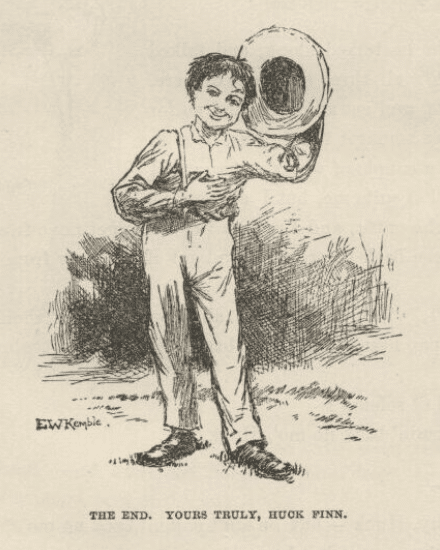
THE END. YOURS TRULY, HUCK FINN.
***
You can find the complete novel online here-> https://www.gutenberg.org/files/76/76-h/76-h
***
- both a literary device and a genre that uses exaggeration, humor, irony, or ridicule to highlight the flaws and absurdities of people and society ↩︎
- dignity, seriousness, or solemnity of manner ↩︎
- OK, the elephant in the room. It would be dishonest of Twain to avoid this epithet because that is how Huck and other white people thought of and referred to Blacks/slaves. It indicates a condescending, dismissive, callow attitude toward those who are considered nothing more than property. That mindset, produced by consciences deformed by white “sivilization,” becomes the major foil to Huck’s innately kind heart, and his struggle to reconcile the two. ↩︎
- a satirical, and episodic genre of fiction featuring a low-born, roguish hero who relies on wit rather than morality to survive in a corrupt society. The protagonist…moves through different social classes, highlighting societal hypocrisy. ↩︎
- The Western Frontier, not yet “sivilized,” where Huck can continue to grow without “deformity.” ↩︎
***
Subscribing only means that you will receive a notice when I publish a new post.
***
(Note: You can view most poems on the website, Poetry Foundation.)
(Note: My Poetry Recordings Playlist: At the very bottom of the post Is a recording. To view my entire playlist of poetry recordings, hover over “1/18” in the upper right corner, then click on ‘My Poetry Recordings Playlist:´and make selection.)
***
Scroll down for comments. **Remember that comments are public. Enter your Comment below.**
***
Subscribing only means that you will receive a notice when I publish a new post.
***
(Note: You can view most poems on the website, Poetry Foundation.)
(Note: My Poetry Recordings Playlist: At the very bottom of the post Is a recording. To view my entire playlist of poetry recordings, hover over “1/18” in the upper right corner, then click on ‘My Poetry Recordings Playlist:´and make selection.)
***
Scroll down for comments. **Remember that comments are public. Enter your Comment below.**
Leave a Reply