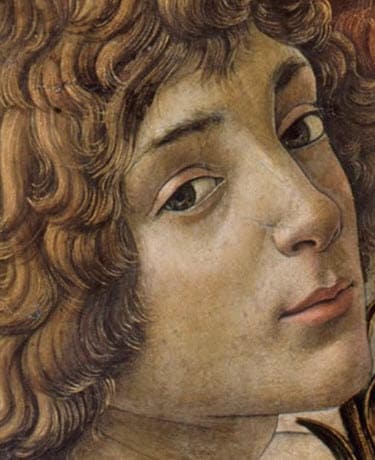
(A Botticelli Youth)
Readers are often surprised, if not shocked, to learn that Shakespeare’s first 126 sonnets–including some of the most famous ones, such as Shall I compare thee to summer’s day –are often referred to as the Fair Youth sonnets, addressed to a beautiful young man. There is a great deal of controversy as to whether all of them actually are to a young man, and are they homoerotic, “homoerotic friendly,” or platonic. Sonnet 20, the subject of this discussion, certainly contains erotic elements, which seem to rule out clearly platonic, but nor are they overtly sexual in terms of one man’s attraction to another. You decide.
Sonnet 20 is often regarded as one of Shakespeare’s “more difficult” poems. As a result, interpretations can be widely disparate. This is just one view.
(The poem is a Shakepearean/Elizabethan Sonnet in form, with three quatrains–four line stanzas–and iambic pentameter 1 meter, with an extra unstressed syllable at the end of the line [feminine rhyme]).
***
A woman’s face with nature’s own hand painted
Hast thou, the master-mistress of my passion;
A woman’s gentle heart, but not acquainted
With shifting change as is false women’s fashion;
An eye more bright than theirs, less false in rolling,
Gilding the object whereupon it gazeth;
A man in hue, all hues in his controlling,
Which steals men’s eyes and women’s souls amazeth.
And for a woman wert thou first created,
Till nature as she wrought thee fell a-doting,
And by addition me of thee defeated
By adding one thing to my purpose nothing.
But since she pricked thee out for women’s pleasure,
Mine be thy love and thy love’s use their treasure.
The essential tension of Sonnet 20 is presaged by the first three words, A woman’s face. We have come to expect that such a phrase would be an introduction to a poem about feminine beauty, perhaps, and, ironically that is true, except that it is a man/youth who has a woman’s face. We don’t know yet if the phrase will be derogatory or flattering since alone it is neutral. There is a measure of discomfort in the rest of the line–with nature’s own hand painted–since a woman’s “painted” face can have negative connotations. In Line 2 The pronoun in Hast thou is neutral. The oxymoronic wordplay in master-mistress heightens the tension: is this person a dominating (master) woman (mistress) or a dominating (mistress) man (master)? The intensity of feeling is made clear in of my passion, which introduces the complexity of his feelings when we learn that the object of that passion is a youth. Lines 3-6, in an extended synecdoche2, suggest a man by stating comparisons to a woman. He has a woman’s gentle heart, but without a false woman’s fickleness (shifting change). His eye is brighter than a woman’s and less false in its movements (rolling), so potent that it embellishes the object of its reflection (Gilding the object whereupon it gazeth).
The intensity of the speaker’s passion of Line 2 is made apparent in the subtext of the comparisons, which is that youths are clearly more desirable than women, to the point of denigrating women. This is passion beyond customary friendship between men, but is it romantic? or sexual? There is even an interpretive possibility in punning on gilding/gelding,3 in that the youth’s gaze is so powerful it neuters other men.
The youth’s masculinity is abundant (A man in hue), an assertion to balanceA woman’s face, so much so that he outshines all other men (all hues–possible pun on Hughes4— in his controlling); and, in fact, attracts other men by his appearance (Which steals men’s eyes); and amazes women’ souls.
The third quatrain of the sonnet clarifies the issue of overt sexuality. Although women were created first, feminine Nature was so attracted to her (fell a-doting) that, in seeking conjugation, added a penis (addition), which, however, for the male speaker, devoided the possibility of consummation (to my purpose nothing).
The final couplet (two-line stanza) resolves this apparent weakening of the speaker-youth relationship by stating that while Nature may have pricked (a common pun at the time) thee out (chose you) for women’s pleasure, let your love be mine, and your body (love’s use) theirs (treasure).
The couplet clearly dismisses the question of a sexual relationship between the speaker and the youth, and although strong male/male relationships are not uncommon in Shakespeare (Antonio & Bassanio [The Merchant of Venice], Hamlet & Horatio [Hamlet] ), the depth of feeling expessed throughout the poem goes far beyond friendship. And there is a note of regret in the last six lines that there cannot be sex between the speaker and his “beloved,” suggesting that if they could, they would?
- a poetic rhythm with ten syllables per line, arranged in five pairs (iambs) of unstressed followed by stressed syllables (da-DUM) ↩︎
- a figure of speech in which a part is made to represent the whole ↩︎
- castrating ↩︎
- Some theories suggest “Hue” is a play on the surname of the person Shakespeare is addressing (often believed to be W.H. or William Hughes).
↩︎
***
Subscribing only means that you will receive a notice when I publish a new post.
***
(Note: You can view most poems on the website, Poetry Foundation.)
(Note: My Poetry Recordings Playlist: At the very bottom of the post Is a recording. To view my entire playlist of poetry recordings, hover over “1/18” in the upper right corner, then click on ‘My Poetry Recordings Playlist:´and make selection.)
***
Scroll down for comments. **Remember that comments are public. Enter your Comment below.**
Leave a Reply