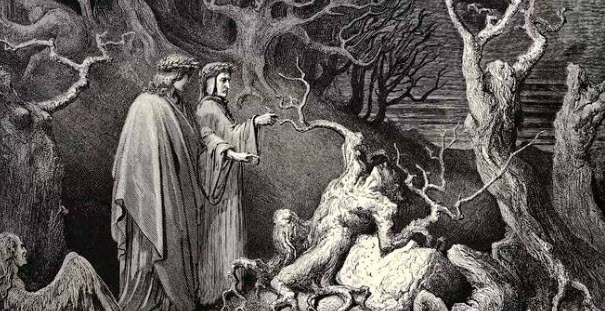
Wikipedia: L’Inferno , Italian for Hell, is the first part of the Italian writer Dante Alighieri’s 14th-century narrative poem, The Divine Comedy, L’Inferno followed by Purgatorio and Paradiso. L’Inferno describes the journey of a fictionalised version of Dante himself through Hell, guided by the ancient Roman poet Virgil. In the poem, Hell is depicted as nine concentric circles of torment located within the Earth; it is the “realm of those who have rejected spiritual values by yielding to bestial appetites or violence, or by perverting their human intellect to fraud or malice against their fellowmen.” As an allegory, the Divine Comedy represents the journey of the soul toward God, with the L’Inferno describing the recognition and rejection of sin.”
Reflecting God’s order of the universe, the L’Inferno is a complicated construction of verse, astounding in its control of meter, rhyme, and Canto (section or “chapter”) structure. All of Divine Comedy is divided into 3 books (parts), the number three a “divine” number itself, as in the Holy Trinity: L’Inferno , Purgatorio (Purgatory), and Paradiso (Paradise). Each book consists of 33 cantos of varying lengths, totaling 99 cantos and . Each canto is divided into 3 line stanzas, with a rhyme scheme of ABA BCB, etc. Hell consists of9 descending concentric circles.
Consider the rhyme scheme: This means that Dante had to adhere to this interlocking rhyming for 3 books x 33 cantos x 3 lines, or 3400 liines for the L’Inferno and 14,000 lines for the total Divine Comedy. Think of that accomplishment. Fortunately, Italian words mostly end in vowels, which made the interlocking rhyming task “easier” than, say, in English.
Nel mezzo del cammin di nostra vita-A
mi ritrovai per una selva oscura,-B
ché la diritta via era smarrita.-A
Ahi quanto a dir qual era è cosa dura-B
esta selva selvaggia e aspra e forte-C
che nel pensier rinova la paura!-B
Tant’ è amara che poco è più morte;-C
ma per trattar del Ben ch’i’ vi trovai,-D
dirò de l’altre cose ch’i’ v’ho scorte.-C
In addition, the entire poem is written in hendecasyllable (literally, 11 syllables) verse, eleven syllables per line, with a stressed syllable invariably falling on the 10th syllable.

Now imagine you are attempting to write this poetry in which: each of the three “books,” (L’Inferno , for example) contains 30 stanzas (Cantos)1; each stanza has 3 lines; each line contains 11 syllables with the 10th syllable always being stressed; with the rhyme scheme of ABA (with the second line rhyming with the first and third lines of the next stanza); with this stanza structure being repeated 30 times.
All of this before we even discuss content.
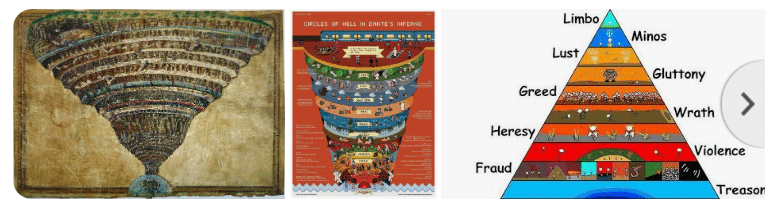
Dante’sL’Inferno features a funnel-shaped structure composed of 9 (3×3) concentric circles, the entrance to which is below Jerusalem; it was formed when Lucifer was hurled from heaven, and he, himself, is located at the bottom, or neck, of the funnel, being the farthest from God. As the funnel descends lower into earth, and closer to Lucifer, the sins and the punishments are increasingly severe, ranging from Limbo (Circle 1), with those sinners condemned but still closest to God, their sins being the least offensive to Him, to Treachery (Circle 9), the worst sinners, “housed” with Lucifer. Each circle embodies specific sins, and is subject to specific pushments. organized by gravity: incontinence (lust, gluttony, greed), violence, and fraud/treachery, with the worst sinners (traitors) at the bottom with Lucifer. The genius of L’Inferno is most brilliant in the symbolic association of each punishment with the sin it represents. A large part of the appreciation, and, dare I say, enjoyment of the poem is waiting to see what ingenious punishment Dante’s imagination conjures for each sin.
The Nine Circles of Hell:
- Limbo: Virtuous pagans and the unbaptized; no active physical punishment, but lack of hope.
- Lust: Driven endlessly around their circle by violent winds, just as their lust drove them endlessly.
- Gluttony: Lie in freezing, filthy slush, hampered in hell by their appeties and bodies as they were in life, tormented by Cerberus, the monster dog with three heads, as their gluttony was sinful multiples of of an addiction to food .
- Greed (Avarice & Prodigality): Hoarders and spendthrifts push heavy weights against each other, just as their excessive miserliness or wastefulness were heavy weights defining them.
- Wrath & Sloth: The Wrathful fight endlessly in waters impeding their movement, while the slothful are underwater, even more actively curtailed in their movement, as they chose to be in life.
- Heresy: Those whose opinions/beliefs were opposed the the Church, are entrapped in tombs, as they were bound to death by their beliefs, tortured by ruinous flames, the opposite of purification..
- Violence: Divided into three rings for violence against others (boiling in what they spilt), self (tortured by their own creations), and God/Nature/Art (tortured by reversing what is natural) (boiling blood, thorny wood, burning sand).
- Fraud (Malebolge2): Ten ditches (bolgias) for various deceivers (flatterers, simoniacs, hypocrites, etc.). From AI Overview:
- . 1st Bolgia3: Panderers and Seducers — Driven by horned demons, they walk in opposite directions while being whipped.
- 2nd Bolgia: Flatterers — They are submerged in a river of human excrement.
- 3rd Bolgia: Simoniacs (corrupt clergy) — They are placed head-down in holes, with their feet set on fire.
- 4th Bolgia: Sorcerers, Astrologers, and False Prophets — Their heads are twisted to face backward, forcing them to walk backward for eternity, blinded by their own tears.
- 5th Bolgia: Barrators (corrupt politicians) — They are immersed in boiling pitch and tar, and if they surface, they are hooked and torn apart by demons known as the Malebranche.
- 6th Bolgia: Hypocrites — They are forced to walk in circles wearing heavy, capes that appear golden but are made of solid, heavy lead.
- 7th Bolgia: Thieves — They are bound, bitten, and chased by serpents and reptiles, resulting in their bodies being burned to ash and regenerating, or being transformed into monsters.
- 8th Bolgia: Fraudulent Counselors — They are hidden from sight, encased individually within tongues of fire.
- 9th Bolgia: Sowers of Discord and Scandal — A demon hacks them with a sword, and as they walk around, their wounds heal only to be cut open again.
- 10th Bolgia: Falsifiers (alchemists, counterfeiter, liars) — They are afflicted with horrible, rotting diseases, such as leprosy, scabs, and plague, causing them to scratch and tear at their own flesh.
- Treachery (Cocytus4): Sinners are frozen in ice, the furthest from God’s light, with Satan at the very center, chewing on history’s greatest traitors (Judas, Brutus, Cassius).5
A word about translations: it is important to select a translation with which you woud be most comfortable; for example, literal, close but conveying the essence of the meaning, etc. We shall be using an example of the latter, by John Ciardi, a very highly regarded translation. The following is an interlinear text, including the original Italian, Ciardi’s translation, and a literal translation. Many prefer Ciardi for its poetic rendering; others prefer a literal translation for its precise rendering.

(In the middle of our life’s journey: life span at the time was considered to be 70 years, so, at age 35. Dante was born in 1265, so, 1300.)
Poetry is what evaporates in translation. This famous quote by Robert Frost is a reminder that when L’Inferno is translated, we lose almost all of the figurative language Dante used to enhance the meaning of his words, such as meter, rhyme, alliteration, assonance and consonance, simile and metaphor. That the enormous appeal of and admiration for L’Inferno persists without much of its original “poetry” is a testamony to how monumental an achievement it is. Some examples from the Cantos above: the interlocking rhyme scheme supplies a forward motion in reading the poem, augmented by the musicality of the persistent use of iambs and trochees. 6

Onomatopoeia: ritrovai and oscura. Internal rhyme: diritta and smarrita.
Dante and Virgil: the ancient Roman poet, Virgil7 serves as Dante’s guide through Hell, representing human Reason and classical wisdom, sent by Dante’s beloved Beatrice8 to lead him on this spiritual journey through the nine circles of torment, teaching him about sin and divine justice before ultimately leaving him at the Earthly Paradise. Virgil’s presence highlights the idea that human intellect and morality can only go so far, requiring divine grace (represented by Beatrice) for true salvation.
Journey with Virgil:
- Lost in the Dark Wood: Dante begins lost, blocked by three beasts (leopard, lion, she-wolf) symbolizing lust, pride, and avarice.
- Virgil’s Arrival: Virgil appears, sent by Beatrice, to guide Dante out of the dark wood and through Hell.
- Gates of Hell: They pass through the famous inscription, “Abandon all hope, ye who enter here,” and cross the River Acheron.
- The Circles: They journey through Limbo (virtuous pagans), Gluttony, Greed, Wrath, Heresy, Violence, Fraud, and Treachery, observing the unique punishments for each sin.
- Limitations of Reason: At the fiery city of Dis (Lower Hell), Virgil’s power falters, requiring divine intervention (an angel), showing reason’s limits without faith.
- The Center of Hell: They descend to the Earth’s center, climbing down Lucifer’s frozen body, to emerge at the base of Mount Purgatory.
Virgil’s journey with Dante demonstrates the power of classical learning and reason but also its ultimate insufficiency for achieving salvation, setting the stage for Beatrice to guide Dante through Purgatory and Paradise.
Canto One begins LL’Inferno and serves as an introduction to the work. Dante tells us that Midway in our life’s journey, i.e., at age 35, he went astray from God’s True Way, and found himself in a dark and frightening wood. Death could scarce be more bitter than that place! The words used to describe the wood symbolically represent the condition of the soul when it wanders from true belief: dark, lost, savage, rugged, powerful, fear.
He sees before him a hill, which he tries to climb, but is thwarted by three savage beasts; he is unable to continue on his own. There then appears the figure of Virgil, sent by Beatrice to assist Dante and act as guide. He advises Dante that , He must go by another way who would escape this wilderness, for that mad beast that fleers before you there, suffers no man to pass. Symbolically man must seek redemptive assistance (in this case, Reason, not Revelation, since Virgil is a pagan) to progress.
Virgil describes the journey Dante must make, progressively rising up to heaven in revelation, as the sinners progressively sank down to hell, in transgression. The journey moves upward from Hell, L’Inferno, Book 1, to Purgatory, Purgatorio, Book 2, to Heaven, Paradiso, Book 3.
Therefore, for your own good, I think it well
you follow me and I will be your guide
and lead you forth through an eternal place.
There you shall see the ancient spirits tried
in endless pain, and hear their lamentation
as each bemoans the second death of souls.
Next you shall see upon a burning mountain
souls in fire and yet content in fire,
knowing that whensoever it may be
they yet will mount into the blessed choir.
To which, if it is still your wish to climb,
a worthier spirit9 shall be sent to guide you.
With her shall I leave you, for the King of Time,
who reigns on high, forbids me to come there
since, living, I rebelled against his law.
He rules the waters and the land and air
and there holds court, his city and his throne.
Oh blessed are they he chooses!” And I to him:
“Poet, by that God to you unknown,
lead me this way. Beyond this present ill
and worse to dread, lead me to Peter’s gate
and be my guide through the sad halls of Hell.“
And I to him:
“Poet, by that God to you unknown,
lead me this way. Beyond this present ill
and worse to dread, lead me to Peter’s gate
and be my guide through the sad halls of Hell.“
And he then: “Follow.” And he moved ahead
in silence, and I followed where he ledAnd he then: “Follow.” And he moved ahead
in silence, and I followed where he led
They finally reach the gates of hell, above which are inscribed the most famous words in L’Inferno, and perhaps in all of literature.
Abandon all hope, ye who enter here.
It is beyond the purvueof this post to address all the cantos in the L’Inferno, so I have selected two examples: one to describe the horror of some of the worst punishments, and one which ameliorates the punishment through Dante’s campassion for the sufferers. (I am using a prose translation here for accuracy of description. I am not addressing many of the individuals in the first example since the historical references would be too plot-consuming and because Dante’s recollection of history is very personal and can be inaccurate or misleading).
The first is Canto XXVIII, Sowers of Discord.
The first sinner Dante meets is Mohamet.10
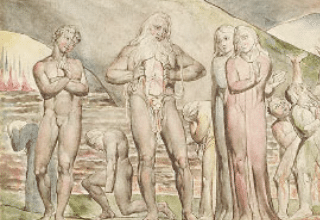
Truly cask, by losing mid-board or cross-piece, is not so split
open as one I saw cleft from the chin to where the wind is
broken: between his legs were hanging his entrails, his
inner parts were visible, and the dismal sack that makes ordure
of what is swallowed. Whilst all on seeing him I fix myself, he
looked at me, and with his hands opened his breast, saying, “Now
see how I rend myself, see how mangled is Mahomet. Ali goeth
before me weeping, cleft in the face from chin to forelock; and
all the others whom thou seest here were, when living, sowers of
scandal and of schism, and therefore are they so cleft.
The punishment here is self-explanatory for the man who created enormous religious discord.
The punishment is eternal since as each sinner completes his circle, his body repairs, only to be cleft again by a devil.
And one of the most famous images from L’Inferno, often replicated in art.

I remained to look at the crowd, and I saw a thing that I
should be afraid, without more proof, only to tell, were it not
that conscience reassures me, the good companion that emboldens man under the hauberk of feeling himself pure. I saw in truth, and still I seem to see it, a trunk without a head going along
even as the others of the dismal flock were going. And it was
holding the cut-off head by its hair, dangling in hand like a
lantern. And it gazed on us, and said, “O me!” Of itself it was
making for itself a lamp; and they were two in one, and one in
two. How it can be He knows who so ordains. When it was right at
the foot of the bridge, it lifted its arm high with the whole
head, in order to approach its words to us, which were, “Now see
the dire punishment, thou that, breathing, goest seeing the dead:
see thou if any other is great as this! … I made father and son
rebellious to each other. … Because I divided persons so united, I bear my brain, alas! divided from its source which is in this trunk. Thus retaliation is observed in me.”
One of the most famous passages in L’Inferno is the Paolo and Francesca episode. AI Overview: “Francesca da Rimini was forced to marry the deformed Giovanni Malatesta but fell in love with his handsome brother Paolo; Giovanni discovered them embracing, leading him to murder them both, condemning them to an eternal, turbulent existence in Hell’s circle of the lustful.”

Now the choir of anguish, like a wound,
strikes through the tortured air. Now I have come
to Hell’s full lamentation, sound beyond sound.
I came to a place stripped bare of every light
and roaring on the naked dark like seas
wracked by a war of winds. Their hellish flight
Of storm and counterstorm through time foregone,
sweeps the souls of the damned before its charge.
Whirling and battering it drives them on,
and when they pass the ruined gap of Hell
through which we had come, their shrieks begin anew.
There they blaspheme the power of God eternal.
And this, I learned, was the ending flight of those who sinned in the flesh, the carnal and lusty who betrayed reason to their appetite.
Just as the carnal and lustful are swept up in their desire, the winds that roar here in storm and counterstorm sweep them in perpetual flight. Dante’s attention is caught by two young lovers, sweet even in their circumstance. Moved to compassion, he asks to speak to them, and they comply. Francesca:
“The town where I was born lies by the shore
where the Po descends into its ocean rest
with its attendant streams in one long murmur.
Love, which in gentlest hearts will soonest bloom
Seized my lover with passion for that sweet body
From which I was torn unshriven to my doom.
Love, which permits no loved one not to love,
Took me so strongly with delight in him
That we are one in Hell, as we were above.
Love led us to one death. In the depths of Hell
Caïna waits for him who took our lives.”
This was the piteous tale they stopped to tell.
And when I had heard those world-offended lovers
I bowed my head. At last the Poet spoke:
“What painful thoughts are these your lowered brow covers?”
When at length I answered, I began: “Alas!
What sweetest thoughts, what green and young desire
Led these two lovers to this sorry pass.”
Then turning to those spirits once again,
I said: “Francesca, what you suffer here
melts me to tears of pity and of pain.
But tell me: in the time of your sweet sighs
by what appearances found love the way
to lure you to his perilous paradise?”
And she: “The double grief of a lost bliss
is to recall its happy hour in pain.
Your Guide and Teacher knows the truth to this. 120
But if there is indeed a soul in Hell
to ask of the beginning of our love
out of his pity, I will weep and tell:
The significance of this episode is important; it humanizes the story and Dante. Not only in the compassionate treatment of the lovers, but also in the messages conveyed: that the intensity in humans that drives them to violence and corruption can also drive them to love (Love, which permits no loved one not to love.); that love can mitigate our reaction to sin; that love can touch our hearts in a place that is shorn of heart (Francesca, what you suffer here melts me to tears of pity and of pain.). Dante, in his intense love for Beatrice, is particularly susceptible to Francesca’s story. And love, as personified by Beatrice throughout Divine Comedy, can be a road to salvation.
on a day for dalliance we read the rhyme
of Lancelot, how love had mastered him.
We were alone with innocence and dim time.
Pause after pause that high old story drew
our eyes together while we blushed and paled;
but it was one soft passage overthrew
our caution and our hearts. For when we read
how her fond smile was kissed by such a lover,
he who is one with me alive and dead
breathed on my lips the tremor of his kiss.
That book, and he who wrote it, was a pander.
That day we read no further.” As she said this, 135
the other spirit, who stood by her, wept
so piteously, I felt my senses reel
and faint away with anguish. I was swept
by such a swoon as death is, and I fell, as a corpse might fall, to the dead floor of Hell.
Some of Ciardi’s best translation is here, capturing the essence of the tenderness of this scene, luring the reader to identify with Dante’s compassion. Dante is so overcome by his feelings toward Paolo and Francesca that he faints.
These two episodes, one brutal, one tender, demonstrate the enormous range of which Dante-the-author is capable. Now remember there are 7 other circles inL’Inferno, then Purgatorio, then Paradiso, all the while in terza rima. Further proof of Dante’s genius is his uncanny ability to create an appropriate punishment fo each sin. His imagination is boundless.
All of which brings us to the lowest place in hell, farthest from God, where resides Satan and others like him, those punished for their Treachery. Satan, of course, fought all-out war with God and the Angels as he attempted a coup (gloriously described in verse in John Milton’s Paradise Lost); when that failed, he seduced God’s chosen–Eve and Adam–into ignoring God’s wishes and eating the forbidden fruit, with the accompanying loss of innocence, thus banishingl themselves from Eden, a transgression we all pay for.
Cocytus: At the very center is Satan, frozen in place, with all the rivers of guilt flowing to him. His enormous wings beat perpetually, providing the freezing wind that creates the ice that holds the sinners–trapped in the ice devoid of any of God’s warmth, just as they were devoid of any compassion in their treachery–ice that also traps Satan. Ironically, then, he is the source of his own punishment. He has three faces, indicative of his false, duplicitous nature. In a travesty of the Holy Trinity, Satan in each of his three mouths holds a sinner, whom he rips with his teeth, and who serves as a paradigm of his sin: Judas Iscariot, Brutus, and Cassius. Judas Iscariot was one of the Twelve Apostles of Jesus who betrayed him to the chief priests for thirty pieces of silver, leading to Jesus’ crucifixion; Gaius Cassius Longinus, the Roman senator and general who led the conspiracy to assassinate Julius Caesar; Brutus; the most famous of the assassins of Julius Caesar.
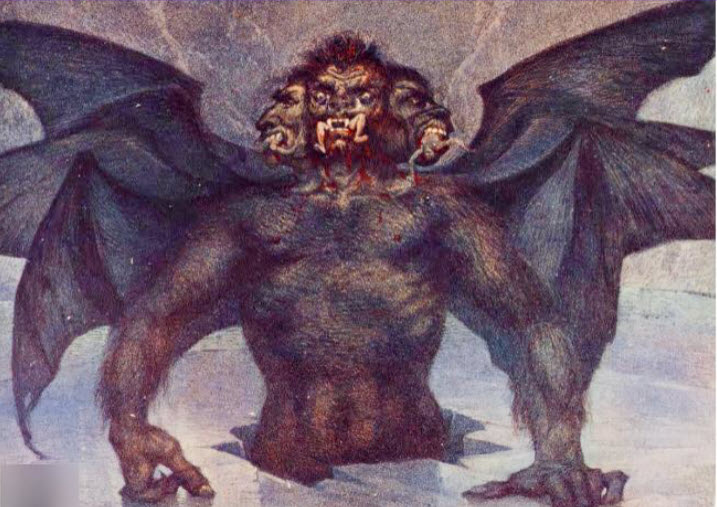
Dante is appropriately overwhelmed.
When we had gone so far across the ice that it pleased my Guide to show me the foul creature which once had worn the grace of Paradise,
he made me stop, and, stepping aside, he said: “Now see the face of Dis! This is the place where you must arm your soul against all dread.”
Do not ask, Reader, how my blood ran cold and my voice choked up with fear. I cannot write it: this is a terror that cannot be told.
Compare this terror, at the bottom of hell, with what he thought was terror in the dark wood at the beginning of L’Inferno. Here he is actually paralyzed with fear.
I did not die, and yet I lost life’s breath: imagine for yourself what I became, deprived at once of both my life and death.
In every mouth he worked a broken sinner between his rake-like teeth. Thus he kept three in eternal pain at his eternal dinner.
For the one in front the biting seemed to play no part at all compared to the ripping: at times the whole skin of his back was flayed away.
“That soul that suffers most,” explained my Guide, “Is Judas Iscariot, he who kicks his legs on the fiery chin and has his head inside.
Of the other two, who have their heads thrust forward, the one who dangles down from the black face is Brutus: note how he writhes without a word.
And there, with the huge and sinewy arms, is the soul of Cassius.
Having reached the nadir of hell, their journey is done.
But the night 1s coming on and we must go, for we have seen the whole.”
Then, as he bade, I clasped his neck, and he, watching for a moment when the wings were opened wide, reached over dexterously
and seized the shaggy coat of the king demon; then grappling matted hair and frozen crusts from one tuft to another, clambered down.
When we had reached the joint where the great thigh merges into the swelling of the haunch, my Guide and Master, straining terribly,
turned his head to where his feet had been and began to grip the hair as if he were climbing; so that I thought we moved toward Hell again.
“Hold fast!” my Guide said, and his breath came shrill with labor and exhaustion. “There is no way but by such stairs to rise above such evil.’
The only way to escape hell is by grappling with its “master,” so grabbing Satan’s hair, with Virgil (Reason), as always, leading the way, tuft by tuft they climb down until they reached Satan’s mid-section. Ever conscious of accuracy, Dante-the-author acknowledges that at the very center of the earth–in this case, Satan’s midsection–down becomes up; they start climbing away from Satan and hell and upward toward the light.
At last he climbed out through an opening in the central rock, and he seated me on the rim; then joined me with a nimble backward spring.
I looked up, thinking to see Lucifer as I had left him, and I saw instead his legs projecting high into the air.
Now let all those whose dull minds are still vexed by failure to understand what point it was I had passed through, judge if I was perplexed.
“Get up. Up on your feet,” my Master said. “The sun already mounts to middle tierce, and a long road and hard climbing lie ahead.
With those understated words, Dante and Virgil leave hell behind and begin the arduous task of climbing the long and hard road to redemption, through Purgatory to Heaven. Halfway through Purgatory, when Reason no longer is enough, Virgil leaves, and Beatrice completes the journey with Dante to Paradise and the divine vision.
***
- L’Inferno is the exception, witht 31 cantos, the first serving as an introduction to the work. ↩︎
- Italian for “evil pouches” or “evil ditches”) ↩︎
- Italian for “ditch” ↩︎
- “River of Wailing” in Greek mythology, one of the five rivers of the underworld Hades ↩︎
- Judas Iscariot, was one of the Twelve Apostles of Jesus who betrayed him to the chief priests for thirty pieces of silver, leading to Jesus’ crucifixion; Gaius Cassius Longinus, the Roman senator and general who led the conspiracy to assassinate Julius Caesar; Brutus; the most famous of the assassins of Julius Caesar. ↩︎
- two syllable poetic “feet” consisting of a stressed and unstressed syllable. ↩︎
- Virgil was a poet who was active in Rome between 70–19 BCE. He wrote one of the great poems of classical literature, The Aeneid , a Latin epic poem by Virgil, written between 29 and 19 BC, that tells the story of the Trojan hero Aeneas, who, after the sack of Troy, travels to Italy to become the ancestor of the Romans. ↩︎
- Beatrice refers to the real-life Florentine woman Beatrice Portinari. Dante’s profound, chaste love for her became the spiritual and literary cornerstone of his works, most famously guiding him through Paradise in The Divine Comedy, symbolizing divine grace and ideal beauty ↩︎
- Beatrice ↩︎
- a variaint spelling of the Arabic name Muahammad, most famously associated with the Prophet Muhammad, the founder of Islam ↩︎
***
Subscribing only means that you will receive a notice when I publish a new post.
***
(Note: You can view most poems on the website, Poetry Foundation.)
(Note: My Poetry Recordings Playlist: At the very bottom of the post Is a recording. To view my entire playlist of poetry recordings, hover over “1/18” in the upper right corner, then click on ‘My Poetry Recordings Playlist:´and make selection.)
***
Scroll down for comments. **Remember that comments are public. Enter your Comment below.**
Leave a Reply