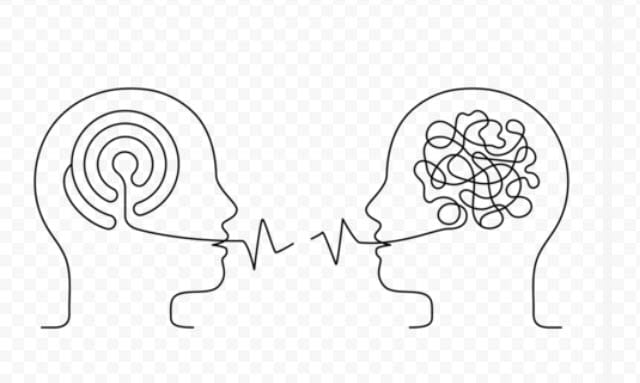
As humans, we are largely constrained by language in efforts to communicate with one another. Obviously, this is a minefield. Do I understand your vocabulary correctly? Do I understand your tone correctly? Do I understand your intention correctly? Are you using sarcasm? Irony? This came home again to me recently when I composed a post analyzing the Nazi filmmaker Leni Riefenstahl’s Triumph of theWill, a tour de force of Nazi propaganda. Being hesitant about the content, I asked a few friends for their reaction to the post. The issue that came up the most shocked me. Will the reader be able to tell if I were aggrandizing or condemning Nazism! Needless to say, I have decided not to publish. But how often in our day to day conversations are our intentions misperceived? It’s happened to all of us, and sometimes with unfortunate consequences. Our personal perception tools can be so different, every conversation is actually a risk. To cite a simple example: I am autistic, and as with many like me, I tend to be literal. So every time someone says goodbye to me with, “See you soon,” I am perplexed. Does the other person mean exactly that, or is it just a meaningless “sign-off”? How can I know?
Literature being nothing but words (no tone or gesture, etc., to amplify the meaning) is especially susceptible to misperception. For me, some of the most famously misunderstood lines are from Robert Frost’s “The Road Not Taken.”
Two roads diverged in a wood, and I—
I took the one less traveled by,
And that has made all the difference.
A common interpretation of these line is that the speaker opted for a non-conformist choice (the one less traveled by) and that independence served them well going forward. So this is often seen as an anthem for individuality. However, a closer reading of the poem suggests otherwise.
Though as for that the passing there
Had worn them really about the same,
And both that morning equally lay
In leaves no step had trodden black.
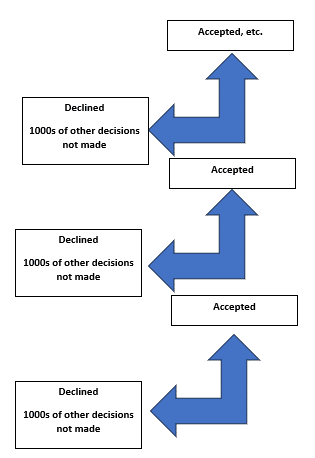
These lines are critical, yet often overlooked. Since the roads were equally worn, that really couldn’t determine the choice. so the decision was basically random. This actually deepens the meaning of the poem. It isn’t about asserting one’s individuality. The meaning is far more grave: each choice we make negates other choices, and we can only know the result of the choice we do make. What did we miss? When I was in high school and about to select colleges for a major/career, being equally right- and left-brained, I was torn between math and English. Obviously, I selected English, but I cannot even imagine what my life would have been like if I had selected math; it would have been another whole, different life. Think of this graphically:
Another famous example, though on a more specific level:
O Romeo, Romeo, wherefore art thou Romeo?
This is often interpreted as Juliet calling out to Romeo where to find him below her balcony so they can be together, a sweet, romantic notion. Actually, at the time Wherefore meant Why, so Juliet’s question is far more meaningful: “Why must you be Romeo (Montague)!” She is rhetorically asking, and lamenting, why must Romeo be Romeo, a Montague, whose family is in opposition to her family, the Capulets. This quesion now emblemizes the over-riding conflict of the story that drives most of the plot.
Deny thy father and refuse thy name. Or if thou wilt not, be but sworn my love And I’ll no longer be a Capulet.
How the reader interpret’s Juliet’s question is meaningful to the entire story.
Misperception in literature is often an author’s formidable tool, ranging from simple misunderstanding to tragedy. Oedipus doesn’t realize that he unknowingly murdered his father and slept with his mother1; Macbeth doesn’t realize that the witches’ prophecies are not assurances, but warnings2; Finny doesn’t realize that Gene, his best friend, harbors jealousy and resentment.3 For me, one of the most poignant and moving passages in American Lit. is from Huckleberry Finn, when Jim, the runaway slave, recounts to Huck an episode between Jim and his daughter. I have normalized the dialect Jim uses:
Huck: But this time I somehow got to talking to him about
his wife and young ones; and by and by he says:
Jim: “What makes me feel so bad dis time ‘uz because I
hear something over yonder on de bank like a whack, er
a slam, while ago, en it remind me er de time I treat my
little ‘Lizabeth so ornery. She warn’t on’y ’bout fo’
year ole, en she took de sk’yarlet fever, en had a
powful rough spell; but she got well, en one day she
was a-stannin’ aroun’, en I says to her, I says:
“‘Shut the door‘.’
“She didn’t do it; jis’ stood dah, kind of smilin’ up
at me. It make me mad; en I says agin, mighty loud,
I says:
“‘Doan’ you hear me? Shet de do’!’
“She jis stood de same way, kiner smilin’ up. I
was a-boilin‘! I says:
“‘I bet I MAKE you mind!’
“En wid dat I fetch’ her a slap upside de head dat
sent her a-sprawlin’. Den I went into de yuther
room, en ‘uz gone ’bout ten minutes; en when I
come back dah was dat door a-stannin’ open YIT, en
dat chile stannin’ mos’ right in it, a-lookin’ down and
mournin’, en de tears runnin’ down. My, but I WUZ
mad! I was going for de chile, but jis’ den — it
was a door dat open inwards— jis’ den, ‘long come de
wind en slam it to, behine de chile, ker-BLAM! — en my
lan’, de chile never move’! My breath mos’ hop outer
me; en I feel so — so — I doan’ know HOW I feel. I
creep out, all a-tremblin’, en creep aroun’ en open de
door easy en slow, en poke my head in behine de chile,
sof’ en still, en all uv a sudden I says POW! jis’ as
loud as I could yell. SHE NEVER BUDGE! Oh, Huck, I
bust out a-cryin’ en grab her up in my arms, en say,
‘Oh, de poor little thing! De Lord God Amighty
fogive poor ole Jim, cause he never going to fogive his-
self as long’s he live!’ Oh, she was plumb deaf en
dumb, Huck, plumb deaf en dumb — en I’d ben a-
treat’n her so!”
Jim’s misperception of ‘Lizabeth’s behavior is a monumental key to the entire novel, the story of an unheard of–and very dangerous– friendship that develops between a runaway slave and a “mischievous” white boy, as they share a raft floating down the Mississippi. Among Twain’s great gifts for humor and story-telling is his profound compassion. Huck and Jim’s travels are a voyage of enlightenment, particularly Huck’s, in learning that Jim is not an object, a slave, but a loving, caring human being, and father, in this case (in opposition to Huck’s father, a mean, cruel tyrant). It is the reader’s voyage as well, as we witness (ironically, with humor) the kindness and cruelty of society through various episodes. The humanity of the book is palpable in its larger themes, but also immensely moving in the character development of Jim and Huck, who begins the novel as a typically “brain-washed” white boy, and, through exposure to the humanity of Jim, has his perceptions of slavery so altered that he rises to “heroic,” though satirically, proportions, culminating in his devastating decision to reject how he has been taught to hate, and, instead, accept what he has learned to be true, even at great personal sacrifice–ironically—stating, “All right, then, I’ll go to hell.” A great, great novel, arguably the best in American Literature.
(Note, but this is Twain, so nothing is “easy.” At the end of the book there is an episode where Huck plays a trick on Jim, treating him as an object of jest.)
Throughout this blog we have seen how our neurons respond to others’ neurons and the actual alteration that occurs. Everyone we meet, everything we experience–every book, poem, or play we read– changes us, making us more complex, less easily defined. It is a miracle of nature.
***
- Oedipus the King (or Oedipus Rex) tells the tragic story of Oedipus, the king of Thebes, who unknowingly fulfills a prophecy to kill his father (King Laius) and marry his mother (Jocasta). When a plague strikes Thebes, Oedipus investigates Laius’s murder, vowing to punish the killer, only to discover through a prophet and a messenger that he is the culprit. Upon realizing he has committed incest and patricide, a horrified Oedipus blinds himself and begs for exile, while Jocasta hangs herself ↩︎
- The witches’ prophecies in Macbeth begin with Macbeth becoming Thane of Cawdor and then King, while Banquo’s descendants will be kings, leading Macbeth to ambition and murder. Later, they give Macbeth cryptic assurances: beware Macduff, no man born of woman can harm him, and he’ll be safe until Birnam Wood moves to Dunsinane, all designed to foster false confidence, ultimately leading to his downfall as Macduff (born by C-section) and an army camouflaged with wood branches defeat him. ↩︎
- A Separate Peace:
Idealism of friendship: Finny assumes friendship is unconditional and pure, an ideal that is shattered by Gene’s actions. He is shocked when the true nature of the “accident” (Gene deliberately jouncing the tree limb) is revealed because it contradicts his vision of how friends behave.
Blind trust: His tragic fall is precipitated by his unquestioning trust in Gene. He never truly believes Gene is capable of the deliberate act of malice that causes his initial injury.
Finny’s lack of understanding ultimately represents a state of innocence that is too fragile for the complex, fallen world, leading to his eventual physical and spiritual demise ↩︎
***
Subscribing only means that you will receive a notice when I publish a new post.
***
(Note: You can view most poems on the website, Poetry Foundation.)
(Note: My Poetry Recordings Playlist: At the very bottom of the post Is a recording. To view my entire playlist of poetry recordings, hover over “1/18” in the upper right corner, then click on ‘My Poetry Recordings Playlist:´and make selection.)
***
Scroll down for comments. **Remember that comments are public. Enter your Comment below.**
***
Subscribing only means that you will receive a notice when I publish a new post.
***
(Note: You can view most poems on the website, Poetry Foundation.)
(Note: My Poetry Recordings Playlist: At the very bottom of the post Is a recording. To view my entire playlist of poetry recordings, hover over “1/18” in the upper right corner, then click on ‘My Poetry Recordings Playlist:´and make selection.)
***
Scroll down for comments. **Remember that comments are public. Enter your Comment below.**
Leave a Reply