
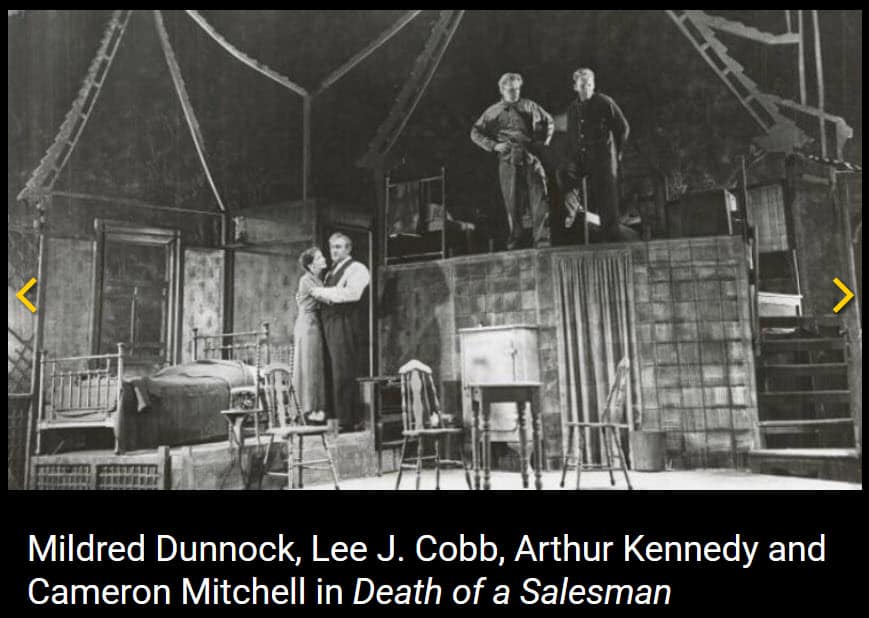
Death of a Salesman is a 1949 stage play written by the American playwright Arthur Miller. The play premiered on Broadway on February 10, 1949, running for 742 performances. It is a two-act tragedy set in late 1940s Brooklyn told through a montage of memories, dreams, and arguments of the protagonist Willy Loman, a travelling salesman.
(Apologies up front for the sometimes inconsistent formatting of the quotes from the play; I could not find a “cleaner” online version.)
Note: It is not within the scope of this post to present a line-by-line analysis. Instead, key elements are selected to elucidate plot, character, and themes.
Wikipedia: “Classical tragedy, rooted in ancient Greek drama, centers on a noble protagonist who, due to a tragic flaw (hamartia) or error in judgment, experiences a catastrophic downfall, evoking pity and fear in the audience to achieve a purging of emotions (catharsis). Key elements include a hero of high status, a conflict with fate or gods, and a plot showing reversal of fortune (peripeteia) and recognition (anagnorisis), often featuring excessive pride (hubris) as the flaw.”
The tenor of Death of a Salesman starts with one word of the title: Salesman. Emblemmatic of modern drama, this is not about “a noble protagonist,” but Everyman, an ordinary or typical human being. The events are not generally “catastrophic” but limited to the purvue of a single man and his family and therefore are less “elevated” than classical tragedy, and more, well, mundane. Few of us can identify with Oedipus or Lear, but most of us can relate in some way to Willy Loman.
A number of plot, character, and theme elements are either presented, suggested, or presaged, so that, as the saying goes, the stage is set.
ACT ONE
Linda [hearing willy outside the bedroom, calls with some trepidation]: Willy!

Willy: It’s all right. I came back.

Linda: Why? What happened? [Slight pause.] Did something happen, Willy?

Willy: No, nothing happened.

Linda: You didn’t smash the car, did you?

Willy [with casual irritation]: I said nothing happened. Didn’t you hear me?

Linda: Don’t you feel well?

Willy: I’m tired to the death. [The flute has faded away. He sits on the bed beside her, a little numb.] I couldn’t make it. I just couldn’t make it, Linda.

Linda [very carefully, delicately]: Where were you all day? You look terrible.

Willy: I got as far as a little above Yonkers. I stopped for a cup of coffee. Maybe it was the coffee.

Linda: What?

Willy [after a pause]: I suddenly couldn’t drive any more. The car kept going off on to the shoulder, y’know?

Linda [helpfully]: Oh. Maybe it was the steering again.
Linda calling with trepidation immediately introduces a note of unease, emphasized by a worried, Did something happen, Willy?
Willy.  No,  nothing  happened.

Part of the greatness of this play is Miller's ability to write dialog that is devastatingly ironic, but not to the speaker. The words are meant to be comforting to Linda, but ironically also apply to the major issue of the play: that Willy is a salesman who no longer can make sales, obviating his identity.
linda.  You  didn’t  smash  the  car,  did
you?
....
Willy.  I  got  as  far  as  a  little  above  Yon¬
kers.  I  stopped  for  a  cup  of  coffee.  Maybe
it  was  the  coffee.
linda.  What?

Willy  ( after  a  pause).  I  suddenly  could¬
n’t  drive  any  more.  The  car  kept  going  off
onto  the  shoulder,  y’know?
Two references to car episodes raise an ominous flag to the reader. Willy attempts to trivialize the significance of these events by saying his erratic driving maybe was caused by coffee, but his attempts are undercut by his admission:
Willy. I’m tired to the death. (He sits on the bed beside her, a little numb) I couldn’t make it. I just couldn’t make it, Linda.
The lack of self-realization that runs through the characters throughout the play heightens its pathos. Often, it is difficult, if not painful to observe.
I’m goin’  off  the  road!  I’m  tellin’  ya,  I  absolutely  forgot  I  was  driving.  If  I’d’ve  gone the  other  way  over  the  white  line  I might’ve  killed  somebody.  So  I  went  on again — and  five  minutes  later  I’m  dreamin’ again,  and  I  nearly —  (He  presses  two fingers  against  his  eyes)  I  have  such thoughts,  I  have  such  strange  thoughts.

Linda.  Willy,  dear.  Talk  to  them  again.
There’s  no  reason  why  you  can’t  work  in New  York.

Willy.  They  don’t  need  me  in  New
York.  I’m  the  New  England  man.  I’m
vital  in  New  England.
Linda, acutely aware that Willy can’t go on like this, suggests that he speak to his company about changing his territory to New York, where he lives. But Willy’s pride (often a key element in any tragedy) won’t allow him to admit his failures. To him, he can’t transfer: the company needs him in New England. To the reader, this self-delusion is another warning bell: how can a company need him if he doesn’t make sales? The “what have you done for me lately” of selling is not what Willy’s temperament or pride is ideal for. He expects gratitude and praise for what he had done in the past, which he does not get from the new regime at his company:
Willy.  If  old  man  Wagner  was  alive  I’d
a  been  in  charge  of  New  York  now!  That
man  was  a  prince,  he  was  a  masterful  man.
But  that  boy  of  his,  that  Howard,  he  don’t
appreciate.  When  I  went  north  the  first
time,  the  Wagner  Company  didn’t  know
where  New  England  was!
Their two boys, Biff and Happy are introduced into the play at this point: Biff, a farmer, and Happy, in merchandise. Both had bought into their father’s dreams and been damaged by them. Willy aggrandized them to levels they could not reach, from women:
About  five  hundred  women  would like  to  know  what  was  said  in  this  room.
(They  share  a  short  laugh)

Biff.  Remember  that  big  Betsy  some¬
thing — what  the  hell  was  her  name — over on  Bushwick  Avenue?

Happy  (combing  his  hair).  With  the
collie  dog!

Biff.  That’s  the  one.  I  got  you  in  there, remember?

Happy.  Yeah,  that  was  my  first  time —
I  think.  Boy,  there  was  a  pig!  (They  laugh, almost  crudely)  You  taught  me  everything 1  know  about  women.  Don’t  forget  that.
to business:
Happy  (enthralled) .  That’s  what  I  dream
about,  Biff.  Sometimes  I  want  to  just  rip my  clothes  off  in  the  middle  of  the  store and  outbox  that  goddam merchandise manager.  I  mean  I  can  outbox,  outrun,  and outlift  anybody  in  that  store,  and  I  have  to take  orders  from  those  common,  petty sons-of-bitches  till  I  can't  stand  it  any more.

Biff.  I’m  tellin’  you,  kid,  if  you  were with  me  I’d  be  happy  out  there.

Happy  (enthused).  See,  Biff,  everybody
around  me  is  so  false  that  I  m  constantly lowering  my  ideals  ...

Biff.  Baby,  together  we’d  stand  up  for
one  another,  we’d  have  someone  to trust.
Happy.  If  I  were  around  you.

Biff.  Hap,  the  trouble  is  we  weren’t
brought  up  to  grub  for  money.  I  don’t
know  how  to  do  it.

Happy.  Neither  can  I!

Biff.  Then  let’s  go!

Happy.  The  only  thing  is — what  can  you
make  out  there?
Each character is self-deluded, their perceptions of reality skewed by their inflated dreams. Willy and his dream of sales success; Linda and her dream of a “normal” family; Biff and Happy and their dreams of success. But everything about them runs counter to their dreams, even their names, which are somewhat diminutive: Willy, Biff, Happy.
Willy.  Bernard  is  not  well  liked,  is  he?

Biff.  He’s  liked,  but  he’s  not  well  liked.

Happy.  That’s  right,  Pop.

Willy.  That’s  just  what  I  mean.  Bernard
can  get  the  best  marks  in  school,  y’understand,  but  when  he  gets  out  in  the  business  world,  y’understand,  you  are  going  to be  five  times  ahead  of  him.  That’s  why  I thank  Almighty  God  you’re  both  built  like Adonises.  Because  the  man  who  makes  an appearance  in  the  business  world,  the  man who  creates  personal  interest,  is  the  man who  gets  ahead.  Be  liked  and  you  will never  want.  You  take  me,  for  instance.  I
never  have  to  wait  in  line  to  see  a  buyer. “Willy  Loman  is  here!”  That’s  all  they have  to  know,  and  I  go  right  through.

Biff.  Did  you  knock  them  dead,  Pop?

Willy.  Knocked  ’em  cold  in  Providence, slaughtered  ’em  in  Boston.
Contrary to reality, their dreams so inflate them that they have developed a false sense of superiority, which makes their failures that much more devastating. Interestingly, Miller has drawn characters who do not fully engage our sympathy. The men’s braggadoccio1 is so off-putting, it verges on repulsive.
Biff. Did you see the new football I got?
Willy (examining the ball). Where’d you get a new ball?
Biff. The coach told me to practice my passing.
Willy. That so? And he gave you the ball, heh?
Biff. Well, l borrowed it from the locker room. (He laughs confidentially).
Willy (laughing with him at the theft). I want you to return that.
Happy. I told you he wouldn’t like it!
Biff (angrily). Well, I’m bringing it back !
Willy (stopping the incipient argument, to Happy). Sure, he’s gotta practice with a regulation ball, doesn’t he? (To Biff) Coach’ll probably congratulate you on your initiative!
Biff. Oh, he keeps congratulating my initiative all the time, Pop.
Willy. That’s because he likes you. If somebody else took that ball there’d be an uproar. So what’s the report, boys, what’s the report?
***
Happy: But take those two we had tonight. Now weren’t they
gorgeous creatures? …. I get that any time I want, Biff.
Whenever I feel disgusted. The only trouble is, it gets like bowling or something. I just keep knockin’ them over and it
doesn’t mean anything. That’s what I long for. Somebody with character, with resistance! Like Mom, y’know? You’re gonna call me a bastard when I tell you this. That girl Charlotte I was with tonight is engaged to be married in five weeks. The guy’s in line for the vice-presidency of the store. I don’t know
what gets into me, maybe I just have an overdeveloped sense of competition or something, but I went and ruined her, and
furthermore I can’t get rid of her. And he’s the third executive I’ve done that to.
However, each of them has brief moments when reality breaks through, and their delusional mask slips:
Willy: I’m tired to the death. I couldn’t make it. I
just couldn’t make it, Linda.
Linda: linda. Well, dear, life is a casting off.
It’s always that way.
Biff: I’m thirty-four years old, I oughta be mak-
in’ my future. That’s when I come run¬
ning home. And now, I get here, and I
don’t know what to do with myself. (After
a pause) I’ve always made a point of not
wasting my life, and everytime I come
back here I know that all I’ve done is to
waste my life.
Happy:Sometimes I want to just rip
my clothes off in the middle of the store
and outbox that goddam merchandise
manager. I mean I can outbox, outrun, and
outlift anybody in that store, and I have to
take orders from those common, petty
sons-of-bitches till I can t stand it any
more.
A new further element is introduced when the boys overhear their father in the backyard, lost in time when the boys were young. So not only is Willy self-delusional, but he is so beat down that he is subject to intense flashbacks, attempts at escaping an imprisoning present. His mental state is worse, perhaps, than we thought. And perhaps the most significant delusion, bordering (?) on psychosis, is Willy’s ongoing imagining of his deceased brother Ben, a symbolic representation of Willy’s concept of success.
Willy  (shaking  Ben’s  hand).  Ben!  I’ve been  waiting  for  you  so  long!  What’s  the answer?  How  did  you  do  it?
...
Willy.  No!  Boys!  Boys!  (Young  Biff and  Happy  appear)  Listen  to  this.  This  is your  Uncle  Ben,  a  great  man!  Tell  my boys,  Ben!

Ben.  Why,  boys,  when  I  was  seventeen I  walked  into  the  jungle,  and  when  I  was twenty-one  I  walked  out.  (He  laughs) And  by  God  I  was  rich.

Willy  (to  the  boys).  You  see  what  I been  talking  about?  The  greatest  things can  happen!
Ben planned to go to Alaska to seek his father, but “made a wrong turn” and ended up in Africa, where he found diamonds and became rich. Not having joined Ben represents to Willy all of his lost opportunies and feeds his tortured mind. The absurdity of the story only adds to the play’s pathos.
Ben is an ambivalent “character,” a positive role-model to Willy, but as is typical with Willy, representing a darker side that Willy overlooks/ignores.
Ben. Yeah? (To Biff) Hit that, boy — hard as you can. (He pounds his stomach).
Biff. Oh, no, sir!
Ben (taking boxing stance). Come on, get to me! (He laughs)
Willy. Go to it, Biff! Go ahead, show him!
Biff. Okay! (He cocks his fists and starts in) .
Linda (to Willy). Why must he fight, dear?
Ben (sparring with Biff). Good boy! Good boy!
Willy. How’s that, Ben, heh?
Happy. Give him the left, Biff!
Linda. Why are you fighting?
Ben. Good boy! (Suddenly comes in, trips Biff, and stands over him, the point of his umbrella poised over Biff’s eye ) .
Linda. Look out, Biff!
Happy. Gee! He tripped him.
Ben (patting Biff’s knee). Never fight fair with a stranger, boy. You’ll never get out of the jungle that way. (Taking Linda’s hand and bowing) It was an honor and a pleasure to meet you, Linda.
Linda ( withdrawing her hand coldly, frightened). Have a nice — trip.
Ben.( to Willy). And good luck with your— what do you do?
Willy. Selling.
Ben. Yes. Well . . . (He raises his hand in farewell to all )
Willy. No, Ben, I don’t want you to think . . . (He takes Ben’s arm to show him) It’s Brooklyn, I know, but we hunt too.
Willy also retreats in his imagination to “better” days when the boys were young and there was still some vestige of hope.
Willy:do  you  let  your  mother  carry  wash  up  the stairs  ?

Biff.  Grab  hold  there,  boy!

Happy.  Where  to,  Mom?

Linda.  Hang  them  up  on  the  line.  And you  better  go  down  to  your  friends,  Biff. The  cellar  is  full  of  boys.  They  don’t  know
what  to  do  with  themselves.

Biff.  Ah,  when  Pop  comes  home  they can  wait!

Willy  ( laughs  appreciatively).  You  better  go  down  and  tell  them  what  to  do, Biff.

Biff.  I  think  I’ll  have  them  sweep  out the  furnace  room.

Willy.  Good  work,  Biff.

Biff  ( goes  through  wall-line  of  kitchen
to  doorway  at  back  and  calls  down).  Fellas!  Everybody  sweep  out  the  furnace room!  I’ll  be  right  down!

Voices.  All  right!  Okay,  Biff!

Biff.  George  and  Sam  and  Frank,  come out  back!  We’re  hangin’  up  the  wash! Come  on,  Hap,  on  the  double!  (He  and Happy  carry  out  the  basket).

Linda.  The  way  they  obey  him!

Willy.  Well,  that’s  training,  the  training.
I’m  tellin’  you,  I  was  sellin’  thousands
and  thousands,  but  I  had  to  come  home.

Linda.  Oh,  the  whole  block’ll  be  at  that
game.
However, slow prodding by Linda, beginning with the trigger line, reveals the arrogance and deceit that underlie Willy’s distortion of reality:
Willy. I’m not going to pay that man!
That goddam Chevrolet, they ought to
prohibit the manufacture of that car!

Linda. Well, you owe him three and a
half. And odds and ends, comes to around
a hundred and twenty dollars by the fif¬
teenth.

Willy. A hundred and twenty dollars!
My God, if business don’t pick up I don’t
know what I’m gonna do!

Linda. Well, next week you’ll do better.

Willy. Oh, I’ll knock ’em dead next
week. I’ll go to Hartford. I’m very well
liked in Hartford. You know, the trouble
is, Linda, people don’t seem to take to me.

(They move onto the forestage.)

Linda. Oh, don’t be foolish.

Willy. I know it when I walk in. They
seem to laugh at me.

Linda. Why? Why would they laugh at
you? Don’t talk that way, Willy.

(Willy moves to the edge of the stage.
Linda goes into the kitchen and starts to
darn stockings.)

Willy. I don’t know the reason for it,
but they just pass me by. I’m not noticed.

Linda. But you’re doing wonderful, dear.
You’re making seventy to a hundred dol¬
lars a week.

Willy. But I gotta be at it ten, twelve
hours a day. Other men — I don’t know —
they do it easier. I don’t know why — I
can’t stop myself — I talk too much. A man
oughta come in with a few words. One
thing about Charley. He’s a man of few
words, and they respect him.

Linda. You don’t talk too much, you’re
just lively.

Willy (smiling). Well, I figure, what
the hell, life is short, a couple of jokes. (To himself) I joke too much! (The smile
goes) .

Linda. Why? You’re —

Willy. I’m fat. I’m very — foolish to look
at, Linda. I didn’t tell you, but Christmas
time I happened to be calling on F. H.
Stewarts, and a salesman I know, as I was going in to see the buyer I heard him say something about — walrus. And I- — I cracked him right across the face. I won’t take that. I simply will not take that. But they do laugh at me. I know that.

Linda. Darling . . .

Willy. I gotta overcome it. I know I
gotta overcome it. I’m not dressing to advantage, maybe.

Linda. Willy, darling, you’re the hand¬
somest man in the world —

Willy. Oh, no, Linda.

Linda. To me you are. (Slight pause)
The handsomest.

(From the darkness is heard the laughter
of a woman. Willy doesn’t turn to it, but
it continues through Linda’s lines.)

Linda. And the boys, Willy. Few men are idolized by their children the way you are.

(Music is heard as behind a scrim, to the
left of the house. The Woman, dimly seen,
is dressing.)

Willy (with great feeling). You’re the best there is, Linda, you’re a pal, you know
that? On the road — on the road I want to
grab you sometimes and just kiss the life
outa you.

(The laughter is loud now, and he moves
into a brightening area at the left, where
The Woman has come from behind the
scrim and is standing, putting on her hat,
looking into a "mirror” and laughing .)

Willy. ’Cause I get so lonely — especially
when business is bad and there’s nobody
to talk to. I get the feeling that I’ll never
sell anything again, that I won’t make a
living for you, or a business, a business for
the boys.
Even Willy can’t sustain the success-ruse for long, especially when confronted with the bills that can’t be paid, an indication of his failure. This causes an abrupt change in Willy: You know, the trouble is, Linda, people don’t seem to take to me. The braggadoccio completely drops, and our antipathy for Willy’s foibles shifts to sympathy for a man who, underneath it all, is filled with shame and humiliation: he is a failure at his job; he is unattractive; he is unpopular; he is a laughingstock; he is insecure; he is afraid. But, Willy being Willy, our sympathy sours quickly as his memories of one of his “women” intrude. Once again he is a cheat, a betrayer who does not deserve our sympathy.
Note: although we mentioned that Death of a Salesman is not a “classic” tragedy, it does share many characteristics of that genre, especially hubris, i.e., excessive pride on the part of the protagonist, which leads to his downfall; a single plot; unavoidable destiny, so that the protagonist is “trapped”; all contributing to the viewer’s reaction of what Aristotle called “pity and terror.” But in classical tragedy the protagonist retains some aspect of his nobility. In Death of a Salesman, Willy is more pathetic; he is ignoble. Yet, in our modern, existential way, we can identify with him as he struggles to maintain his dignity, as he struggles to “mean” something. Miller makes him complex in his own way, as an individual “common” man.
We now learn, in terms of hubris, that Willy’s old friend, Charley, has been lending him money to cover the truth of his sales failures and has offered him a job, which Willy refuses out of pride. Willy then tells Charley that he has been fired. Whenever we think Willy has hit rock bottom, life gets worse. From our own experiences, we are aware that people can take just so much before collapsing (pity and terror). Linda’s “trepidation” is now ours. What possible outcome can there be?
The blows pile up: Biff tries to have his old employer take him back, but he doesn’t even recognize Biff; Biff failed math in high school, which would ruin his chances at an athletic scholarship; Biff had the opportunity to pass math but rejected it out of desolation when he finds out Willy is unfaithful to Linda; Biff stole athletic equipment, which ruined his chances at job advancement; any sympathy we may have mustered toward Willy at this point is negated when we learn he had the cheap affairs, in spite of all his supposed idolizing of Linda, and her of him; and, finally, and inevitably:
Back in the present, the older Linda enters to find Willy outside. Biff and Happy come downstairs and discuss Willy’s condition with their mother. Linda scolds Biff for judging Willy harshly. Biff tells her that he knows Willy is a fake (the affairs), but he refuses to elaborate. Linda mentions that Willy has tried to commit suicide. And there it is. All the walls of delusion, lying, diversion, deflection, fantasy, come tumbling down, and we realize that our fears have already been met: Willy has passed the point of no return, and we expect there will be consequences, whether sooner or later.
Ben’s imaginary “visit” triggers further mind-wandering on Willy’s part, with Willy rambling around the backyard and loudly voicing his ruminations, which wakes the boys and brings them downstairs. Biff, with all his resentment toward Willy, suggests that these are the rantings of someone unhinged. Linda comes to Willy’s defense:
Happy  (surlily).  Just  don’t  call  him
crazy!

Biff.  He’s  got  no  character — Charley
wouldn’t  do  this.  Not  in  his  own  house-spewing  out  that  vomit  from  his  mind.

Happy.  Charley  never  had  to  cope  with
what  he’s  got  to.

Biff.  People  are  worse  off  than  Willy
Loman.  Believe  me,  I’ve  seen  them!

Linda.  Then  make  Charley  your  father,
Biff.  You  can’t  do  that,  can  you?  I  don’t say  he’s  a  great  man.  Willy  Loman  never made  a  lot  of  money.  His  name  was  never in  the  paper.  He’s  not  the  finest  character that  ever  lived.  But  he’s  a  human  being, and  a  terrible  thing  is  happening  to  him. So  attention  must  be  paid.  He’s  not  to  be
allowed  to  fall  into  his  grave  like  an  old dog.  Attention,  attention  must  be  finally paid  to  such  a  person.
In what can be seen as a thematic turning point in the play, Linda delivers a type of eulogy2 for Willy, her compassion for his pain over-riding his faults. It is a crie-de-coeur3 for lost souls, for those who might be seen as sinking into insignificance. In the last analysis, their humanity has to be recognized: Attention, attention must be finally paid to such a person.
Underlining that assertion, Linda reveals:
Linda.  He’s  dying,  Biff.

( Happy  turns  quickly  to  her,  shocked.)

Biff  ( after  a  pause).  Why  is  he  dying?

Linda.  He’s  been  trying  to  kill  himself.

Biff  ( with  great  horror).  How?

Linda.  I  live  from  day  to  day.

Biff.  What’re  you  talking  about?

Linda.  Remember  I  wrote  you  that  he
smashed  up  the  car  again?  In  February?

Biff.  Well?

Linda.  The  insurance  inspector  came.  He
said  that  they  have  evidence.  That  all  these accidents  in  the  last  year — weren’t — weren’t — accidents.
The remainder of Act I concerns attempts at hope and the reality of failure, tempered by the rocky family dynamic: Biff’s job failure due to his lackadaisical approach to business in the past; confrontations between Biff and Willy; Biff’s resolution to talk to his old boss, Mr. Oliver; the men making plans to create a family sporting goods business, “The Loman Brothers”; Willy’s demeaning business meeting advice to Biff; Willy’s dismissive treatment of Linda and Biff’s reaction to it; Biff’s escalating hope of his meeting with Oliver to obtain a large loan; Willy’s hopes of speaking with his boss about a New York territory. The Act ends ominously with Biff removing a length of rubber tubing from behind the heater: Willy’s way out.
***
Act Two begins with Linda and Willy at breakfast, with the conversation eventually devolving into laments about their debts, when Linda reminds Willy to meet the boys for dinner that evening.
Prior to that, Willy has his meeting with Howard about changing his territory to New York. The entire scene is acutely painful as Howard insists on showing off his new, expensive recording machine while Willy attempts to make his deaperate request known. After an interminable display of Howard’s new machine and Willy’s failure to interrupt, it suddenly occurs to Howard:
Howard.  Say,  aren’t  you  supposed  to  be
in  Boston?

Willy. That’s what I want to talk to
you about, Howard. You got a minute?

Howard. What happened? What’re you
doing here?

Willy. Well ...

Howard. You didn’t crack up again, did
you?

Willy. Oh, no. No . . .

Howard. Geez, you had me worried
there for a minute. What’s the trouble?

Willy. Well, tell you the truth, Howard.
I’ve come to the decision that I d rather
not travel any more.

Howard. Not travel! Well, what’ll you
do?

Willy. Remember, Christmas time,
when you had the party here? You said
you’d try to think of some spot for me
here in town.

HOWARD. With us?

Willy. Well, sure.

Howard. Oh, yeah, yeah. I remember.
Well, I couldn’t think of anything for
you, Willy.

Willy. I tell ya, Howard. The kids are
all grown up, y’know. I don’t need much
anv more. If I could take home — well,
sixty-five dollars a week, I could swing it.

Howard. Yeah, but Willy, see I —

Willy. I tell ya why, Howard. Speaking
frankly and between the two of us, y’know
—I’m just a little tired.

Howard. Oh, I could understand that,
Willy. But you’re a road man, Willy, and
we do a road business. We’ve only got a
half-dozen salesmen on the floor here.

Willy. God knows, Howard, I never
asked a favor of any man. But I was with
the firm when your father used to carry
you in here in his arms.

Howard. I know that, Willy, but —

Willy.  Your  father  came  to  me  the  day
you  were  born  and  asked  me  what  I
thought  of  the  name  of  Howard,  may  he
rest  in  peace.

Howard.  I  appreciate  that,  Willy,  but
there  just  is  no  spot  here  for  you.  If  I  had a  spot  I’d  slam  you  right  in,  but  I  just don’t  have  a  single  solitary  spot.
As the conversation continues and Howard is unmoved, Willy keeps lowering his demands, desperately, until he finally says he will go to Boston after all.
The day’s demolition of last night’s hopes begins, as failures land like blows on Willy’s already battered psyche.
Howard. Willy, you can’t go to Boston
for us.

Willy. Why can’t I go?

Howard. I don't want you to represent
us. I’ve been meaning to tell you for a
long time now.

Willy. Howard, are you firing me?

Howard. I think you need a good long
rest, Willy.

Willy. Howard —

Howard. And when you feel better,
come back, and we’ll see if we can work
something out.

Willy. But I gotta earn money, Howard.
I’m in no position to —

Howard. Where are your sons? Why
don’t your sons give you a hand?

Willy. They’re working on a very big
deal.

Howard. This is no time for false pride,
Willy. You go to your sons and tell them
that you’re tired. You’ve got two great
boys, haven’t you?

Willy. Oh, no question, no question,
but in the meantime . . .

Howard. Then that’s that, heh?

Willy. All right, I’ll go to Boston tomorrow.

HOWARD. No, no.

Willy. I can’t throw myself on my sons.
I’m not a cripple!
But, of course, he is.
The blows continue to fall, and we see the walls of Willy’s world continue to constrict , and the tragic consequences of his false dreams, his actions, and his pride. Once again, out of pride, he refuses Charley’s offer of the deperately needed job. We learn that Biff waited five hours in Oliver’s office, and then, “he comes out. Didn’t remember who I was or anything.” The dinner with Willy, Biff, and Happy is a failure. We learn that Biff discovered Willy with another woman, and calls Willy out: “You fake! You phony little fake! You fake!”
Willy.  She’s  nothing  to  me,  Biff.  I  was
lonely,  I  was  terribly  lonely.

Biff.  You — you  gave  her  Mama’s  stock¬
ings!  (His  tears  break  through  and  he  rises
to  go.)

Willy  (grabbing  for  Biff).  I  gave  you  an
order!

Biff.  Don’t  touch  me,  you — liar!

Willy.  Apologize  for  that!

Biff.  You  fake!  You  phony  little  fake!
You  fake!  (Overcome,  he  turns  quickly
and  weeping  fully  goes  out  with  his  suit¬
case.  Willy  is  left  on  the  floor  on  his
knees.)

Willy.  But  we  were  supposed  to  have
dinner  together.
It is telling that from this point on in the play Biff frequently addresses Willy by his name instead of Pop.
The last scenes claustrophobically present the continued deterioration of the family, as bitterness and resentment come to the fore. Linda finally reaches her breaking point with the boys. Re Linda: an interesting point has yet to be approached in this discussion–the role of Linda as enabler. While she appears strong in the next scene, it is only with the boys. With Willy she forgives pretty much anything. It is apparent that all of her support in regards to Willy actually allows him to continue his fantasies, rather than confronting him about them. Might things have turned out differently if she had tried to call him back to reality more firmly? Instead she treats him like a wounded animal or child, only offering condolences and solace. She allows Willy to mistreat her, thinking it is her role as a passive wife instead of standing up to him as an equal, a sharing partner who can love but still admonish, as she does with the boys. Is this really helping Willy?
We see that Linda can be forceful in the following scenes, when she actually tells the boys that they have been cruel to Willy and tells them to leave the house. Happy continues to be Happy, but Biff breaks down and admits to being a failure , as a son, in business, etc.
He  looks  into  the  living-room and  freezes.  Inside,  Linda,  unseen,  is
seated,  Willy’s  coat  on  her  lap.  She  rises ominously  and  quietly  and  moves  toward Happy,  who  backs  up  into  the  kitchen, afraid.)

Happy.  Hey,  what’re  you  doing  up?
(Linda  says  nothing  but  moves  toward
him  implacably.)  Where’s  Pop?  (He  keeps
backing  to  the  right,  and  now  Linda  is  in full  view  in  the  doorway  to  the  living-room)  Is  he  sleeping?


Linda.  Where  were  you?

Happy  (trying  to  laugh  it  off).  We  met
two  girls,  Mom,  very  fine  types.  Here,  we brought  you  some  flowers.  (Offering  them to  her)  Put  them  in  your  room, Ma.

(She  knocks  them  to  the  floor  at Biff’s
feet.  He  has  now  come  inside  and  closed the  door  behind  him.  She  stares  at  Biff, silent.)

Happy.  Now  what’d  you  do  that  for?
Mom,  I  want  you  to  have  some  flowers —

Linda  (cutting  Happy  off ,  violently  to
Biff).  Don’t  you  care  whether  he  lives  or dies  ?

Happy  (going  to  the  stairs).  Come  up¬
stairs,  Biff.

Biff  (with  a  flare  of  disgust,  to  Happy). Go  away  from  me!  (To  Linda)  What  do you  mean,  lives  or  dies?  Nobody’s  dying around  here,  pal.

Linda.  Get  out  of  my  sight!  Get  out  of here!

Biff.  I  wanna  see  the  boss.

Linda.  You’re  not  going  near  him!

Biff.  Where  is  he?  (He  moves  into  the
living-room  and  Linda  follows.)

Linda  (shouting  after  Biff).  You  invite
him  for  dinner.  He  looks  forward  to  it  all day — (Biff  appears  in  his  parents’  bedroom,  looks  around,  and  exits) — and  then you  desert  him  there.  There’s  no  stranger you’d  do  that  to!

Happy.  Why?  He  had  a  swell  time  with
us.  Listen,  when  I — (Linda  comes  back
into  the  kitchen) — desert  him  I  hope  I
don’t  outlive  the  day!

Linda.  Get  out  of  here!

Happy.  Now  look,  Mom  .  .  .

Linda.  Did  you  have  to  go  to  women  to
night?  You  and  your  lousy  rotten whores!
(Biff  re-enters  the  kitchen.)

Happy.  Mom,  all  we  did  was  follow  Biff
around  trying  to  cheer  him  up!  (To Biff) Boy,  what  a  night  you  gave  me!

Linda.  Get  out  of  here,  both  of  you,  and don’t  come  back!  I  don’t  want  you  tormenting  him  any  more.  Go  on  now,  get your  things  together!  (To  Biff)  You  can sleep  in  his  apartment.  (She  starts  to  pick up  the  flowers  and  stops  herself)  Pick  up this  stuff,  I’m  not  your  maid  any  more. Pick  it  up,  you  bum,  you!

(Happy  turns  his  back  to  her  in  refusal. Biff  slowly  moves  over  and  gets  down  on his  knees,  picking  up  the  flowers.)

Linda.  You’re  a  pair  of  animals!  Not
one,  not  another  living  soul  would  have
had  the  cruelty  to  walk  out  on  that  man in  a  restaurant!

Biff  (not  looking  at  her).  Is  that  what he  said?

Linda.  He  didn’t  have  to  say  anything.
He  was  so  humiliated  he  nearly  limped
when  he  came  in.

Happy.  But,  Mom,  he  had  a  great  time
with  us —

Biff  (cutting  him  off  violently).  Shut
up!

(Without  another  word,  Happy  goes  up¬
stairs.)

Linda.  You!  You  didn’t  even  go  in  to
see  if  he  was  all  right!

Biff  (still  on  the  floor  in  front  of  Linda, the  flowers  in  his  hand;  with  self-loathing). No.  Didn’t.  Didn’t  do  a  damned  thing. How  do  you  like  that,  heh?  Left  him  babbling  in  a  toilet.

Linda.  You  louse.  You  .  .  .

Biff.  Now  you  hit  it  on  the  nose!  (He
gets  up,  throws  the  flowers  in  the  wastebasket)  The  scum  of  the  earth,  and  you’re looking  at  him!

Linda.  Get  out  of  here!

Biff.  I  gotta  talk  to  the  boss.  Mom.
Where  is  he?

Linda.  You’re  not  going  near  him.  Get
out  of  this  house!

Biff  (with  absolute  assurance,  determi¬
nation).  No.  We’re  gonna  have  an  abrupt
conversation,  him  and  me.

Linda.  You’re  not  talking  to  him!
(Hammering  is  heard  from  outside  the
house,  off  right.  Biff  turns  toward  the
noise.)

Linda  (suddenly  pleading).  Will  you
please  leave  him  alone?
They hear Willy out in the yard, where he is planting seeds, a sad metaphor for what little hope Willy has left. He then has another fantasized scene with Ben, where we learn that Willy has one last desperate hope:
You gotta  consider,  now.  Don’t  answer  so quick.  Remember,  it’s  a  guaranteed  twenty- thousand-dollar  proposition.  Now  look, Ben,  I  want  you  to  go  through  the  ins and  outs  of  this  thing  with  me.  I’ve  got nobody  to  talk  to,  Ben,  and  the  woman  has suffered,  you  hear  me?

Ben  (standing  still,  considering).  What’s the  proposition?

Willy.  It’s  twenty  thousand  dollars  on the  barrelhead.  Guaranteed,  gilt-edged,  you understand?

Ben.  You  don’t  want  to  make  a  fool  of yourself.  They  might  not  honor  the  policy.

Willy.  How  can  they  dare  refuse? Didn’t  I  work  like  a  coolie  to  meet  every premium  on  the  nose?  And  now  they don’t  pay  off?  Impossible!

Ben.  It’s  called  a  cowardly  thing,  William.

Willy.  Why?  Does  it  take  more  guts  to stand  here  the  rest  of  my  life  ringing  up  a zero?

Ben  (yielding).  That’s  a  point,  William.
(He  moves,  thinking,  turns)  And  twenty thousand — that  is something  one  can  feel with  the  hand,  it  is  there.

Willy  (now  assured,  with  rising  power).
Oh,  Ben,  that’s  the  whole  beauty  of  it!  I see  it  like  a  diamond,  shining  in  the  dark, hard  and  rough,  that  I  can  pick  up  and touch  in  my  hand.  Not  like — like  an  appointment!  This  would  not  be  another damned-fool  appointment,  Ben,  and  it changes  all  the  aspects.  Because  he  thinks I’m  nothing,  see,  and  so  he  spites  me.  But the  funeral — (Straightening  up)  Ben,  that funeral  will  be  massive!  They’ll  come  from Maine,  Massachusetts,  Vermont,  New Hampshire!  All  the  old-timers  with  the strange  license  plates — that  boy  will  be thunder-struck,  Ben,  because  he  never  realized — I  am  known!  Rhode  Island,  New York,  New Jersey — I  am  known,  Ben,  and he’ll  see  it  with  his  eyes  once  and  for  all. He’ll  see  what  I  am,  Ben!  He’s  in  for  a shock,  that  boy!

Ben  ( coming  down  to  the  edge  of  the garden).  He’ll  call  you  a  coward.

Willy  ( suddenly  fearful).  No,  that would  be  terrible.

Ben.  Yes.  And  a  damned  fool.

Willy.  No,  no,  he  mustn’t.  I  won’t  have that!  (He  is  broken  and  desperate)

Ben.  He’ll  hate  you,  William.

(The  gay  music  of  the  Boys  is  heard.)
....
Willy. Why,  why
can’t  I  give  him  something  and  not  have him  hate  me?

Ben.  Let  me  think  about  it.  (He  glances at  his  watch)  I  still  have  a  little  time.  Remarkable  proposition,  but  you’ve  got  to  be sure  you’re  not  making  a  fool  of  yourself.
Willy’s abject desperation asserts itself when we learn that his last great hope is to commit suicide in order to collect the $20,000 insurance money. It is at this point that we can overlook all of his faults and feel tremendous compassion for a man who has been driven to this state. Yes, he still is blind, imagining a “massive” funeral (“that boy will be thunderstruck), and Biff’s realization that Willy is a hero–he’ll see it with his eyes once and for all. He’ll see what I am, Ben! He’s in for a shock, that boy! Ben tries to assert some reality by saying that the insurance company may not honor the policy (suicide), and some consider suicide to be cowardly, but Willy has to hang on to this last vestige of hope . I see it like a diamond, shining in the dark, hard and rough, that I can pick up and touch in my hand. Not like — like an appointment! This would not be another damned-fool appointment, Ben, and it changes all the aspects. Because he thinks I’m nothing, see, and so he spites me. He’ll hate you, William.
Biff enters, is exasperated to see Willy planting seeds, and a confrontation begins. Biff tells Willy that they will always clash, so he plans to leave and never come back. Willy repeatedly refers to Biff’s actions as spite, with Biff unable to break through, even when he confronts Willy with the rubber tubing Willy as been hiding.
Biff. You know why I had no address
for three months? I stole a suit in Kansas
City and I was in jail. (To Linda, who is
sobbing) Stop crying, I’m through with it.
(Linda turns away from them, her hands
covering her face.)

Willy. I suppose that’s my fault!

Biff. I stole myself out of every good job
since high school!

Willy. And whose fault is that?

Biff. And I never got anywhere because
you blew me so full of hot air I could
never stand taking orders from anybody!
That’s whose fault it is!

Willy. I hear that!

Linda. Don’t, Biff!

Biff. It’s goddam time you heard that!
I had to be boss big shot in two weeks,
and I’m through with it!

Willy. Then hang yourself! For spite,
hang yourself!

Biff. No! Nobody’s hanging himself. Willy! I ran down eleven flights with a pen in my hand today. And suddenly I stopped, you hear me? And in the middle of that office building, do you hear this? I stopped in the middle of that building and I saw — the sky. I saw the things that I love in this world. The work and the food and time to sit and smoke. And I looked at the pen and said to myself, what the hell am I grabbing this for? Why am I trying to become what I don’t want to be? What am I doing in an office, making a contemptuous, begging fool of myself, when all I want is out there, waiting for me the minute I say I know who I am! Why can’t I say that, Willy? (He tries to make Willy face him, but Willy pulls away and moves to the left)

Willy (with hatred, threateningly). The
door of your life is wide open!

Biff. Pop, I’m a dime a dozen, and so are you!

Willy (turning on him now in an uncontrolled outburst). I am not a dime a dozen! I am Willy Loman, and you are Biff Loman!

(Biff starts for Willy, but is blocked by Happy. )

Biff. You gonna wish me luck, scout? What do you say? People ask where I am and what I m doing, you don't know, and you don t care.
I am not a leader of men, Willy, and neither are you. You were never anything but a hard-working drummer who landed in the ash can like all the rest of them! I’m one dollar an hour, Willy! I tried seven states and couldn’t raise it. A buck an hour! Do you gather my meaning? I’m not bringing home any prizes any more, and you’re going to stop waiting for me to bring them home!

Willy ( directly to Biff). You vengeful, spiteful mutt!

( Biff breaks from Happy. Willy, in fright,
starts up the stairs. Biff grabs him.)

Biff (at the peak of his fury). Pop, I’m nothing! I’m nothing, Pop. Can’t you understand that? There’s no spite in it any more. I’m just what I am, that’s all.
( Biff’s  fury  has  spent  itself,  and  he  breaks
down,  sobbing,  holding  on  to  Willy,  who
dumbly  fumbles  for  Biff’s  face.)
Biff’s crying finally penetrates Willy’s anger, and he becomes just a father, not a symbol or a character.
Willy (astonished) . What’re you doing?


What’re you doing? (To Linda) Why is
he crying?

Biff (crying, broken). Will you let me
go, for Christ’s sake? Will you take that
phony dream and burn it before something
happens? {Struggling to contain himself, he
pulls away and moves to the stairs) I’ll go
in the morning. Put him — put him to bed. (Exhausted, Biff moves up the stairs to his room)

Willy (after a long pause, astonished,
elevated). Isn’t that— isn’t that remarkable?
Biff — he likes me!

Linda. He loves you, Willy.

Happy (deeply moved). Always did,
Pop.

Willy. Oh, Biff! (Staring wildly) He
cried! Cried to me. (He is choking with
his love, and now cries out his promise)
That boy— that boy is going to be mag¬
nificent!

(Ben appears in the light just outside the
kitchen.)

Ben. Yes, outstanding, with twenty thousand
behind him.

Linda (sensing the racing of his mind,
fearfully, carefully). Now come to bed,
Willy. It’s all settled now.

Willy (finding it difficult not to rush
out of the house). Yes, we’ll sleep. Come
on. Go to sleep, Hap.

Ben. And it does take a great kind of a
man to crack the jungle.

(In accents of dread, Ben’s idyllic music
starts up.)

Happy (his arm around Linda). I’m get¬
ting married, Pop, don’t forget it. I’m
changing everything. I’m gonna run that
department before the year is up. You’ll
see, Mom. (He fusses her)

Ben. The jungle is dark but full of dia¬
monds, Willy.

(Willy turns, moves, listening to Ben.)

Linda. Be good. You’re both good boys,
just act that way, that’s all.

Happy. ’Night, Pop. (He goes upstairs)

Linda (to Willy). Come, dear.

Ben (with greater force). One must go
in to fetch a diamond out.

Willy (to Linda, as he moves slowly
along the edge of the kitchen, toward the
door). I just want to get settled down,
Linda. Let me sit alone for a little.

Linda (almost uttering her fear). I want
you upstairs.

Willy (taking her in his arms). In a
few minutes, Linda. I couldn’t sleep right
now. Go on, you look awful tired. (He
fusses her)

Ben. Not like an appointment at all. A
diamond is rough and hard to the touch.

Willy. Go on now. I’ll be right up.

Linda. I think this is the only way,
Willy.

Willy. Sure, it’s the best thing.

Ben. Best thing!

Willy. The only way. Everything is
gonna be — go on, kid, get to bed. You
look so tired.

Linda. Come right up.

Willy. Two minutes.
.
Linda senses Willy’s mood and is alarmed but goes upstairs with Willie’s urging.
Willy, beside himself with excitement continues to prophesy great things for Biff to Ben.
Willy.  Can  you  imagine  that  magnifi¬
cence  with  twenty  thousand  dollars  in  his pocket?

Linda  (calling  from  her  room).  Willy!
Come  up!

Willy  (calling  into  the kitchen).  Yes! Yes.  Coming!  It’s  very smart,  you  realize that,  don’t  you,  sweetheart?  Even  Ben  sees it.  I  gotta  go,  baby.  ’By!  ’By!  (Going  over to  Ben,  almost  dancing)  Imagine?  When the  mail  comes  he’ll  be  ahead  of Bernard again!
Willie, alone.
Willy  (elegiacally ,  turning  to  the  house).
Now  when  you  kick  off,  boy,  I  want  a seventy-yard  boot,  and  get  right  down  the field  under  the  ball,  and  when  you  hit,  hit low  and  hit  hard,  because  it’s  important, boy.  (He  swings  around  and  faces  the audience)  There’s  all  kinds  of  important people  in  the  stands,  and  the  first  thing you  know  .  .  .  (Suddenly  realizing  he  is alone)  Ben,  Ben,  where  do  I  ...  ?  (He makes  a  sudden  movement  of  search)  Ben, how  do  I  .  .  .?
The tension becomes unbearable as Linda becomes frantic with Willy not answering her, mirrored by the music rising to an almost unbearable scream.
Linda  (calling).  Willy,  you  coming  up?

Willy  (uttering  a  gasp  of  fear,  whirling about  as  if  to  quiet  her).  Sh!  (He  turns around  as  if  to  find  his  way;  sounds,  faces, voices  seem  to  be  swarming  in  upon  him and  he  flicks  at  them,  crying)  Sh!  Sh! (Suddenly  music,  faint  and  high,  stops him.  It  rises  in  intensity,  almost  to  an  unbearable scream.  He  goes  up  and  down  on his  toes,  and  rushes  off  around  the  house). Shhh!

Linda.  Willy?

(There  is  no  answer.  Linda  waits.  Biff  gets up  off  his  bed.  He  is  still  in  his  clothes. Happy  sits  up.  Biff  stands  listening.)

Linda  (with  real  fear).  Willy,  answer
me!  Willy!
The tension climaxes with the feared and anticipated:
(There is the sound of a car starting and moving away at full speed.)
Linda. No!
Biff (rushing down the stairs). Pop!
(As the car speeds off, the music crashes down in a frenzy of sound, which becomes the soft pulsation of a single cello string. Biff slowly returns to his bedroom. He and Happy gravely don their jackets. Linda slowly walks out of her room. The music has developed into a death march. The leaves of day are appearing over everything. Charley and Bernard, somberly dressed, appear and knock on kitchen door. Biff and Happy slowly descend the stairs to the kitchen as Charley and Bernard enter. All stop a moment when Linda in clothes of mourning, bearing a little bunch of roses, comes through the draped doorway into the kitchen. She goes to Charley and takes his arm. Now all move toward the audience, through the wall-line of the kitchen. At the limit of the apron, Linda lays down the flowers, kneels, and sits back on her heels. All stare down at the grave.)
REQUIEM
The play ends with a sadness that is overwhelming.
There was no “massive” attendance at the funeral.
Linda.  Why  didn’t  anybody  come?

Charley.  It  was  a  very  nice  funeral.

Linda.  But  where  are  all  the  people  he knew?  Maybe  they  blame  him.

Charley.  Naa.  It’s  a  rough  world,  Linda. They  wouldn’t  blame  him.
We learn that the mortgage has been paid, and Linda wonders why that wasn’t enough. He only needed a little salary. Charley: No man only needs a little salary. Linda is not aware, of course, that Willy’s pride would not let him accept a position with Charley.
Biff.  He  had  the  wrong  dreams.  All,  all wrong.

Happy  (almost  ready  to  fight  Biff).
Don’t  say  that!

Biff.  He  never  knew  who  he  was.

Happy, of course, maintains Willy's fantasies:  I’m  not  licked  that  easily.  I’m staying  right  in  this  city,  and  I’m  gonna beat  this  racket!  (He  looks  at  Biff,  his  chin set)  The  Loman  Brothers!

Charley, elegiacally, provides the eulogy for the Requiem for the death of a salesman.
Nobody dast blame this man. You don’t understand: Willy was a salesman. And for a salesman, there is no rock bottom to the life. He don’t put a bolt to a nut, he don’t tell you the law or give you medicine. He’s the man way out there in the blue riding on a smile and a shoeshine. And when they start not smiling back — that’s an earthquake. And then you get yourself a couple of spots on your hat, and you’re finished. Nobody dast blame this man. A salesman is got to dream, boy. It comes with the territory.
Linda delivers the final words to the man she loved so completely. But the words are tempered by her continued inability to really see Willy: I search and search and I search, and I can’t understand it, Willy. And the saddest, heart-rending irony, unstated but understood, is that Willy failed even in death since the insurance company will not honor the policy due to suicide.
Forgive me, dear. I can’t cry. I don’t know what it is, but I can’t cry. I don’t understand it. Why did you ever do that? Help me, Willy, I can’t cry. It seems to me that you’re just on another trip. I keep expecting you. Willy, dear, I can ‘t cry. Why did you do it? I search and search and I search, and I can’t understand it, Willy. I made the last payment on the house today. Today, dear. And there’ll be nobody home. (A sob rises in her throat) We’re free and clear. (Sobbing more fully, released) We’re free. (Biff comes slowly toward her) We’re free . . . We re free . . . (Biff lifts her to her feet and moves up right with her in his arms. Linda sobs quietly. Bernard and Charley come together and follow them, followed by Happy. Only the music of the flute is left on the darkening stage as over the house the hard towers of the apartment buildings rise into sharp focus, and)
the curtain falls .
- boastful or arrogant. ↩︎
- a speech or writing in praise of a person, especially one who recently died or retired, or as a term of endearment ↩︎
- a passionate outcry, “a cry from the heart” ↩︎
***
Subscribing only means that you will receive a notice when I publish a new post.
***
(Note: You can view most poems on the website, Poetry Foundation.)
(Note: My Poetry Recordings Playlist: At the very bottom of the post Is a recording. To view my entire playlist of poetry recordings, hover over “1/18” in the upper right corner, then click on ‘My Poetry Recordings Playlist:´and make selection.)
***
Scroll down for comments. **Remember that comments are public. Enter your Comment below.**
Leave a Reply