
John Donne
***
We start our survey with the English Poetry of the Seventeenth Century. We could start our study with Shakespeare, of course, but we have already studied some of his poems, so we will begin with four very different poets: Donne, Lovelace, Suckling, and Milton. And, yes, Lovelace and Suckling are their real names.
John Donne is often categorized as a Metaphysical Poet: “The hallmark of their poetry is the metaphysical conceit (a figure of speech that employs unusual and paradoxical images), a reliance on intellectual wit, learned imagery, and subtle argument.” That’s a pretty reliable description, considering how abstract the term “metaphysical” can be. Look it up in a dictionary or Wikipedia and you’ll see what I mean. Another definition of conceit is “the style of extended and heightened metaphor,” “extended” meaning the metaphor may be carried throughout much or all of a poem; heightened meaning intensified. Of course the best way to understand these concepts is in the poetry itself. We already studied Donne’s “Death be not proud.” Now let’s take a look at “Valediction: Forbidding Mourning.” You’re familiar with the term Valediction, meaning…
“A farewell speech?”
So the title sets the concept. How would you paraphrase it?
“A farewell speech that says that there should be no sadness.”
“A farewell speech to someone, telling them not to mourn the speaker’s leaving.”
Ok. We’re going to read the poem in its original form so that you can see what spelling and punctuation were like during Donne’s time. English usage and spelling were still somewhat fluid, as also evidenced in Shakespeare. Note also that what is printed here as an “f” is actually what’s called a long “s” and appears at the beginning or in middle of words.
A Valediction : forbidding mourning.
AS virtuous men paffe mildly away,
And whifper to their foules, to goe,
Whilft fome of their fad friends doe fay,
The breath goes now, and fome fay, no :
So let us melt, and make no noife,
No teare-floods, nor figh-tempefts move,
T'were prophanation of our joyes
To tell the layetie 1our love.
Moving of th'earth brings harmes and feares,
Men reckon what it did and meant,
But trepidation 2of the fpheares,
Though greater farre, is innocent.
Dull fublunary 3lovers love
(Whofe foule is fenfe) cannot admit
Abfence, becaufe it doth remove
Thofe things which elemented it.
But we by a love, fo much refin'd
That our felves know not what it is,
Inter-affured of the mind,
Care leffe, eyes, lips, and hands to miffe.
Our two foules therefore, which are one,
Though I muft goe, endure not yet
A breach, but an expanfion,
Like gold to ayery thinneffe beate.
If they be two, they are two fo
As ftiffe twin compaffes are two,
Thy foule the fixt foot, makes no fhow
To move, but doth, if the'other doe.
And though it in the center fit,
Yet when the other far doth rome,
It leanes, and hearkens after it,
And growes erect, as that comes home.
Such wilt thou be to mee, who muft
Like th'other foot, obliquely 4runne;
Thy firmnes makes my circle juft,
And makes me end, where I begunne.
Donne may have written this to his wife when he was about to leave for a long stay on the continent. It’s a perfect example of what T. S. Eliot said, “[the Metaphysical Poets’] work fuses reason with passion; it shows a unification of thought and feeling.”
Keeping in mind the title of the poem, how would you paraphrase the first stanza?
“Um, good men die so quietly that their friends can’t tell when they actually die.”
“If they whisper to their souls to go, doesn’t ‘go’ mean go to heaven?”
Great. It introduces the concept that their separation is sacred, just as the soul leaves the body at death.
Second stanza?
“As a couple, they should melt quietly, not loudly weeping and moaning.”
“And he refers again to the sacredness of their love by saying that carrying on would be profaning their love by making a loud display in front of the laity, regular people, I guess.”
Well, just as the laity are those outside of the clergy, so the laity here are those outside of their love. Third stanza?
“Is ‘moving of the earth’ an earthquake?”
That’s a possible read, and it works well with the tear-floods and sigh-tempests of the previous stanza. It may also refer to the cosmology of the time which envisioned that the planets relate to each other in harmony. Any disturbance to this balance would result in harms; men’s fears would try to interpret what it meant.
Next?
[silence]
Think of what I just said about the planets.
“Doesn’t ‘trepidation’ mean shaking with fear?”
In Donne’s usage, it simply means “great movement.”
“Okay then, the movement of the planets is much more significant than an earthquake, yet it is not a problem.”
“In fact you mentioned before that the planets should be in harmony, right?, so when they are, all is well, like innocence.”
Right. Keep all of this cosmology in mind when you look at the next stanza.
“Earthly lovers, whose soul isn’t pure like the Donnes’, base their love on physical attraction, so when they are apart, the attraction disappears.”
“And it’s carried on in the next stanza where he describes how their love is different and doesn’t rely on just physical attraction.”
Right again. You’re all so brilliant, I don’t know why I’m here, truly. Oh, wait, maybe you’ll need me in the next stanzas. Read over stanzas four, five, and six, as Donne’s genius really shines through.
[long pause]
“Ok. I’m going to be a genius here. Not just brilliant. There are all kinds of references to the metal gold. I think he introduces–is this a conceit? [teacher nods]–this concept in the previous stanza with the word ‘elemented,’ then continues here with ‘refined’ and ‘gold to airy thinness beat.’ Just as gold is one of the most precious metals, so their love is of the most precious kind. And he refers to the–um–ductile quality of gold. That is, it can be stretched almost to be as thin as air. So it’s that quality that ties them together, no matter how far apart they are. Their souls–I guess?–can stretch as far as necessary.”
Okay, so maybe you don’t need me after all. But there is still an open issue up my sleeve, so I’ll ask an ambiguous, abstract question that no one can answer. What else is there in these lines?
Good, I’m still necessary. Okay, well to show how generous I am, I’ll give you a big hint: alchemy.
“Turning lead into gold?”
Yup.
[pause}
“Wow. . In stanza four when he’s comparing earthly love to their love, he uses the words ‘dull’ and ‘elemented.’ Is he referring to lead? ”
Wow, indeed. When Metaphysical characteristics are in the hands of a master, they work so well that they don’t seem forced. And then there’s the beauty of how the sound echoes the sense: Like gold–an open, round sound–to airy–which is an airy sound–thinness–which is a thin sound–beat–which is a long sound ending in a stop; onomatopoetic.
And now we come to what is probably the most famous conceit in poetry: stanzas seven, eight and nine.
If they be two, they are two fo
As ftiffe twin compaffes are two,
Thy foule the fixt foot, makes no fhow
To move, but doth, if the'other doe.
And though it in the center fit,
Yet when the other far doth rome,
It leanes, and hearkens after it,
And growes erect, as that comes home.
Such wilt thou be to mee, who muft
Like th'other foot, obliquely runne;
Thy firmnes makes my circle juft,
And makes me end, where I begunne.
What’s the conceit here?
“Comparing their love to a compass?”
Right.
Can someone come to the board and illustrate this?
And identify the “fixed foot” and “leans and harkens after it.”
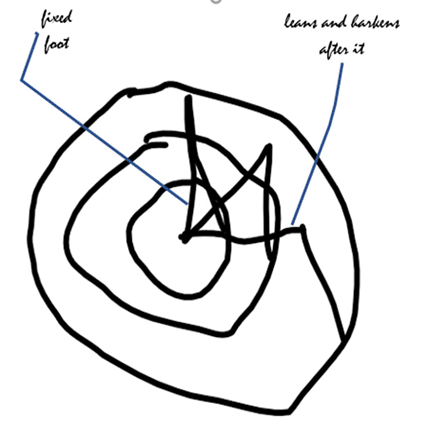
I see you draw as well as I do. Circles and straight lines are killers. Not to mention perspective.
In other poetic hands, this may have been over-wrought. But Donne uses just the right words to make it work. “fixed foot,” “leans,” “erect,” are all onomatopoetic. And who wouldn’t be touched by this sentiment? What a wonderful way to express the two=one-ness of love. Not that he was away that often. They had twelve children.
“Ouch!”
Well, they followed the Bible’s bidding.
On very much the other hand, the Metaphysical Poet’s penchant for wit could lead to some quirky poetry. Another side of Donne is seen in “The Flea.” We’ll use the text’s normalized version.
Mark but this flea, and mark in this,
How little that which thou deny’st me is;
It sucked me first, and now sucks thee,
And in this flea, our two bloods mingled be;
Thou knowest that this cannot be said
A sin, nor shame, nor loss of maidenhead.
Yet this enjoys before it woo,
And pampered, swells with one blood made of two,
And this, alas, is more than we would do.
Oh stay, three lives in one flea spare,
Where we almost, yea, more than married are.
This flea is you and I, and this
Our marriage bed, and marriage temple is;
Though parents grudge, and you, we are met
And cloistered in these living walls of jet.
Though use make you apt to kill me,
Let not to that self murder added be,
And sacrilege, three sins in killing three.
Cruel and sudden, hast thou since
Purpled thy nail in blood of innocence?
Wherein could this flea guilty be
Except in that drop which it sucked from thee?
Yet thou triumph’st, and sayest that thou
Find’st not thyself, nor me, the weaker now.
‘Tis true, then learn how false fears be;
Just so much honor, when thou yieldst to me,
Will waste, as this flea’s death took life from thee.
Anyone?
“Now that’s an extended metaphor.”
Yes, this poem is almost as famous as “Valediction” due to its ribald humor.
“What’s ribbled?”
ribald
“Racy, vulgar?”
Right.
What’s the humor?
“Well, he’s trying to seduce his girlfriend by telling her that the flea that just bit them both has both their bloods, so they are joined already, why not make it in bed. Talk about giving someone a line.”
“I think the funniest part is that the girl smashes the flea, in other words, smashes his hopes. You go, girl.”
“But he has the last word, saying, well, see, even though we both joined in the flea, it’s dead but we are fine. So if you give in to me, we’ll join but come away from it just fine.”
And what’s the ribaldry?
“’sucked and sucks’.”
“’two bloods mingled be.’”
“’loss of maidenhead’.”
“’swells with blood.’ Glad my Mom’s not here.”
“Um, ‘that drop that it sucked from thee.’”
To those, I would add “purpled in blood of innocence.” I am also glad your Mom’s not here. And the general–nope, can’t use the word I was thinking–movement of the poem from anxious to urgent to climactic speaks for itself. The humor is also heightened by Donne’s/the speaker’s use of religious imagery throughout the poem: three lives in one—a reference to the Holy Trinity–marriage temple, cloistered, sacrilege, purpled.
“Why ‘purpled’?”
Purple dye was very expensive and was reserved in large part for religious robes; also for royalty.
You may have sensed the age difference in Donne when he wrote these poems: “Valediction” is obviously the work of a mature married man; Donne wrote “The Flea” when he was in college. It’s also historically interesting to note that the flea image isn’t something that Donne just thought up. It was a common image at the time. Apparently it started when some men observed a flea on a woman’s breast, and they thought this very amusing, so they wrote about it. It caught on in the patriarchal atmosphere of the times, and many poems and songs were written about it. It would be great to see a female counterpart to The Flea, but the major female authors were predominantly novel authors–great ones, of course, such as Mary Shelley, the Brontes, Austen, Eliot–of the 19th century, until Emily Dickinson, who remains one of the giants of American poetry. (Though, if interested, you might want to read the poetry of Anne Bradstreet, a 17th century American poet.)
- layetie=laity=secular people ↩︎
- trepidation=movement ↩︎
- sublunary=Beneath the moon, i.e. earth ↩︎
- not in a direct way ↩︎
***
Subscribing only means that you will receive a notice when I publish a new post.
***
(Note: You can view most poems on the website, Poetry Foundation.)
(Note: My Poetry Recordings Playlist: At the very bottom of the post Is a recording. To view my entire playlist of poetry recordings, hover over “1/18” in the upper right corner, then click on ‘My Poetry Recordings Playlist:´and make selection.)
***
Scroll down for comments. **Remember that comments are public. Enter your Comment below.**
Leave a Reply