Ozymandias
I met a traveller from an antique land,
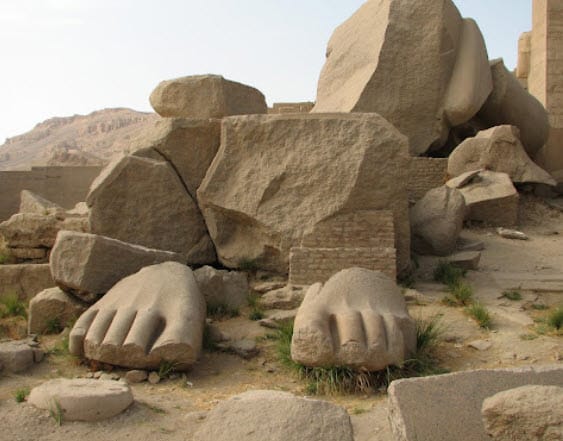
Who said—“Two vast and trunkless legs of stone
Stand in the desert. . . . Near them, on the sand,
Half sunk a shattered visage lies, whose frown,
And wrinkled lip, and sneer of cold command,
Tell that its sculptor well those passions read
Which yet survive, stamped on these lifeless things,
The hand that mocked them, and the heart that fed;
And on the pedestal, these words appear:
My name is Ozymandias, King of Kings;
Look on my Works, ye Mighty, and despair!”
Nothing beside remains. Round the decay
Of that colossal Wreck, boundless and bare
The lone and level sands stretch far away.
The poem is a variation of a Petrarchan Sonnet, divided into an octet (8 lines) and a sestet (6 lines), with an irregular rhyme scheme. The octet sets the scene, and the sestet provides the sentiment.
The octet begins with the narrator introducing us to the speaker, a “sight-seer” (traveller) in an ancient location (in the desert), who vividly describes a broken statue he comes across. He is impressed (vast) by the size of the legs, the only part of the statue that remains standing, personifying them as if human (stand). With the word, “trunkless,” though, Shelley introduces a negative note. The only other part of the statue that is visible is the head, though Shelley uses synecdoche in referring to just the face (visage). The negative connotation already introduced is intensified (half sunk, shattered, frown, sneer, cold command, lifeless) with the sculptor skillfully conveying the subject’s arrogance (mocked, heart that fed). The frequent use of commas fragmenting the lines adds to the general sense of decay.
The sestet ironically provides the traveller’s impressions of what he is viewing, the surviving legs and head, fragments of a statue that was originally designed as a testimony to the power of the subject, a ruler. The metaphorically personified pedestal, as the absolute ruler (King of Kings), “speaks” in an apostrophe to other rulers (ye Mighty), asserting his power over everyone. He is Ozymandias, a king of kings, but what he asserts is undermined by the consciousness that we are listening to a wreck. Other rulers are supposed to be so in awe of Ozymandias’ power to commission such a monumental self-testimony, that they despair by comparison. But Shelley’s brilliance here is in the irony of those words. For what the rulers (and the observers) actually see is a testimony to time’s fleeting nature (decay), which reminds them and us of our insignificance in terms of history, leading to despair. Then three immensely powerful words, “Nothing beside remains,” which could mean that only decayed fragments have survived, or that in history’s timeline, decay is inevitable, leaving nothing but a fragmented testimony to our transience. The statue is now a broken Wreck, but the limitless, barren, monotonous sands survive, inevitably. A depressing, despairing thought. (Not intentionally meant, the words of a nineteenth century poet, however, have survived.)
***
Subscribing only means that you will receive a notice when I publish a new post.
***
(Note: You can view most poems on the website, Poetry Foundation.)
(Note: My Poetry Recordings Playlist: At the very bottom of the post Is a recording. To view my entire playlist of poetry recordings, hover over “1/18” in the upper right corner, then click on ‘My Poetry Recordings Playlist:´and make selection.)
***
Scroll down for comments. **Remember that comments are public. Enter your Comment below.**
Leave a Reply