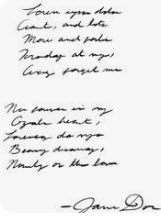
In Poetry Explained. Clearly! 2-How to Easily Recognize Meter and Scansion. we scanned the first four lines of a Dickinson poem and saw they are iambic trimeter, iambic trimeter, iambic tetrameter, and iambic trimeter. If we look at the scansion of the entire poem, we see that every four lines scan this way. Now the same rhyme-scheme–abcb–also pertains to every four lines. We refer to divisions within poems as stanzas; they are like the paragraphs of prose.
A poet may choose to organize her lines into these groups, or stanzas. In the Dickinson example, the first group of lines–identified by the meter and rhyme scheme (there often is a blank line between stanzas)–represent a stanza, called a quatrain, because it has four lines, quattor being the Latin word for “four,” as in quadrilateral, a four-sided figure (“d” and “t” are often interchanged from one language to another).
So:
couplet = 2 lines
tercet/triplet = 3 lines
quatrain = 4 lines
quintet/cinquain = 5 lines
sestet/sestain = 6 lines
septet = 7 lines
octave/octet = 8 lines
We will use the first term indicated for each type of stanza.
Two of the most famous uses of stanza form are the Italian, or Petrarchan Sonnet, and the English, or Shakespearean Sonnet. A sonnet is a 14-line poem which usually expresses a single thought or feeling on the part of the poet. The Italian Sonnet is organized into an octave ( 8 lines) and a sestet (6 lines); the English Sonnet employs three quatrains (4 lines) and a couplet (2 lines). The Italian Sonnet rhyme-scheme is abbaabba cdecde, though the sestet varies considerably. The English Sonnet rhyme-scheme is abab cdcd efef gg. Both are typically in iambic pentameter.
In case all of these terms together are a bit overwhelming, let’s review:
- octave is a stanza of 8 lines
- sestet is a stanza of 6 lines
- quatrain is a stanza of 4 lines
- couplet is a stanza of 2 lines.
- iambic pentameter is a line composed of 5 poetic feet, each foot being an iamb, which consists of an unstressed syllable followed by a stressed syllable.
Okay, so two examples to make these explanations clearer:
The first is an Italian Sonnet, written in English by Emma Lazarus; you are probably very familiar with parts of it.
The New Colossus
Not like the brazen giant of Greek fame, (a)
With conquering limbs astride from land to land; (b)
Here at our sea-washed, sunset gates shall stand (b)
A mighty woman with a torch, whose flame (a)
Is the imprisoned lightning, and her name (a)
Mother of Exiles. From her beacon-hand (b)
Glows world-wide welcome; her mild eyes command (b)
The air-bridged harbor that twin cities frame. (a)
Keep, ancient lands, your storied pomp!’ cries she (c)
With silent lips. ‘Give me your tired, your poor, (d)
Your huddled masses yearning to breathe free, (c)
The wretched refuse of your teeming shore. (d)
Send these, the homeless, tempest-tost to me, (c)
I lift my lamp beside the golden door!’ (d)
The second sonnet is an English Sonnet, by, of course, Shakespeare:
Sonnet LXXI
No longer mourn for me when I am dead (a)
Then you shall hear the surly sullen bell (b)
Give warning to the world that I am fled (a)
From this vile world, with vilest worms to dwell: (b)
Nay, if you read this line, remember not (c)
The hand that writ it; for I love you so (d)
That I in your sweet thoughts would be forgot (c)
If thinking on me then should make you woe. (d)
O, if, I say, you look upon this verse (e)
When I perhaps compounded am with clay, (f)
Do not so much as my poor name rehearse. (e)
But let your love even with my life decay, (f)
Lest the wise world should look into your moan (g)
And mock you with me after I am gone. (g)